Skip to content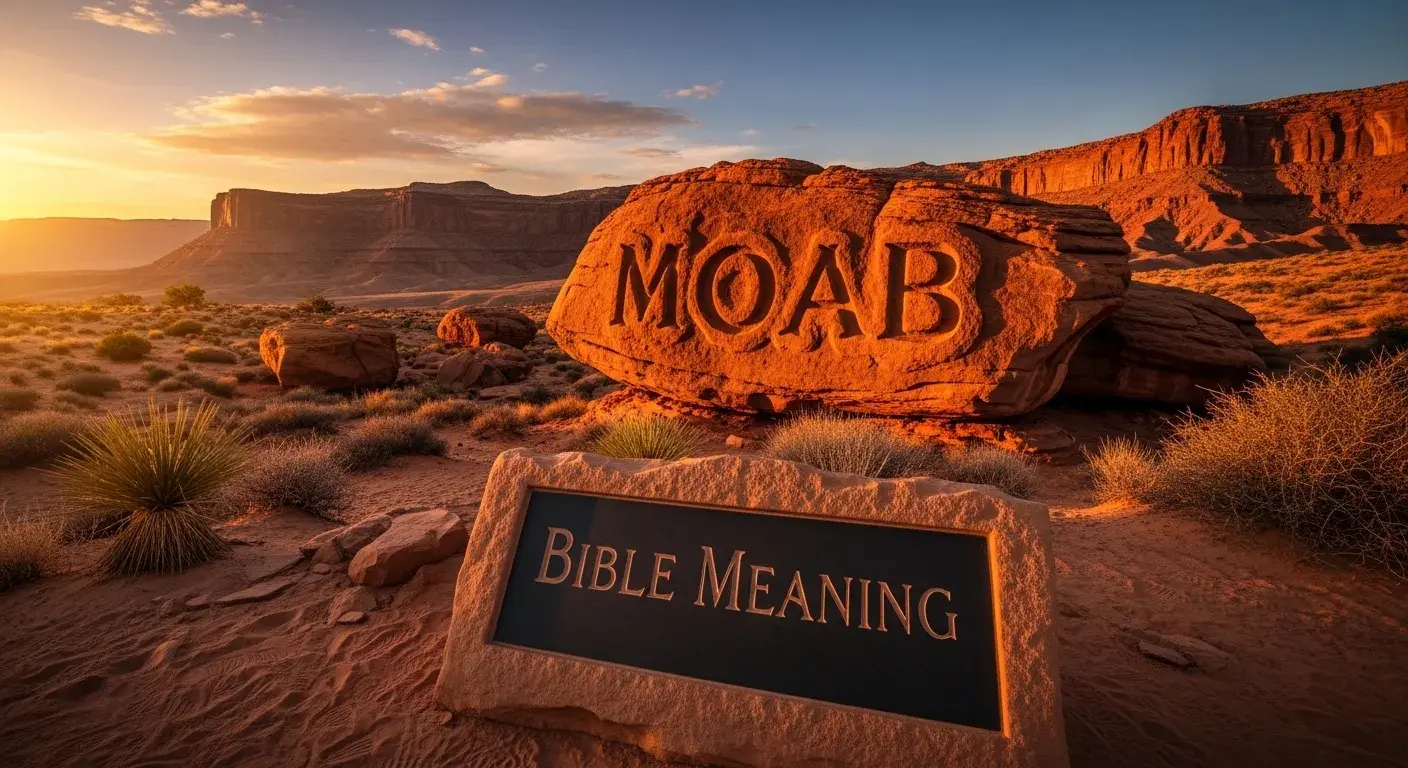
Have you ever come across the word Moab while reading the Bible or in a dream, and paused for a moment? It may have felt strange or even a little confusing. Maybe you wondered, “Why did this word stand out to me?”
Picture this: you are reading quietly, and suddenly the name Moab appears again and again. It feels important, like it carries a hidden message.
Or maybe you saw it in a dream, and it left you with a deep feeling you can’t explain.
In the Bible, names and places often hold deep spiritual meaning. They are not just history they can be part of a divine message for your life today.
So, what does Moab really mean in the Bible? Is it a warning, a lesson, or a sign of hope? Let’s explore the Moab Bible meaning together and discover what God may be showing you.
Moab Bible
In the Bible, Moab refers both to a people and to the land where they lived. Moab was located east of the Dead Sea, near the territory of ancient Israel.
The Moabites were descendants of Moab, the son of Lot. Genesis 19:30–38 explains that Lot’s older daughter had a son named Moab, who became the ancestor of the Moabites.
The relationship between Israel and Moab was complicated. The Israelites were related to the Moabites through Lot, but the two nations often had conflict.
During Israel’s journey to the Promised Land, Moab’s king, Balak, feared the Israelites and asked Balaam to curse them, but God did not allow Balaam to curse Israel (Numbers 22–24).
The Bible also shows that Moab was not always an enemy of Israel. Ruth, one of the most important women in Scripture, was a Moabite woman who married Boaz and became part of the family line of King David (Ruth 1:4; 4:13–17). This makes Moab an important part of biblical history.
Moab in the Bible
Moab in the Bible is connected with several major biblical events:
- Moab came from Lot’s family : Moab was the son of Lot (Genesis 19:37).
- The Moabites lived east of the Dead Sea : Their territory bordered Israel’s eastern side.
- Balak opposed Israel : The king of Moab hired Balaam to curse Israel (Numbers 22:1–6).
- Balaam blessed Israel instead : God prevented Balaam from pronouncing the desired curse (Numbers 23–24).
- Israel later fought Moab : Moab appears in several conflicts with Israel throughout the Old Testament.
- Ruth was a Moabite : Ruth left Moab, followed Naomi, and became the wife of Boaz (Ruth 1:16–17; 4:13).
- Ruth became an ancestor of David : Her son Obed became the father of Jesse, David’s father (Ruth 4:17).
- Moab was judged by God : Prophets such as Isaiah, Jeremiah, and Ezekiel announced judgment against Moab because of its pride and opposition to God’s people (Isaiah 15–16; Jeremiah 48; Ezekiel 25:8–11).
Definition of moab in the bible
Moab was an ancient nation located east of the Dead Sea. The Bible traces the origin of the Moabites to Moab, the son of Lot, who was born through an incestuous relationship between Lot and his older daughter after the destruction of Sodom and Gomorrah (Genesis 19:30–38).
The name and history of Moab are closely connected with Lot’s family and Israel’s later relationship with the Moabites. Although Moab was related to Israel through Lot, the two peoples often had a difficult relationship.
Key biblical points:
- Moab descended from Lot.
- Moab was located east of the Dead Sea.
- The Moabites were related to the Israelites through Abraham’s nephew Lot.
- Moab sometimes opposed Israel.
- God judged Moab for pride and other sins.
Bible verse:
“And the elder bore a son, and called his name Moab: he is the father of the Moabites unto this day.”
: Genesis 19:37 (KJV)
Moab in the bible meaning
The moab in the bible meaning is connected to the ancient nation of Moab, a people group who lived east of the Dead Sea. Moab came from Moab, the son of Lot, through an incestuous relationship between Lot and his older daughter after the destruction of Sodom and Gomorrah. His descendants became known as the Moabites.
The Bible first introduces Moab in Genesis 19:30–38. The name is often understood in connection with the Hebrew expression “from father” (mē’āb), although the exact etymology is debated.
Moab later became an important nation in the biblical story. The Moabites were related to Israel through Lot, but their relationship with Israel was often marked by conflict, opposition, and idolatry.
“And the firstborn bare a son, and called his name Moab: the same is the father of the Moabites unto this day.”
: Genesis 19:37 (KJV)
What does Moab represent in the Bible?
Moab can represent several important biblical themes:
- Human weakness and broken family history : Moab’s origin came through a sinful situation involving Lot and his daughter.
- A neighboring nation of Israel : Moab occupied territory east of the Dead Sea.
- Conflict with God’s people : Moab sometimes opposed Israel.
- Pride and judgment : Several prophets spoke against Moab because of its pride and hostility.
- God’s sovereignty : Despite Moab’s troubled history, God still worked through individual Moabites, most notably Ruth.
One important point is that Moab should not simply be treated as a symbol of evil in every biblical passage. The story of Ruth shows that a Moabite woman could become a faithful follower of Israel’s God and an ancestor of King David.
Biblical meaning of moab
The biblical meaning of moab involves both the historical identity of Moab and the spiritual lessons connected with the nation throughout Scripture.
Moab was descended from Lot and became a nation neighboring Israel. When Israel traveled toward the Promised Land, God instructed Israel not to seize the territory of Moab because He had given that land to the descendants of Lot.
“Distress not the Moabites, neither contend with them in battle: for I will not give thee of the land of the children of Ammon any possession; because I have given it unto the children of Lot for a possession.”
: Deuteronomy 2:19 (KJV)
This passage is important because it shows that the Bible presents Moab as a real nation under God’s sovereign rule.
Moab and Israel
The relationship between Moab and Israel was complicated. At times, Moab fought against Israel or attempted to bring trouble upon God’s people. Numbers 22–24 records the famous account of Balak, king of Moab, who hired Balaam to curse Israel. God, however, prevented the intended curse and turned it into blessing.
Later, the Moabites influenced Israel toward idolatry.
“And Israel joined himself unto Baalpeor: and the anger of the LORD was kindled against Israel.”
: Numbers 25:3 (KJV)
The Bible therefore uses Moab’s history to teach lessons about temptation, compromise, pride, judgment, and God’s protection.
Moab also has a beautiful side
The story of Ruth provides an important balance. Ruth was a Moabite woman who married Boaz and became part of the family line leading to David.
“And Boaz begat Obed, and Obed begat Jesse, and Jesse begat David.”
: Ruth 4:21–22 (KJV)
Ruth’s story demonstrates that biblical identity is not simply about someone’s national background. Her loyalty and faith became a beautiful part of God’s redemptive plan.
Moab hebrew meaning
The moab hebrew meaning comes from the Hebrew name מוֹאָב (Mo’av). The name is commonly connected with the Hebrew words מֵאָב (me’av), understood as “from the father” or “from a father.”
Genesis connects the name directly with the birth of Lot’s son:
“And the firstborn bare a son, and called his name Moab: the same is the father of the Moabites unto this day.”
: Genesis 19:37 (KJV)
The Hebrew etymology is not completely certain, so it is best to say that “from the father” is the traditional or commonly proposed meaning, rather than claiming that the meaning is absolutely settled.
Moab in Hebrew and its biblical context
The Hebrew name is important because Moab was not merely a personal name. It became the name of an entire people and their territory.
The Bible frequently refers to:
- Moab : the nation or territory.
- Moabites : the people descended from Moab.
- King of Moab : the ruler of the nation.
- Land of Moab : the territory east of the Dead Sea.
Moab’s location and history made it an important neighbor of ancient Israel.
Moabe meaning
The moabe meaning generally refers to Moab, the biblical name associated with the son of Lot and the nation descended from him. “Moabe” is also used in some languages as a form of the biblical name Moab.
In the Bible, Moab is associated with the descendants of Lot:
“And the younger, she also bare a son, and called his name Benammi: the same is the father of the children of Ammon unto this day.”
: Genesis 19:38 (KJV)
The previous verse identifies Moab as the son of Lot’s older daughter and the father of the Moabites.
The spiritual lesson of Moab
Moab’s story contains both warning and hope.
As a warning, the Bible describes Moab’s pride and rebellion. The prophets repeatedly announced judgment against Moab. For example:
“We have heard of the pride of Moab; he is very proud.”
: Isaiah 16:6 (KJV)
As a message of hope, Ruth shows that a person from Moab could become part of God’s covenant story through faith and loyalty. Ruth ultimately became the great-grandmother of David.
This makes Moab a fascinating biblical subject: its history begins in a deeply broken situation, continues through conflict and judgment, yet ultimately includes a woman whose faith becomes part of the lineage of David and, according to the New Testament genealogy, Jesus Christ (Matthew 1:5–16).
Key biblical lessons from Moab
- God remains sovereign over nations.
- Sin can create painful consequences across generations.
- Pride can lead to judgment (Isaiah 16:6–7; Jeremiah 48:29–30).
- God can bring redemption from unexpected places.
- Faith and loyalty matter more than ethnic background, as demonstrated by Ruth.
- God’s plan can include people from outside Israel, as Ruth’s place in David’s genealogy demonstrates.
Define moab in the bible
To define Moab in the Bible, it is best understood as both a historical nation and a biblical symbol connected with pride, opposition, judgment, and God’s sovereignty.
Moab was a real nation with its own land, kings, and people. The Moabites appear throughout the Old Testament. Their relationship with Israel was not always hostile, but several important conflicts occurred between them.
One famous example is Balak, king of Moab, who hired Balaam to curse Israel. God, however, prevented the intended curse from succeeding (Numbers 22–24).
Moab therefore has several dimensions in Scripture:
- Historical: An ancient nation descended from Lot.
- Geographical: A territory east of the Dead Sea.
- Political: A neighboring kingdom that sometimes fought Israel.
- Spiritual: A nation repeatedly confronted by God’s judgment because of pride and rebellion.
מה 의미? /
The name Moab is connected in the Bible with the descendants of Lot, Abraham’s nephew. After the destruction of Sodom and Gomorrah, Lot’s older daughter had a son through her father and named him Moab. The Bible then identifies Moab as the ancestor of the Moabites.
Genesis 19:37 says:
“The firstborn bore a son and named him Moab; he is the father of the Moabites of today.”
The meaning is commonly understood as “from the father” or “from a father.” The name is therefore closely connected to the unusual circumstances surrounding Moab’s birth.
The Bible later presents Moab as both a neighboring nation of Israel and, at different times, an enemy of Israel. However, the story of Moab is not only negative. Ruth, a Moabite woman, became part of Israel and entered the family line of King David and ultimately Jesus Christ (Ruth 4:13–17; Matthew 1:5).
Key biblical facts about Moab
- Moab was the son of Lot (Genesis 19:37).
- The Moabites descended from Moab.
- Moab occupied territory east of the Dead Sea.
- Israel had complicated relationships with Moab.
- Ruth was a Moabite who faithfully followed Naomi and the God of Israel (Ruth 1:16–17).
- Ruth became the great-grandmother of David (Ruth 4:17).
- Moab’s story shows that God can bring redemption and blessing from unexpected places.
Significado de moab en la biblia
In the Bible, Moab refers both to a person and to the nation descended from him. Moab was the son of Lot and the ancestor of the Moabites. His birth is described in Genesis 19:30–38.
Genesis 19:37 states:
“She bore a son and named him Moab; he is the father of the Moabites to this day.”
The biblical meaning commonly associated with the name Moab is “from the father.” This meaning relates to the circumstances of his birth described in Genesis.
Moab later became a nation located east of the Dead Sea. The Moabites sometimes opposed Israel, and the Bible records several conflicts between the two peoples.
For example, King Balak of Moab hired Balaam to curse Israel, but God did not allow the intended curse to succeed (Numbers 22–24).
Yet Moab’s biblical story also contains a beautiful example of faith through Ruth. Although Ruth was a Moabite, she chose to remain with Naomi and declared her commitment to Naomi’s people and God:
“Your people shall be my people, and your God my God.” : Ruth 1:16
This makes Moab an important biblical example of how a person’s background does not prevent God from working through faithful obedience.
What Moab represents in the biblical story
- A nation descended from Lot.
- A neighboring nation of Israel.
- At times, opposition and hostility toward Israel.
- A place associated with spiritual temptation in Israel’s history (Numbers 25:1–3).
- Yet also the homeland of Ruth, a woman remembered for loyalty and faith.
Significado de moab en la biblia
The significado de Moab en la Biblia is closely tied to its origin in the family of Lot. Moab was born after Lot’s older daughter became pregnant by her father, and she named her son Moab.
Genesis 19:37 gives the origin of the name and identifies Moab as the ancestor of the Moabites.
The Moabites later became a distinct people living east of Israel. Their history with Israel was mixed. At times they were hostile, but the Bible also records peaceful or positive connections.
One of the most important examples is Ruth. She was a Moabite woman who married Boaz and became part of the ancestry of David.
Ruth 4:17 says:
“A son has been born to Naomi.”
And they named him Obed. He was the father of Jesse, the father of David.
Therefore, when studying Moab according to the Bible, it is important not to reduce the word to a single negative idea. Moab had a troubled beginning and often opposed Israel, but God still included a Moabite woman, Ruth, in the lineage leading to David and Jesus.
Important lesson
The story of Moab teaches that heritage does not have to determine a person’s relationship with God. Ruth came from Moab, but through faith and loyalty she became an important part of biblical redemption history.
Que signifie moab dans la bible
In the Bible, Moab is the name of Lot’s son and the nation descended from him. The name is commonly understood as “from the father,” based on the account of Moab’s birth in Genesis 19.
Genesis 19:37 connects the name directly with the origin of the Moabite people:
“She bore a son and named him Moab; he is the father of the Moabites.”
Moab was located east of the Dead Sea. The Moabites became neighbors of Israel and had a complicated relationship with God’s people.
One major conflict appears in Numbers 22–24, when Balak, king of Moab, attempted to have Balaam curse Israel. Instead, God caused blessings to be spoken over Israel.
Moab also became associated with Israel’s temptation toward idolatry at Baal-peor (Numbers 25:1–3).
However, the Bible gives another side of the story through Ruth. Ruth was a Moabite, yet she became a faithful follower of the God of Israel and eventually became part of David’s family line.
This gives Moab a powerful biblical contrast:
- Moab could represent opposition to God’s people.
- Moab was associated with idolatrous temptation in some biblical events.
- But a Moabite woman, Ruth, demonstrated remarkable faith.
- Ruth became part of the ancestry of King David (Ruth 4:17).
- Matthew includes Ruth in the genealogy of Jesus (Matthew 1:5).
So, biblically, Moab has a complicated history rather than one simple spiritual meaning.
Moab meaning bible
The Moab meaning in the Bible is generally connected with “from the father.” Moab was the son of Lot, and Genesis 19:37 identifies him as the ancestor of the Moabites.
The Moabites became a nation living east of the Dead Sea. They appear throughout the Old Testament in stories involving Israel.
Moab in the Bible
1. Moab was descended from Lot
“He is the father of the Moabites of today.” : Genesis 19:37
2. Moab became a nation
The descendants of Moab became the Moabites, who occupied territory east of the Dead Sea.
3. Moab sometimes opposed Israel
King Balak of Moab attempted to use Balaam against Israel (Numbers 22:4–7). God, however, turned the intended curse into blessing (Numbers 23–24).
4. Moab was connected with temptation
Numbers 25 records Israel’s involvement with the women of Moab and the worship of Baal of Peor, leading Israel into serious sin.
5. Ruth was a Moabite
This is one of the most important positive connections. Ruth left her homeland and followed Naomi and the God of Israel:
“Your God my God.” : Ruth 1:16
6. Ruth entered David’s family line
Ruth married Boaz, and their son Obed became the father of Jesse, the father of David (Ruth 4:13–17).
The deeper biblical lesson of Moab
Moab’s story shows that God’s purposes are bigger than human background or nationality. Although the Moabite nation had a difficult relationship with Israel, Ruth’s faith placed her within the family line of David and, according to Matthew 1:5, the genealogy of Jesus Christ.
What does the word moab mean
The word Moab is commonly understood in biblical studies as meaning “from the father” or “from a father.” The Bible itself connects the name to the birth story of Moab.
Genesis 19:37 says:
“The firstborn bore a son and named him Moab; he is the father of the Moabites.”
Moab was the son of Lot and the ancestor of the Moabites. The name therefore became associated with both the individual and the nation that descended from him.
Who was Moab?
- Father: Lot
- Mother: Lot’s older daughter
- Descendants: The Moabites
- Location: East of the Dead Sea
- Important biblical figure from Moab: Ruth
- Major biblical passages: Genesis 19; Numbers 22–25; Ruth; 2 Kings 3; Jeremiah 48
The story becomes especially interesting because Ruth was a Moabite. Although Moab often appears in the Old Testament in opposition to Israel, Ruth demonstrates that God can work through someone from a background that might seem spiritually unlikely.
Her declaration to Naomi is one of the Bible’s strongest statements of loyalty:
“Where you go I will go… your people shall be my people, and your God my God.” :Ruth 1:16
Signification de moab dans la bible
The signification de Moab dans la Bible is connected first with the biblical origin of the name and then with the history of the Moabite people.
Moab was born to Lot’s older daughter after the destruction of Sodom and Gomorrah. His mother gave him the name Moab, and Genesis identifies him as the father of the Moabites (Genesis 19:37).
The Moabites later became a neighboring nation of Israel. Their relationship with Israel included conflict, political opposition, and spiritual temptation. Numbers 22–24 describes how Balak, king of Moab, sought to have Balaam curse Israel, but God prevented the curse.
Yet the Bible also presents Ruth the Moabite as a striking example of faith.
Ruth chose Naomi and committed herself to Naomi’s God:
“Your God my God.” : Ruth 1:16
She eventually married Boaz, and their descendants included King David (Ruth 4:17). Matthew 1:5 also places Ruth in the genealogy of Jesus.
Arti moab dalam alkitab
The Indonesian phrase “arti moab dalam alkitab” means “the meaning of Moab in the Bible.”
Biblically, Moab refers first to the nation descended from Lot’s son Moab. However, when people ask about the spiritual meaning of Moab, they are often interested in what Moab represents in biblical teaching.
The Bible particularly associates Moab with pride, hostility toward God’s people, false spiritual influence, and eventual judgment. At the same time, the story of Ruth, a Moabite woman who became part of Israel and entered the family line of King David, shows that God’s grace can reach people from outside Israel.
Important lesson: Moab’s story should not be reduced to something entirely negative. Ruth demonstrates that an individual can turn toward the God of Israel even when coming from a nation with a complicated history.
Moab meaning in the bible
The biblical meaning of Moab begins with its identity as a nation descended from Lot. Scripture says that Moab was the father of the Moabites (Genesis 19:37).
Throughout the Old Testament, Moab appears in different situations. Sometimes Moab was an enemy of Israel, while at other times there were peaceful interactions. Ruth, one of the most important women in the Bible, was a Moabite.
Ruth’s story gives Moab a surprising place in biblical history. She left her homeland, followed Naomi, and declared her commitment to Naomi’s God.
“Thy people shall be my people, and thy God my God.”
: Ruth 1:16 (KJV)
So, Moab in the Bible can teach two contrasting lessons:
- Pride and rebellion can lead to judgment.
- Faith and loyalty can lead to blessing and restoration.
What is the meaning of moab in the bible
The meaning of Moab in the Bible is connected to both ancestry and spiritual history.
Moab was the name given to Lot’s son and later became the name of the nation descended from him. The Moabites lived near Israel but frequently had tense relationships with God’s people.
One important theme associated with Moab is pride. The prophet Isaiah describes Moab’s pride and arrogance.
“We have heard of the pride of Moab; he is very proud…”
: Isaiah 16:6 (KJV)
However, Moab’s biblical story also includes Ruth. This reminds readers that biblical nationality does not automatically determine an individual’s relationship with God.
Moab meaning in bible
Moab meaning in the Bible can be understood through its history, ancestry, and relationship with Israel.
Moab was descended from Lot, Abraham’s nephew. The Moabites became a distinct people living east of the Dead Sea.
The Bible records several important events involving Moab:
- Balak attempted to have Balaam curse Israel.
- Moab became involved in conflicts with Israel.
- Moabite women influenced Israel into idolatry at Peor (Numbers 25).
- Ruth, a Moabite woman, became an ancestor of David.
- The prophets later announced judgment against Moab.
This makes Moab an interesting biblical example because its history contains both serious spiritual failure and an extraordinary example of faith through Ruth.
Meaning of moab in the bible
The meaning of Moab in the Bible is not limited to one spiritual definition. It is primarily the name of an ancient people and territory.
In Scripture, Moab is associated with:
- Lot’s descendants
- A neighboring nation of Israel
- Conflict and opposition
- Pride
- Idolatrous influence
- God’s judgment
- Ruth’s story of faith and redemption
The story of Ruth is especially important because Ruth was a Moabite who became part of the genealogy of Jesus Christ.
Matthew records:
“And Salmon begat Booz of Rachab; and Booz begat Obed of Ruth…”
: Matthew 1:5 (KJV)
Thus, Moab’s history ultimately points to an important biblical truth: God’s redemptive plan can include people whom others might consider outsiders.
Spirit of moab
The phrase “spirit of Moab” is not a specific biblical phrase describing a supernatural spirit. Scripture does not present a formal doctrine called the “spirit of Moab.”
However, some modern Christian teachings use the phrase symbolically to describe attitudes that appear in biblical accounts of Moab.
These may include:
- Pride and arrogance
- Opposition toward God’s people
- Dependence on worldly strength
- Idolatry
- Hostility toward God’s purposes
- Refusal to humble oneself before God
Isaiah specifically connects Moab with pride:
“The pride of Moab, and his haughtiness, and his pride, and his wrath…”
: Isaiah 16:6 (KJV)
It is important to distinguish what Scripture explicitly says from later spiritual interpretations. The Bible does not instruct Christians to identify every personal struggle as a literal “spirit of Moab.”
A safer biblical application is to recognize and reject the pride, rebellion, idolatry, and hostility toward God that Scripture associates with Moab’s history.
Moabites spiritual meaning
The spiritual meaning of the Moabites can be studied through the way their nation interacted with Israel and God.
The Moabites were descendants of Lot, but their history became complicated because of repeated conflicts and spiritual compromise.
One significant event occurred when Moabite women became involved with Israelite men at Peor. This led Israel into sexual immorality and idolatry.
Numbers 25:1–3 records that Israel joined themselves to Baal of Peor, and God’s anger was kindled against Israel.
This episode can teach Christians about:
- The danger of compromising one’s faith.
- The influence of ungodly practices.
- The seriousness of idolatry.
- The need to remain faithful to God.
- The consequences of spiritual compromise.
But Ruth provides another side of the story. She was a Moabite who chose the God of Israel.
Therefore, the spiritual lesson is not that every Moabite was evil. Ruth proves otherwise.
What does moab mean
The name Moab is traditionally connected with the account in Genesis 19, where Lot’s older daughter gave birth to a son and named him Moab.
Genesis explains:
“And called his name Moab: he is the father of the Moabites unto this day.”
: Genesis 19:37 (KJV)
The exact etymology of the name is discussed by biblical scholars, but the biblical narrative itself connects the name directly with Lot’s son and the Moabite nation.
So, in the Bible, Moab primarily identifies a person, a people, and a territory.
Moab in the bible
Moab appears in many important biblical passages. The Moabites lived east of the Dead Sea and interacted with Israel throughout Old Testament history.
One of the best-known accounts is the story of Balak and Balaam.
Balak, king of Moab, feared Israel and attempted to have Balaam curse them. Instead, God caused Balaam to pronounce blessings over Israel.
“How shall I curse, whom God hath not cursed?” : Numbers 23:8 (KJV)
Another major Moabite figure is Ruth.
Ruth was a Moabite woman who married Boaz and became the great-grandmother of David.
Moab therefore appears in Scripture in contexts involving:
- Family ancestry
- National conflict
- Spiritual temptation
- Prophecy
- God’s judgment
- Redemption through Ruth
Moab biblical meaning
The biblical meaning of Moab becomes clearer when its major stories are considered together.
Moab represents a real nation with a complicated relationship with Israel. Its history demonstrates the consequences of pride and rebellion, but Ruth demonstrates God’s ability to bring redemption from unexpected places.
The prophets repeatedly spoke against Moab because of its pride and other offenses.
Jeremiah says:
“We have heard the pride of Moab…”
: Jeremiah 48:29 (KJV)
The biblical message is therefore not simply “Moab is evil.” Instead, Moab’s history gives several lessons:
- Pride can bring a person or nation down.
- Opposition to God’s purposes has consequences.
- Spiritual compromise can lead people away from God.
- God’s judgment is real.
- God’s grace can transform outsiders into faithful servants.
- Ruth demonstrates that faithfulness matters more than nationality.
What does moab represent in the bible
Moab can represent several themes when its biblical history is used for spiritual reflection.
1. Pride
Moab is repeatedly criticized for pride and arrogance.
2. Opposition
Moab sometimes stood against Israel and God’s purposes.
3. Spiritual compromise
The events surrounding Baal of Peor show the danger of idolatry and compromise.
4. Judgment
The prophets announced God’s judgment against Moab because of its sins.
5. Unexpected redemption
Ruth provides a powerful contrast. Although she was a Moabite, she became a faithful follower of Israel’s God and entered the family line of David and Jesus.
Therefore, Moab can represent both a warning against pride and compromise and a reminder that God’s grace reaches beyond expected boundaries.
Moab meaning in hebrew
The Hebrew name for Moab is מוֹאָב (Mô’āḇ).
Genesis 19:37 gives the biblical origin story for the name. However, the exact linguistic meaning of “Moab” is debated. Some explanations connect it with Hebrew expressions related to “from father” or “of the father,” based on the narrative surrounding Lot’s daughter.
It is important not to claim that there is only one universally accepted Hebrew definition.
From the biblical text, what is clear is:
- Moab was the name of Lot’s son.
- Moab became the ancestor of the Moabites.
- The nation was called Moab.
- The Moabites occupied territory east of the Dead Sea.
The biblical narrative in Genesis 19 is therefore the strongest starting point for understanding the name.
What is the meaning of moab
The meaning of Moab can be understood on several levels.
Historically, Moab was an ancient nation descended from Lot.
Biblically, Moab appears as one of Israel’s neighboring nations.
Spiritually, its history provides warnings about pride, idolatry, compromise, and opposition to God.
Redemptively, Ruth shows that someone from Moab could become part of God’s unfolding plan.
Ruth’s words to Naomi are especially powerful:
“Thy people shall be my people, and thy God my God.”
: Ruth 1:16 (KJV)
This makes Moab’s story much more complex than simply being a symbol of evil. Scripture contains both judgment and grace within the broader story.
Moab spiritual meaning
The spiritual meaning of Moab can be applied carefully to Christian life.
Moab’s history can serve as a warning against allowing pride, worldly influence, idolatry, and spiritual compromise to control one’s decisions.
At the same time, Ruth shows that a person’s background does not have to determine their spiritual future.
Spiritual lessons from Moab include:
- Reject pride: Moab’s pride was repeatedly condemned.
- Avoid spiritual compromise: Israel’s experience at Peor shows its danger.
- Do not resist God’s purposes: Balak could not overturn God’s blessing.
- Choose faithfulness: Ruth made a deliberate commitment to God.
- Remember God’s grace: Ruth became part of David’s family line.
- Trust God’s sovereignty: Human opposition could not defeat God’s plan.
The strongest biblical application is therefore not to label people as “Moabites,” but to examine whether pride, compromise, or rebellion is present in one’s own life.
Que significa moab espiritualmente
The Spanish question “que significa moab espiritualmente” means “what does Moab mean spiritually?”
From a biblical perspective, Moab can symbolize pride, spiritual compromise, opposition to God’s people, and God’s judgment. These themes appear repeatedly in the Old Testament.
However, Ruth gives the story a beautiful contrast. She was a Moabite woman who chose faithfulness to Naomi and to the God of Israel.
This teaches an important spiritual principle:
A person’s past or background does not prevent God from working through a life surrendered to Him.
The story of Ruth ultimately leads into the genealogy of David and, according to Matthew, the genealogy of Jesus.
Moab in bible meaning
The meaning of Moab in the Bible is best understood by looking at the whole biblical story, rather than assigning one fixed symbolic meaning.
Moab began as the name of Lot’s son and became the name of an ancient nation. The Moabites had a complicated relationship with Israel. Their history includes conflict, idolatrous influence, pride, prophecy, and judgment.
Yet the Bible also gives us Ruth the Moabite, whose faith became part of Israel’s history and ultimately the genealogy of Christ.
In summary, Moab’s biblical meaning includes:
- Ancestry: Moab was descended from Lot.
- Nation: Moab became an ancient kingdom east of the Dead Sea.
- Conflict: Moab sometimes opposed Israel.
- Pride: Scripture repeatedly condemns Moab’s arrogance.
- Spiritual compromise: Moab was connected with Israel’s temptation toward idolatry.
- Judgment: God’s prophets announced judgment against Moab.
- Grace: Ruth shows that God can bring faithful people from unexpected backgrounds.
- Redemption: Ruth became part of the family line leading to David and Jesus.
The most balanced biblical conclusion is that Moab is both a historical nation and a source of spiritual lessons. Its negative history warns against pride, rebellion, idolatry, and compromise, while Ruth’s story reminds us of God’s mercy, faithfulness, and power to include outsiders in His redemptive plan.
Biblical Meaning of Moab
The name Moab comes from a nation that descended from Lot, the nephew of Abraham (Genesis 19:37). The Moabites lived east of the Dead Sea. But in the Bible, Moab is more than just a place it carries a spiritual meaning.
1. A Symbol of Separation from God
Moab often represents a life that is distant from God’s will. The Moabites worshiped false gods and did not follow the ways of the Lord.
In Numbers 25:1-2, the people of Israel were led into sin by Moab. This shows how Moab can symbolize temptation and spiritual distraction.
Spiritual Message:
Sometimes, Moab reflects moments when we drift away from God or feel spiritually weak.
2. A Place of Testing and Struggle
Moab is also linked to hard seasons. In the book of Ruth, Naomi went to Moab during a time of famine (Ruth 1:1). It was a place of survival, but also of loss.
Spiritual Meaning:
Moab can represent times in your life when you feel lost, tired, or uncertain.
But even in Moab, God was still working.
3. A Sign of Redemption and Grace
Here is the beautiful part Moab is not only about struggle. It is also about hope and transformation.
Ruth, a Moabite woman, chose to follow God. She said, “Your people will be my people and your God my God” (Ruth 1:16).
Because of her faith, she became part of the lineage of Jesus Christ.
Divine Message:
Even if you feel far from God, His grace can bring you back.
4. A Warning Against Pride
In Isaiah 16:6, Moab is described as proud and arrogant. This shows another side of its meaning.
Spiritual Lesson:
Moab can be a reminder to stay humble and trust God, not our own strength.
Spiritual meaning of moab in the bible
In the Bible, Moab is more than the name of an ancient nation. Moab represents a complicated relationship with God’s people. The Moabites came from Moab, the son of Lot, after Lot’s relationship with his older daughter following the destruction of Sodom and Gomorrah.
Genesis records that she named her son Moab and says, “He is the father of the Moabites unto this day” (Genesis 19:37, KJV).
Spiritually, Moab can remind readers of human weakness, family consequences, pride, temptation, opposition, and God’s ability to bring redemption from difficult circumstances.
Although Moab often opposed Israel, the Bible also shows that God did not treat every Moabite as personally condemned. Ruth, a Moabite woman, became part of Israel and an ancestor of King David.
Spiritual lessons associated with Moab
- Moab shows the consequences of sinful choices. Its origin was connected with Lot’s family tragedy after Sodom’s destruction (Genesis 19:30–38).
- Moab represents opposition to God’s people. The Moabite king Balak tried to have Balaam curse Israel (Numbers 22–24).
- Moab can symbolize pride. The prophets repeatedly criticized Moab for its arrogance (Isaiah 16:6; Jeremiah 48:29).
- Moab also demonstrates God’s mercy. Ruth was a Moabite, yet she became part of the family line leading to David (Ruth 1:16–17; 4:13–17).
- God can bring redemption from complicated backgrounds. Ruth’s story is a powerful example of someone from a nation associated with Israel’s enemies becoming an important person in biblical history.
One important point is that the Bible does not say that “Moab” universally means a particular demon, curse, or spiritual force.
Those interpretations are often found in modern spiritual discussions, but they should not be presented as direct biblical teaching.
What happened to moab in the bible
Moab had a long and troubled history with Israel. The Moabites lived east of the Dead Sea, in territory that is largely associated with modern-day Jordan. During Israel’s journey toward the Promised Land, Moab became concerned about the Israelites and its king, Balak, sought help from Balaam to curse them.
God prevented Balaam from cursing Israel and instead caused blessings to be spoken over them.
“How shall I curse, whom God hath not cursed?” : Numbers 23:8, KJV
Later, Moab’s relationship with Israel included both conflict and periods of submission. During the period of the Judges, Eglon king of Moab oppressed Israel for eighteen years until Ehud delivered Israel (Judges 3:12–30).
The prophets later announced judgment against Moab because of its pride, violence, and hostility.
Major events involving Moab
- Moab originated from Lot’s son Moab (Genesis 19:37).
- The Israelites encountered Moab during their journey toward Canaan (Numbers 22).
- King Balak attempted to have Balaam curse Israel (Numbers 22–24).
- Moab became involved in Israel’s history during the time of the Judges (Judges 3:12–30).
- Ruth, a Moabite woman, married Boaz and became part of David’s ancestry (Ruth 4:13–17).
- King David fought against Moab and subjected the Moabites (2 Samuel 8:2).
- The prophets announced judgment against Moab (Isaiah 15–16; Jeremiah 48; Ezekiel 25:8–11).
- Moab eventually disappeared as an independent biblical kingdom.
Jeremiah 48 gives one of the Bible’s most extensive descriptions of Moab’s downfall. Yet even in this judgment passage, there is a remarkable statement:
“Yet will I bring again the captivity of Moab in the latter days, saith the LORD.” : Jeremiah 48:47, KJV
This shows that biblical prophecy about Moab contains both judgment and a note of restoration.
Meaning of moab in hebrew
The Hebrew name for Moab is מוֹאָב (Mô’āḇ). The exact etymology is debated, but the biblical narrative connects the name with Lot’s son, born through Lot’s older daughter.
Genesis 19:37 says:
“And the firstborn bare a son, and called his name Moab: the same is the father of the Moabites unto this day.” : Genesis 19:37, KJV
The name is commonly explained as “from the father” or “from father,” although scholars discuss the precise linguistic origin.
Hebrew meaning of Moab
- Hebrew: מוֹאָב
- Transliteration: Mo’av / Mô’āḇ
- Commonly given meaning: “from the father”
- Biblical connection: Moab, son of Lot
- Associated people: The Moabites
- Location: East of the Dead Sea
It is best to distinguish between the traditional explanation of the name and interpretations that attempt to assign additional spiritual meanings to the Hebrew word. Scripture itself primarily uses Moab as the name of a person, nation, and territory.
Moab name meaning
The name Moab is traditionally understood as meaning “from the father.” In the Bible, Moab was the son of Lot’s older daughter and became the ancestor of the Moabite people.
The origin of Moab is described in Genesis 19:30–38. This story occurs after the destruction of Sodom and Gomorrah, when Lot and his daughters were living in a cave.
“And the firstborn bare a son, and called his name Moab.” : Genesis 19:37, KJV
The name therefore has a difficult beginning in the biblical story. However, the significance of Moab cannot be understood only through its origin. The later story of Ruth gives the name a much more hopeful biblical connection.
What does the name Moab represent?
- Historical identity: Moab became the ancestor of the Moabites.
- Geographical identity: Moab became the name of a territory east of the Dead Sea.
- Family connection: Moab was related to Israel through Lot.
- Spiritual lesson: A difficult beginning does not prevent God from working through an individual’s life.
- Redemptive connection: Ruth was a Moabite who became the great-grandmother of King David (Ruth 4:17).
Facts about moab in the bible
Moab appears throughout the Old Testament and plays several important roles in Israel’s history.
The Moabites were closely related to the Israelites because both nations traced their ancestry through Terah’s family: Abraham was Isaac’s father, while Lot was Abraham’s nephew and Moab’s father.
Important facts about Moab
- Moab was the son of Lot.
Genesis 19:37 identifies Moab as the son of Lot’s older daughter. - The Moabites were descendants of Moab.
They became a distinct nation east of the Dead Sea. - Moab was related to Israel.
Lot was Abraham’s nephew, making Moab part of Abraham’s extended family. - Israel passed near Moab during the Exodus.
The Israelites camped in the plains of Moab before entering Canaan (Numbers 22:1). - Balak was king of Moab.
He feared Israel and hired Balaam to curse them (Numbers 22:4–7). - God protected Israel from Balaam’s intended curse.
Balaam ultimately blessed Israel instead (Numbers 23–24). - Moab oppressed Israel during the Judges period.
Eglon, king of Moab, controlled Israel for eighteen years (Judges 3:12–14). - Ruth was a Moabite.
She married Boaz and became part of the ancestry of David (Ruth 4:13–17). - David fought against Moab.
Moab was defeated during David’s reign (2 Samuel 8:2). - Moab was repeatedly condemned by the prophets.
Isaiah, Jeremiah, Ezekiel, Amos, and Zephaniah all contain prophetic references to Moab. - Moab was known for pride.
Jeremiah describes Moab’s arrogance in strong language (Jeremiah 48:29).
One of the most important facts is that Moab’s story is not only a story of conflict. Ruth demonstrates that an individual Moabite could turn toward Israel’s God and become part of an extraordinary story of faith and redemption.
Moab meaning in greek
In the Greek Old Testament, known as the Septuagint, Moab is written as Μωάβ (Mōab). Greek does not give Moab a completely different biblical meaning. It primarily transliterates the Hebrew name.
So, when studying the Greek meaning of Moab, it is important not to invent a separate meaning that Scripture does not provide.
Moab in Hebrew and Greek
- Hebrew: מוֹאָב (Mo’ab)
- Greek: Μωάβ (Mōab)
- English: Moab
- Biblical identity: Son of Lot and ancestor of the Moabites
- Common traditional meaning: “from the father”
The Greek form appears in passages dealing with Moab’s history and territory. For example, the Greek Old Testament preserves the name in the accounts surrounding Israel’s journey and the prophecies against Moab.
Therefore, moab meaning in greek is best understood as the Greek form of the biblical proper name rather than as a completely different word with a separate spiritual definition.
Story of moab in the bible
The story of Moab begins with Lot, Abraham’s nephew. After Sodom and Gomorrah were destroyed, Lot and his daughters lived in a cave. Genesis 19 describes how Lot’s older daughter gave birth to a son and named him Moab.
“He is the father of the Moabites unto this day.” : Genesis 19:37, KJV
Generations later, the Moabites became a nation living east of the Dead Sea. Their story became closely connected with Israel.
When Israel approached Canaan, Balak king of Moab feared the Israelites. He sent messengers to Balaam, asking him to curse Israel. However, God would not allow Balaam to pronounce a curse on His people. Instead, Balaam blessed Israel.
The story then continues through the period of the Judges. Eglon, king of Moab, oppressed Israel until Ehud killed him and led Israel to victory (Judges 3:12–30).
But the most beautiful part of the Moab story is Ruth.
Ruth was a Moabite woman who married into an Israelite family. After becoming widowed, she chose to remain with her mother-in-law Naomi and expressed her commitment to Naomi and her God:
“Thy people shall be my people, and thy God my God.” : Ruth 1:16, KJV
Ruth eventually married Boaz. Their son Obed became the father of Jesse, and Jesse became the father of King David (Ruth 4:17).
The major spiritual lesson from Moab’s story
Moab’s story contains a striking contrast:
Moab began in a deeply troubled family situation, became associated with opposition to Israel, experienced God’s judgment, yet produced Ruth, a woman whose faith became part of the ancestry of David.
This teaches an important biblical principle: a person’s background does not have to determine the final direction of their life.
Moab in bible today
Biblical Moab does not exist today as an independent nation. The ancient territory of Moab was located east of the Dead Sea, primarily in what is now Jordan.
The ancient Moabite kingdom occupied territory around the eastern side of the Dead Sea. Important biblical locations associated with the region include the plains of Moab and Mount Nebo.
However, it would be incorrect to say that modern Jordanians are simply “the Moabites” described in the Bible. The ancient Moabite kingdom and people disappeared as a distinct political and ethnic entity over time.
What remains of Moab today?
- The geographical region associated with ancient Moab remains in modern Jordan.
- The Dead Sea continues to exist in the same general region.
- Archaeological discoveries provide evidence about ancient Moabite culture.
- The Mesha Stele is an important ancient inscription connected with the Moabite king Mesha.
- Biblical locations connected with Moab remain important for understanding Old Testament history.
- The Moabite kingdom itself is no longer an independent political state.
From a biblical perspective, the most important “legacy” of Moab may not be its political kingdom but Ruth’s story. A woman from Moab became part of the family line of David, showing how God’s purposes can reach beyond expected boundaries.
Moab name meaning
The name Moab is connected with the story of Lot and his older daughter in Genesis 19. After the destruction of Sodom and Gomorrah, Lot’s two daughters became pregnant by their father. The older daughter gave birth to a son and named him Moab, who became the ancestor of the Moabites.
The name is commonly understood as being related to the Hebrew expression meaning “from father” or “from my father.” This meaning fits the unusual circumstances surrounding Moab’s birth.
“And the firstborn bare a son, and called his name Moab: the same is the father of the Moabites unto this day.” Genesis 19:37 (KJV)
What does Moab mean in the Bible?
- Moab was the name of Lot’s son.
- Moab became the ancestor of the Moabite people.
- The name is associated with the phrase “from father.”
- The Moabites lived in the region east of the Dead Sea.
- Moab later became an important nation in Israel’s biblical history.
The Bible therefore presents Moab as both a personal name and the name of a nation descended from Lot.
Spiritual meaning of moab
The spiritual meaning of Moab should be understood carefully because the Bible does not give one simple statement saying, “Moab means this spiritually.” Instead, Moab becomes a biblical picture through the stories and warnings connected with the Moabites.
Moab’s history contains both conflict with God’s people and moments of unexpected kindness. The Moabites opposed Israel at different points, yet Ruth, a Moabite woman, became part of Israel and eventually entered the family line of King David and Jesus Christ.
This makes Moab an interesting biblical theme. It reminds readers that a person’s background does not have to determine their final relationship with God.
Spiritual lessons connected with Moab
- Background does not define your future: Ruth was a Moabite, yet she became part of God’s redemptive story.
- Pride can lead to downfall: The prophets repeatedly spoke against Moab’s pride.
- God sees the heart: Ruth’s faith and loyalty mattered more than her nationality.
- God can bring redemption from unexpected places: Ruth became the great-grandmother of David.
- Obedience matters: Moab’s history also shows the consequences of opposing God’s purposes.
Ruth gives one of the strongest positive spiritual lessons connected with Moab. She left her homeland and chose to follow Naomi and her God.
“Thy people shall be my people, and thy God my God.” Ruth 1:16 (KJV)
This shows that spiritual identity is not simply determined by where someone comes from. Faith and commitment to God matter deeply.
Spiritual meaning of moab in the bible
The spiritual meaning of Moab in the Bible is best understood through the nation’s entire biblical story. Moab can represent themes such as pride, opposition, judgment, human weakness, loyalty, and redemption.
Moab began through Lot’s family after the events of Genesis 19. Later, the Moabites became neighbors of Israel. Their relationship with Israel was often difficult. In Numbers 22–24, Balak, king of Moab, attempted to have Balaam curse Israel. God, however, prevented the intended curse from succeeding.
“How shall I curse, whom God hath not cursed? or how shall I defy, whom the LORD hath not defied?” Numbers 23:8 (KJV)
Major spiritual themes associated with Moab
1. Pride
The prophets strongly associated Moab with pride. Isaiah describes Moab as arrogant and boastful.
“We have heard of the pride of Moab; he is very proud.” Isaiah 16:6 (KJV)
Spiritually, this can remind believers that pride can move a person away from humility before God.
2. Opposition to God’s people
Moab sometimes acted against Israel. Its attempt to bring a curse upon Israel shows opposition to God’s purposes.
This teaches an important biblical principle: human plans cannot overturn what God has determined to bless.
3. Redemption beyond human expectations
Ruth provides a very different picture. She was a Moabite woman, yet she became part of the genealogy of King David.
“And Boaz begat Obed of Ruth: and Obed begat Jesse, And Jesse begat David.” Ruth 4:21–22 (KJV)
Matthew later includes Ruth in the genealogy of Jesus.
“And Booz begat Obed of Ruth; and Obed begat Jesse;” Matthew 1:5 (KJV)
This is one of the most encouraging spiritual lessons connected with Moab: God’s grace can bring someone from an unexpected background into an important place in His plan.
4. The danger of pride and self-confidence
Moab’s prophetic judgment repeatedly points toward pride.
Jeremiah says:
“We have heard the pride of Moab, he is exceeding proud.” Jeremiah 48:29 (KJV)
The lesson is not that every Moabite was personally evil. Rather, the biblical accounts warn against attitudes such as arrogance, self-reliance, and rebellion against God.
5. God can transform a person’s story
Ruth’s story is especially important because she did not remain defined by her Moabite background. She chose loyalty to Naomi and faith in the God of Israel.
Her story demonstrates that God’s purposes can reach people from outside expected religious or national boundaries.
What Moab can teach Christians today
- Do not allow pride to control your life.
- Do not assume someone’s past determines their future.
- Trust God when people oppose His purposes.
- Choose faith and loyalty like Ruth.
- Remember that God’s grace can work through unexpected people.
- Let your relationship with God become more important than your background.
Overall, Moab has a complex spiritual picture in Scripture. It is associated with pride, conflict, and judgment, but Ruth shows that a person from Moab could become part of God’s redemptive plan.
Therefore, the strongest lesson is not simply “Moab is bad.” Instead, the Bible presents a deeper contrast between pride and humility, opposition and faithfulness, and human background and God’s grace.
Spiritual Significance and Symbolism
The spiritual symbolism of Moab is deep and personal. It often reflects a journey of the heart.
1. A Journey Away and Back
Moab may represent a time when you feel far from God. But it also shows that you can return. Like Ruth, your story can change through faith and choice.
2. Growth Through Hard Times
Life is not always easy. Moab reminds us that even in pain, God is shaping us. These moments can lead to spiritual awakening.
3. God’s Presence Never Leaves
Even in a place like Moab, God was still present. Naomi thought her life was empty, but God was preparing something new.
Faith Insight:
You may feel alone, but God is always working behind the scenes.
Biblical Interpretations in Dreams or Real Life
If you see Moab in a dream or feel drawn to it in real life, it may carry a spiritual message.
Peaceful Feeling
If the dream feels calm, Moab may mean healing and transformation. God may be leading you back to Him.
Confusing or Heavy Feeling
If the dream feels dark or stressful, it may point to spiritual struggle or distraction. It could be a gentle warning to refocus on God.
Walking Through Moab
This can mean you are in a season of testing, but it will not last forever.
What to Do:
Pray and ask God for clarity. He will guide your heart with peace.
Practical Lessons & Faith Insights
- Stay close to God, even in hard times
- Trust that God’s plan is still good
- Learn from mistakes, but don’t stay stuck
- Choose faith, like Ruth did
- Pray for guidance and strength daily
Conclusion:
The meaning of Moab in the Bible carries both historical and spiritual significance.
It reflects a nation born out of complex origins, often representing human weakness, pride, and distance from God.
Yet, Moab’s story also reveals God’s mercy and redemption, as seen through figures like Ruth.
Understanding Moab reminds believers that even flawed beginnings can lead to grace, restoration, and a purposeful place in God’s greater plan.
Read More Posts
- Azriel Bible Meaning: A Complete Biblical And Spiritual Explanation
- Dogs in the Bible Meaning: Symbolism and Spiritual Insights
- Iniquities Bible Meaning: What Does Iniquity Mean in Scripture?

I am Joseph Parker, a devoted Bible content writer dedicated to sharing God’s Word with clarity and purpose.
Through Biblicaltribez.com, I create inspirational and scripture-centered articles that strengthen faith.
My goal is to guide readers into a deeper understanding of biblical teachings and Christian living.