Skip to content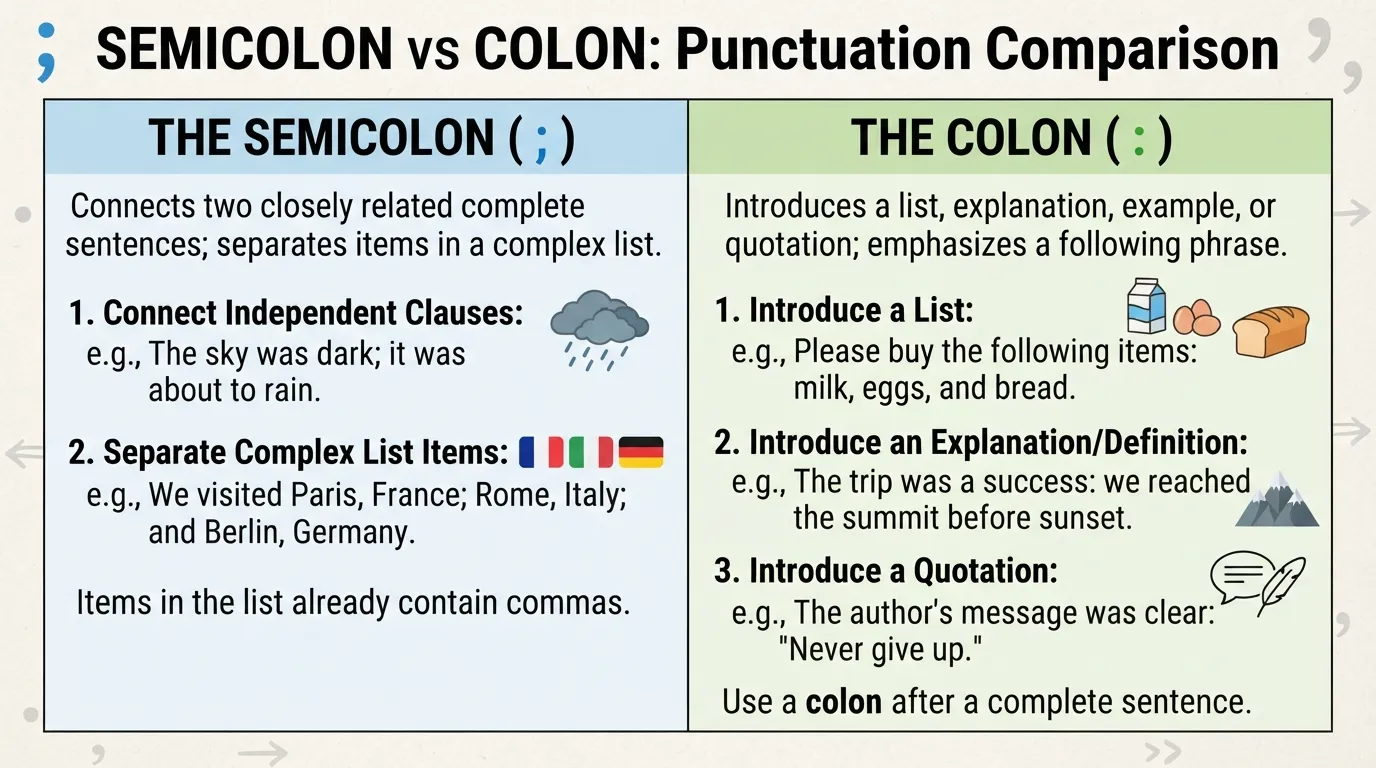
A semicolon (;) connects two closely related independent clauses or separates complicated list items.
A colon (:) introduces a list, explanation, example, quotation, or expansion after a complete clause.
In simple terms, a semicolon connects related ideas, while a colon tells the reader that more detail is coming.
Key Takeaways
- Use a semicolon to connect two closely related complete sentences.
- Use a colon to introduce a list, explanation, example, or quotation.
- A semicolon can separate list items that already contain commas.
- The words before a colon should normally form a complete clause.
- Before choosing either mark, ask whether you are connecting ideas or introducing information.
What Is the Difference Between a Semicolon and a Colon?
The main difference between a semicolon and a colon is the relationship between the ideas around the punctuation mark.
A semicolon (;) connects two related independent clauses. Both sides can normally stand alone as complete sentences.
The weather was cold; we stayed inside.
“The weather was cold” is a complete sentence. So is “We stayed inside.” The semicolon connects the two related thoughts.
A colon (:) usually introduces information that explains, expands, illustrates, or lists something mentioned before it.
We stayed inside for one reason: the weather was terrible.
The information after the colon explains the “one reason” mentioned before it.
The MLA Style Center also notes that a colon can connect two independent clauses when the second clause expands on the first. This is an important distinction because the colon is not limited to lists.
Semicolon: Connects Related Complete Thoughts
Think of a semicolon as a strong link between two related ideas.
Maria finished her homework; she watched TV afterward.
Both parts could be separate sentences:
Maria finished her homework.
She watched TV afterward.
The semicolon simply shows that the two ideas are closely connected.
Colon: Introduces or Expands on an Idea
Think of a colon as a signal that says, “Here is the information I promised.”
Maria finished everything she needed to do: her homework, her chores, and her reading.
The first part introduces the information. The second part provides it.
When to Use a Semicolon
There are three especially useful situations where a semicolon works well.
Join Two Related Independent Clauses
Use a semicolon when you have two complete thoughts that are closely related.
The store was closing; we hurried to the checkout.
I wanted to call you; my phone battery died.
The test was difficult; many students needed extra time.
You could replace the semicolon with a period in each example. The semicolon keeps the related thoughts together.
Do not use a semicolon simply because you want a longer pause. The grammatical relationship matters.
Use a Semicolon With However and Therefore
A semicolon is commonly used before a conjunctive adverb such as however, therefore, therefore, or moreover when it connects two independent clauses.
The weather looked bad; however, we decided to go.
The road was closed; therefore, we took another route.
The usual pattern is:
Independent clause + semicolon + however/therefore + comma + independent clause
A common error is using only a comma:
Incorrect: The weather looked bad, however, we went outside.
Correct: The weather looked bad; however, we went outside.
Separate Items in a Complex List
Semicolons can separate items in a list when the individual items already contain commas.
The conference included speakers from Austin, Texas; Portland, Oregon; and Miami, Florida.
The semicolons make the three locations easier to distinguish.
Without them, the internal commas could make the list difficult to read.
When to Use a Colon
A colon generally points forward to information that explains or expands on what came before it.
Introduce a List
Use a colon when a complete clause introduces a list.
I need three things: a notebook, a pen, and a laptop.
She packed everything for the trip: clothes, shoes, and a camera.
Notice that the part before the colon can stand alone:
I need three things.
That makes the colon appropriate.
Introduce an Explanation or Example
A colon can introduce an explanation that gives more information about the previous statement.
He had one goal: to finish the project today.
There was one problem: nobody had the key.
The material after the colon explains or identifies what came before it.
Introduce a Quotation
A colon can introduce a quotation when the preceding clause appropriately sets it up.
The teacher gave the class one simple message: “Keep practicing.”
The colon signals that the quotation provides the promised message.
Connect Two Clauses When the Second Explains the First
A colon can sometimes appear between two complete clauses when the second clause explains or expands the first.
She knew what she had to do: she needed to apologize.
Both sides are complete clauses, but the second explains the first.
This differs from a semicolon because the colon creates a more specific explanation or expansion relationship. The MLA Style Center describes this as a key distinction between the two marks.
Semicolon vs Colon: Side-by-Side Comparison
| Feature | Semicolon (;) | Colon (:) |
| Main job | Connects related ideas | Introduces or expands information |
| Before the mark | Usually a complete independent clause | Usually a complete independent clause |
| After the mark | Usually another independent clause | A list, phrase, explanation, quotation, or clause |
| Common use | Two related sentences | Lists and explanations |
| Complex lists | Separates complicated items | Introduces the list |
| Example | It was late; we left. | We left for one reason: it was late. |
| Easy memory | Connect | Introduce |
The distinction is also reflected across current grammar resources: semicolons are commonly described as connectors between related independent clauses, while colons introduce or expand information.
Semicolon vs Colon Examples
Correct Semicolon Examples
Example 1:
The movie was long; we still enjoyed it.
Two related complete thoughts are connected.
Example 2:
I wanted to buy the shirt; it was too expensive.
Both sides can stand alone.
Example 3:
The team practiced hard; however, the game was canceled.
The semicolon correctly comes before “however.”
Example 4:
We visited Dallas, Texas; Denver, Colorado; and Boise, Idaho.
The semicolons separate list items that contain commas.
Correct Colon Examples
Example 1:
She bought three fruits: apples, oranges, and bananas.
The colon introduces a list.
Example 2:
He had one request: give him more time.
The second part explains the request.
Example 3:
There was only one problem: the door was locked.
The second clause explains the problem.
Example 4:
She gave us this advice: “Always check your work.”
The colon introduces the quotation.
Similar Sentences With Different Meanings
Compare these examples:
The meeting ended; everyone went home.
The semicolon connects two related events.
The meeting ended for one reason: the manager had to leave.
The colon introduces an explanation.
Another pair:
I packed my bag; I left for the airport.
The second idea is closely connected to the first.
I packed three things: my passport, phone, and wallet.
The colon introduces the list.
This is the simplest way to understand the difference: a semicolon connects, while a colon introduces or explains.
Common Semicolon and Colon Mistakes
Using a Semicolon Before a List
A semicolon should not normally introduce an ordinary list.
❌ I bought three things; bread, milk, and eggs.
Use a colon:
✓ I bought three things: bread, milk, and eggs.
The semicolon may be appropriate inside a complicated list, but the colon introduces the list itself.
Using a Colon After an Incomplete Clause
Do not put a colon between a verb and its object.
❌ She bought: apples, oranges, and bananas.
✓ She bought apples, oranges, and bananas.
Similarly:
❌ My favorite foods are: pizza and tacos.
✓ My favorite foods are pizza and tacos.
The phrase before the colon should normally be complete. Grammar resources commonly identify this as one of the most frequent colon errors.
Using a Comma Where a Semicolon Is Needed
A comma cannot normally join two independent clauses by itself.
❌ The rain started, we went inside.
This is a comma splice.
Use a semicolon:
✓ The rain started; we went inside.
You could also write:
✓ The rain started, so we went inside.
Confusing a Colon With a Semicolon
Consider:
❌ She had one goal; finish the assignment.
The second part explains the “one goal,” so a colon is more appropriate:
✓ She had one goal: finish the assignment.
Now compare:
✓ She finished the assignment; she submitted it before lunch.
Here, both sides are complete, closely related thoughts, so a semicolon works.
How to Choose Between a Semicolon and Colon
When you are unsure, ask one simple question:
Am I connecting two related complete thoughts, or am I introducing an explanation or list?
Choose a semicolon when you mean:
“These two ideas are closely connected.”
Example:
The store was crowded; we left quickly.
Choose a colon when you mean:
“Here is the detail that explains or develops what I just said.”
Example:
We left quickly for one reason: the store was closing.
You can also use this quick test:
Two complete, related sentences → semicolon
Complete statement followed by a list, explanation, example, or expansion → colon
Remember that punctuation is about meaning as well as grammar. A semicolon and colon may sometimes appear in similar positions, but they tell the reader to understand the relationship differently.
FAQs:
What is the main difference between a semicolon and a colon?
A semicolon connects two closely related independent clauses. A colon introduces or expands on information that follows, such as a list, explanation, example, or quotation. Both marks can follow a complete clause, but they create different relationships between the ideas.
Can a colon connect two complete sentences?
Yes. A colon can connect two independent clauses when the second clause explains, expands, or illustrates the first. For example: “She knew what she had to do: she needed to apologize.” The second clause explains the first.
Can you use a semicolon before “however”?
Yes. When “however” connects two independent clauses, a semicolon can come before it, followed by a comma: “The weather was poor; however, the event continued.” This structure avoids using a comma alone to join two complete clauses.
Can you use a colon before a list?
Yes. A colon can introduce a list when the words before it form a complete clause. For example: “Bring these items: a notebook, a pencil, and a folder.” Avoid placing a colon directly after an incomplete phrase such as “Bring:.”
Should the word after a colon be capitalized?
Usually, a word after a colon is lowercase when it begins a phrase or ordinary continuation. Capitalization can vary by style guide when a complete sentence follows. For formal writing, follow the style guide required for your publication, school, or organization.
Can a semicolon be used in a list?
Yes. Semicolons can separate list items when those items already contain commas. For example: “The winners were Alex Brown, captain; Maria Lee, coach; and James Smith, manager.” This prevents the internal commas from making the list confusing.
What is an easy way to remember semicolon vs colon?
Remember semicolon = connect and colon = introduce. A semicolon connects closely related complete thoughts. A colon introduces something that explains, expands, or gives details about the preceding statement.
Conclusion:
Understanding semicolon vs colon becomes much easier when you focus on the job each punctuation mark does. A semicolon connects two closely related complete thoughts, while a colon introduces a list, explanation, example, or additional detail.
Use a semicolon when the ideas can stand as separate sentences but are closely connected. Use a colon when the second part explains or expands on the first. With practice, this simple difference can help you choose the right punctuation with confidence.
The key is to think about the relationship between your ideas, not just the pause in the sentence. When you know whether you are connecting or introducing, choosing between a semicolon and colon becomes much clearer.

I am Joseph Parker, a devoted Bible content writer dedicated to sharing God’s Word with clarity and purpose.
Through Biblicaltribez.com, I create inspirational and scripture-centered articles that strengthen faith.
My goal is to guide readers into a deeper understanding of biblical teachings and Christian living.