Skip to content
In the United States, a dietitian is a trained and credentialed nutrition professional who can provide nutrition counseling and, when qualified, medical nutrition therapy.
“Nutritionist” is a broader term whose education and legal requirements vary by state. If you need nutrition care for a medical condition, look for a Registered Dietitian (RD) or Registered Dietitian Nutritionist (RDN).
Key Takeaways
- Dietitian and dietician refer to the same profession, but “dietitian” is the standard spelling used in the U.S.
- Registered dietitians (RDs) and registered dietitian nutritionists (RDNs) meet specific education, supervised-practice, examination, and continuing-education requirements.
- Nutritionist does not have one standardized meaning across the United States.
- An RDN can provide personalized nutrition care and medical nutrition therapy for many health conditions.
- Your best choice depends on your health needs, the professional’s credentials, and your state’s rules.
What Is the Difference Between a Dietician and a Nutritionist?
The main difference is professional training and regulation.
In the United States, registered dietitians and registered dietitian nutritionists must meet specific education and professional requirements. They complete accredited dietetics education, supervised practice, and a national registration examination. They also maintain their credentials through continuing professional education.
The word nutritionist is less consistent. There is no single nationwide standard definition for the title. Depending on the state, a person using the term may have formal nutrition education, a specific credential, or very little professional training. The Academy of Nutrition and Dietetics recommends checking a nutrition professional’s credentials rather than relying on the title alone.
This means that the terms can overlap, but they should not automatically be treated as identical.
Dietician vs Dietitian: Which Spelling Is Correct?
Dietician and dietitian are spelling variants for the same profession.
However, dietitian is the spelling normally used by U.S. professional organizations and in the official credential Registered Dietitian (RD) or Registered Dietitian Nutritionist (RDN).
So, if you are searching for a qualified professional in the United States, you will usually see:
- Dietitian
- Registered Dietitian (RD)
- Registered Dietitian Nutritionist (RDN)
The keyword “dietician vs nutritionist” is still common in searches, but the professional term you are most likely to encounter is dietitian.
What Does a Dietitian Do?
A dietitian uses food and nutrition science to help people improve their health, meet nutritional needs, and manage certain health conditions.
Registered dietitian nutritionists work in hospitals, clinics, private practices, community programs, food service, research, education, and other settings. Their work can include nutrition assessment, counseling, meal planning, and personalized nutrition recommendations.
Medical Nutrition Therapy
One important area is medical nutrition therapy (MNT).
MNT is a personalized nutrition-based approach used to help manage health conditions. An RDN can assess a person’s nutritional needs and create recommendations that fit the person’s condition, food choices, and lifestyle.
For example, someone with diabetes, kidney disease, heart disease, food allergies, or an eating disorder may benefit from working with an RDN.
A dietitian may also help people who simply want to improve their eating habits, lose or gain weight, support athletic performance, or develop a healthier relationship with food.
What Does a Nutritionist Do?
A nutritionist may provide guidance about healthy eating, food choices, meal planning, and general nutrition.
However, the important point is that “nutritionist” does not have one standardized meaning throughout the United States. Some nutritionists have advanced degrees or professional certifications, while others may have less formal training. Regulation also varies between states.
Because of this variation, you should look beyond the job title.
For example, two people might both advertise themselves as nutritionists while having very different levels of education and professional training.
A qualified nutritionist may be useful for general wellness goals, but someone dealing with a medical condition may want the additional training and credentials of an RD or RDN.
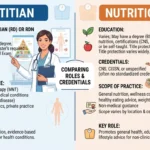
Dietitian vs Nutritionist: Key Differences
| Feature | Dietitian/RDN | Nutritionist |
| Title | RD or RDN is a professional credential | Meaning varies |
| Education | Specific accredited education required for RDN eligibility | Requirements vary |
| Supervised practice | Required for RDN credentialing | Depends on training and state |
| National exam | Required for RDN credential | Not universally required |
| Medical nutrition therapy | Qualified RDNs can provide it | Depends on credentials and applicable rules |
| State regulation | Dietetics practice may be regulated | Varies significantly |
| Best known for | Evidence-based nutrition and clinical nutrition care | General nutrition guidance, depending on qualifications |
The biggest difference is not simply what each person talks about. Both may discuss food and healthy eating. The difference is the education, credentialing, and scope of practice behind the professional title.
Education and Credentials
Becoming an RDN involves several formal steps.
As of January 1, 2024, people seeking eligibility for the dietitian registration examination for the first time must have at least a graduate degree from an appropriately accredited institution. They must also meet required dietetics coursework and supervised-practice requirements and pass the national examination.
ACEND-accredited pathways can integrate graduate-level coursework with supervised experiential learning. Current ACEND information describes programs with at least 1,000 hours of experiential learning for relevant RDN pathways.
After earning the credential, RDNs also have continuing professional education requirements. In addition, many states have their own laws regulating dietitians and nutrition practitioners.
This is why seeing RD or RDN after a person’s name can be useful when you are looking for a formally credentialed nutrition professional.
When Should You See a Dietitian?
An RDN may be the better choice when nutrition is closely connected to a health condition or when you need individualized, evidence-based nutrition care.
You may want to consider a dietitian if you:
- Have diabetes or another chronic health condition.
- Have kidney, heart, or digestive health concerns.
- Have a food allergy or significant food intolerance.
- Need nutrition support during medical treatment or recovery.
- Are dealing with an eating disorder.
- Want help managing your weight in a personalized way.
- Need sports nutrition guidance.
- Want professional help improving your overall diet.
For example, a person with kidney disease may have specific nutritional needs that are very different from those of a healthy person looking for general healthy-eating advice. In situations like this, specialized nutrition training matters.
When Might a Nutritionist Be a Good Choice?
A qualified nutritionist may be useful when your main goal is general nutrition education or lifestyle improvement.
For example, you may want help with:
- Building healthier eating habits.
- Understanding basic nutrition.
- Planning balanced meals.
- Improving everyday food choices.
- Learning more about nutrition for general wellness.
However, check the person’s education and credentials first. The title “nutritionist” alone does not tell you how much formal training that person has.
If you have a diagnosed medical condition, it is generally safer to look for a credentialed professional whose training and legal scope match your needs.
How to Choose a Qualified Nutrition Professional
When comparing a dietitian and nutritionist, don’t focus only on the title.
Ask about:
- Credentials: Does the person have an RD or RDN credential?
- Education: What degree and nutrition training have they completed?
- Experience: Do they regularly work with people who have your specific goal or condition?
- State requirements: Does the professional meet the rules that apply where you live?
- Approach: Are their recommendations based on established nutrition evidence?
- Communication: Do they listen to your needs and explain recommendations clearly?
The Academy of Nutrition and Dietetics provides a directory where people can search for credentialed nutrition professionals by location, specialty, language, and payment or insurance options.
FAQs:
Is a dietitian better than a nutritionist?
Not automatically. The right professional depends on your needs and the individual’s qualifications. However, an RD or RDN has completed specific education, supervised practice, and examination requirements. If you need nutrition care related to a medical condition, an RDN is often the more appropriate choice because qualified RDNs can provide medical nutrition therapy.
Can a nutritionist call themselves a dietitian?
A person should not assume that having nutrition knowledge makes them an RD or RDN. In the U.S., the RD/RDN credential has specific requirements. State laws can also regulate the practice and use of professional titles. Always check a person’s actual credentials rather than relying on a general title.
Do dietitians and nutritionists do the same thing?
There is some overlap. Both may discuss healthy eating, food choices, and nutrition. The major difference is the level of standardized education, credentialing, and regulation. Registered dietitians have a defined professional pathway and can provide specialized nutrition care within their scope of practice.
Is a dietitian a doctor?
No. A dietitian is a nutrition and dietetics professional, not a medical doctor. Registered dietitians can work as part of a health care team and provide specialized nutrition care, but they do not have an MD or DO medical degree.
What should I look for when choosing a nutrition professional?
Look for qualifications that match your needs. For medical nutrition care, check for an RD or RDN credential and relevant experience. For general nutrition guidance, also ask about education, certifications, experience, and whether the person is regulated in your state. A professional’s actual qualifications are more important than the title “nutritionist.”
Conclusion:
The key difference in dietician vs nutritionist is not simply the type of food advice they provide. It is the level of professional education, credentialing, supervised training, and regulation behind that advice.
In the United States, an RD or RDN has completed a defined professional pathway and can provide specialized nutrition care, including medical nutrition therapy. The term nutritionist is broader and can have different requirements depending on the state.
If you need help with a medical condition, checking for an RD or RDN is a practical way to find a credentialed nutrition professional.

I am Caleb Anderson, a Christian writer passionate about exploring deep biblical meanings and spiritual truths.
On Biblicaltribez.com, I share faith based insights to help readers grow closer to God through Scripture.
My writing focuses on making the Bible easy to understand, meaningful, and relevant to everyday life.