Skip to content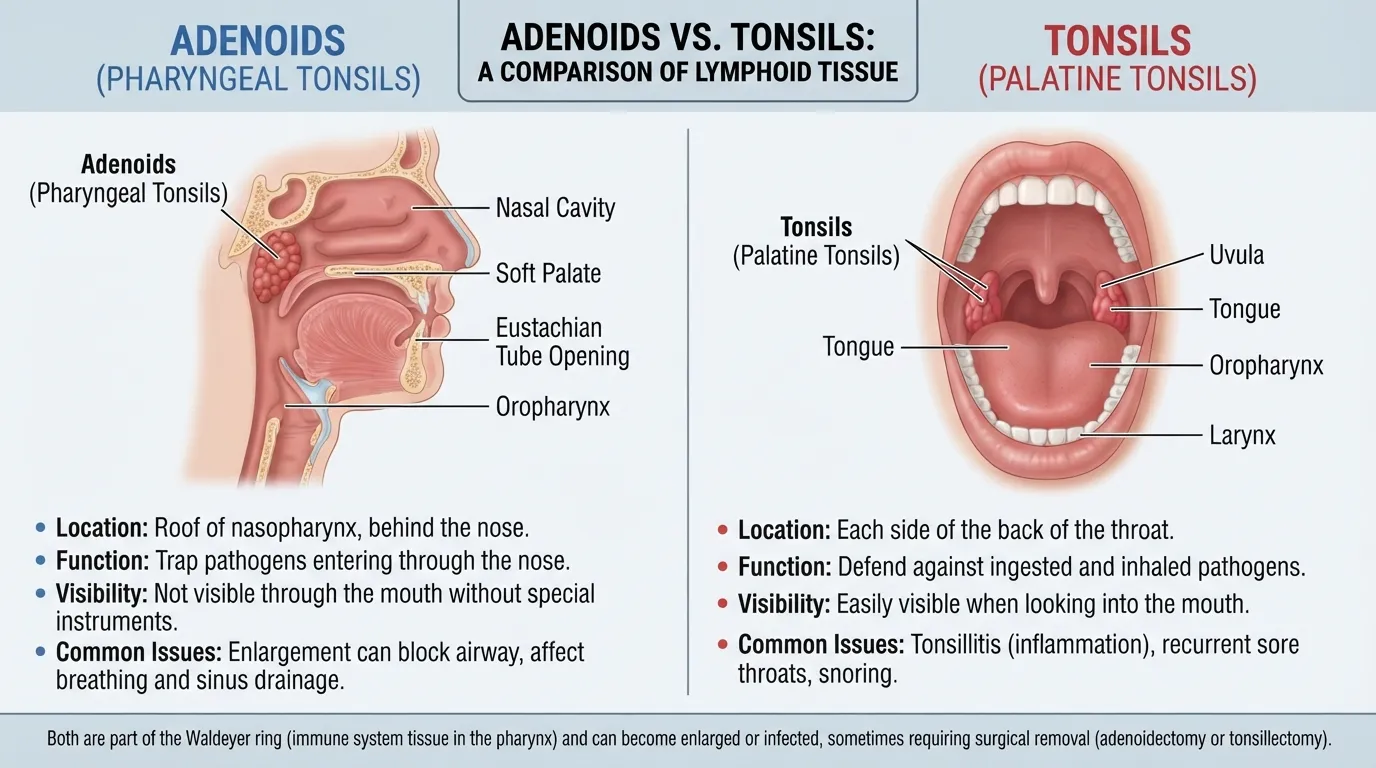
Adenoids and tonsils are different tissues that both help the immune system. Tonsils are two visible tissue pads on each side of the back of the throat.
Adenoids sit higher, behind the nose, and cannot normally be seen by looking into the mouth.
Enlarged tonsils often cause throat or swallowing problems, while enlarged adenoids more often affect nasal breathing, sleep, and the ears.
Key Takeaways
- Tonsils are on both sides of the back of the throat and can usually be seen when you open your mouth.
- Adenoids are behind the nose and are not normally visible without special equipment.
- Both tissues help the immune system recognize germs entering through the nose or mouth.
- Enlarged adenoids often cause nasal blockage, mouth breathing, snoring, and ear problems.
- Enlarged tonsils can cause sore throats, painful swallowing, recurrent tonsillitis, snoring, and breathing problems during sleep.
- Some children have problems with both at the same time.
What Are Tonsils?
Tonsils are two round or oval areas of lymphoid tissue at the back of the throat. There is one on each side. Because they sit in the mouth and throat area, you can usually see them when you open your mouth and look toward the back of your throat.
Tonsils are part of the immune system. They help detect germs that enter through the mouth and contribute to the body’s immune response.
Where Are Tonsils Located?
The tonsils most people mean when they say “tonsils” are the palatine tonsils. They sit on the left and right sides of the throat.
Their location explains why tonsil problems often cause symptoms such as:
- Sore throat
- Pain when swallowing
- Red or swollen tonsils
- White or yellow patches
- Fever
- Swollen neck lymph nodes
Tonsillitis means inflammation of the tonsils. It can be caused by viruses or bacteria.
What Do Tonsils Do?
Tonsils help the body respond to germs entering through the mouth. They are one part of a larger immune system network.
They are useful, especially during childhood, but having tonsils is not the body’s only way to fight infections.
What Are Adenoids?
Adenoids are also lymphoid tissue, but they are located in a different place.
They sit behind the nose and above the soft palate, where the nasal passage meets the upper throat. Unlike tonsils, adenoids cannot normally be seen simply by opening your mouth. A doctor may use a flexible scope or other methods to examine them.
Adenoids are especially active during childhood. They usually become smaller as children grow and are often much less prominent by adulthood.
Where Are Adenoids Located?
Think of the anatomy this way:
Nose → adenoids farther back → throat
The adenoids are high in the airway, behind the nasal cavity. Because of this position, enlarged adenoids can interfere with air moving through the nose.
What Do Adenoids Do?
Adenoids help recognize and respond to germs that enter through the nose. Like tonsils, they are part of the body’s lymphatic and immune system.
When adenoids become enlarged, however, they can sometimes cause physical blockage. This can affect nasal breathing, sleep, and the function of the eustachian tubes connected with the middle ear.
Adenoids vs Tonsils: Key Differences
| Feature | Adenoids | Tonsils |
| Location | Behind the nose, high in the throat | On both sides of the back of the throat |
| Visible? | Usually not visible by looking in the mouth | Usually visible |
| Main immune role | Helps respond to germs entering through the nose | Helps respond to germs entering through the mouth |
| Common problems | Nasal blockage, mouth breathing, snoring, ear problems | Tonsillitis, sore throat, painful swallowing |
| Sleep problems | Can contribute to snoring and sleep apnea | Can contribute to snoring and sleep apnea |
| Common surgery | Adenoidectomy | Tonsillectomy |
Both can become enlarged and contribute to airway obstruction, particularly during sleep.
Adenoids vs Tonsils Symptoms
One of the easiest ways to understand adenoids vs tonsils is to look at where the symptoms occur.
Symptoms Linked to Enlarged Adenoids
Because adenoids are behind the nose, enlargement often affects nasal breathing.
Possible symptoms include:
- Constant or frequent nasal blockage
- Mouth breathing
- Snoring
- Noisy breathing
- A blocked-sounding voice
- Trouble sleeping
- Recurrent ear infections
- Fluid or pressure in the middle ear
- Sleep-disordered breathing
Enlarged adenoids can interfere with the eustachian tubes and contribute to middle-ear problems in children.
Symptoms Linked to Enlarged Tonsils
Tonsil problems tend to produce more obvious throat symptoms.
These can include:
- Sore throat
- Painful swallowing
- Red or swollen tonsils
- White or yellow patches
- Fever
- Bad breath
- Swollen lymph nodes in the neck
- Repeated tonsillitis
Very large tonsils can also narrow the airway and contribute to snoring or obstructive sleep apnea.
Symptoms They Can Both Cause
There is considerable overlap.
Both enlarged adenoids and tonsils can contribute to:
- Snoring
- Mouth breathing
- Poor sleep
- Noisy breathing
- Pauses in breathing during sleep
- Obstructive sleep apnea
This is why one symptom alone cannot tell you which tissue is causing a problem. A child with enlarged tonsils and adenoids may have symptoms from both.
Can You Have Enlarged Tonsils and Adenoids?
Yes. Enlarged tonsils and enlarged adenoids can occur together.
This is particularly important when a child snores regularly or has signs of obstructive sleep apnea. Both tissues can narrow the upper airway during sleep. Doctors may evaluate both when a child has persistent snoring, mouth breathing, restless sleep, or pauses in breathing.
The symptoms can overlap, so an ENT specialist may examine the throat, nose, ears, and airway rather than focusing on one tissue alone.
How Doctors Diagnose Adenoid and Tonsil Problems
Tonsils are usually easier to examine because they can be seen by looking into the mouth.
Adenoids are deeper in the airway. Depending on the situation, a healthcare professional may use a flexible scope, imaging, or another examination method to assess them. If sleep apnea is suspected, a sleep study may also be considered.
Doctors also consider the person’s symptoms and medical history.
For example, repeated throat infections may point toward a tonsil problem, while persistent nasal obstruction and recurrent ear problems may raise concern about enlarged adenoids.
When Are Adenoids or Tonsils Removed?
Not everyone with enlarged tonsils or adenoids needs surgery.
Doctors consider factors such as the severity and duration of symptoms, repeated infections, airway obstruction, sleep problems, and other complications.
Adenoidectomy
An adenoidectomy removes the adenoids.
It may be considered when enlarged adenoids cause significant breathing problems, sleep-disordered breathing, chronic nasal problems, or certain recurrent ear problems.
Tonsillectomy
A tonsillectomy removes the tonsils.
It may be considered for recurring or severe tonsillitis and for breathing problems related to enlarged tonsils. Tonsillectomy is also used in some children with obstructive sleep apnea.
Adenotonsillectomy
Sometimes both procedures are performed during the same operation. This is commonly called an adenotonsillectomy.
For children with obstructive sleep apnea caused by enlarged tonsils and adenoids, removing both may be recommended when appropriate.
The decision should be made with a qualified healthcare professional, because snoring, sore throats, nasal congestion, and breathing problems can have several possible causes.
FAQs:
Are adenoids and tonsils the same thing?
No. They are different areas of lymphoid tissue. Tonsils are located on both sides of the back of the throat and can usually be seen. Adenoids are located higher, behind the nose, and cannot normally be seen by looking into the mouth. Both have immune-system functions.
Which causes more trouble with the nose?
Enlarged adenoids are more commonly associated with nasal blockage because they sit behind the nose. They can cause mouth breathing, snoring, and difficulty breathing through the nose. However, allergies, infections, and other nasal conditions can cause similar symptoms.
Can enlarged adenoids cause sleep apnea?
Yes. Enlarged adenoids can narrow the upper airway and contribute to obstructive sleep apnea, especially in children. Enlarged tonsils can do the same, and both may contribute at the same time.
Can you have both enlarged tonsils and adenoids?
Yes. Both tissues can become enlarged and contribute to breathing or sleep problems. When both are involved, a healthcare professional may evaluate the entire upper airway before deciding whether treatment or surgery is appropriate.
Conclusion:
The main difference in adenoids vs tonsils is their location and the problems they tend to cause.
Tonsils are visible on both sides of the back of the throat and are often associated with sore throats, tonsillitis, and swallowing problems. Adenoids sit behind the nose and are more often linked with nasal blockage, mouth breathing, snoring, and some ear problems.
Both tissues can become enlarged, and both can contribute to sleep-disordered breathing.
If persistent snoring, breathing pauses, repeated infections, difficulty swallowing, or ongoing nasal and ear problems are present, a healthcare professional can determine whether the tonsils, adenoids, or another condition is responsible.

I am Joseph Parker, a devoted Bible content writer dedicated to sharing God’s Word with clarity and purpose.
Through Biblicaltribez.com, I create inspirational and scripture-centered articles that strengthen faith.
My goal is to guide readers into a deeper understanding of biblical teachings and Christian living.