Skip to content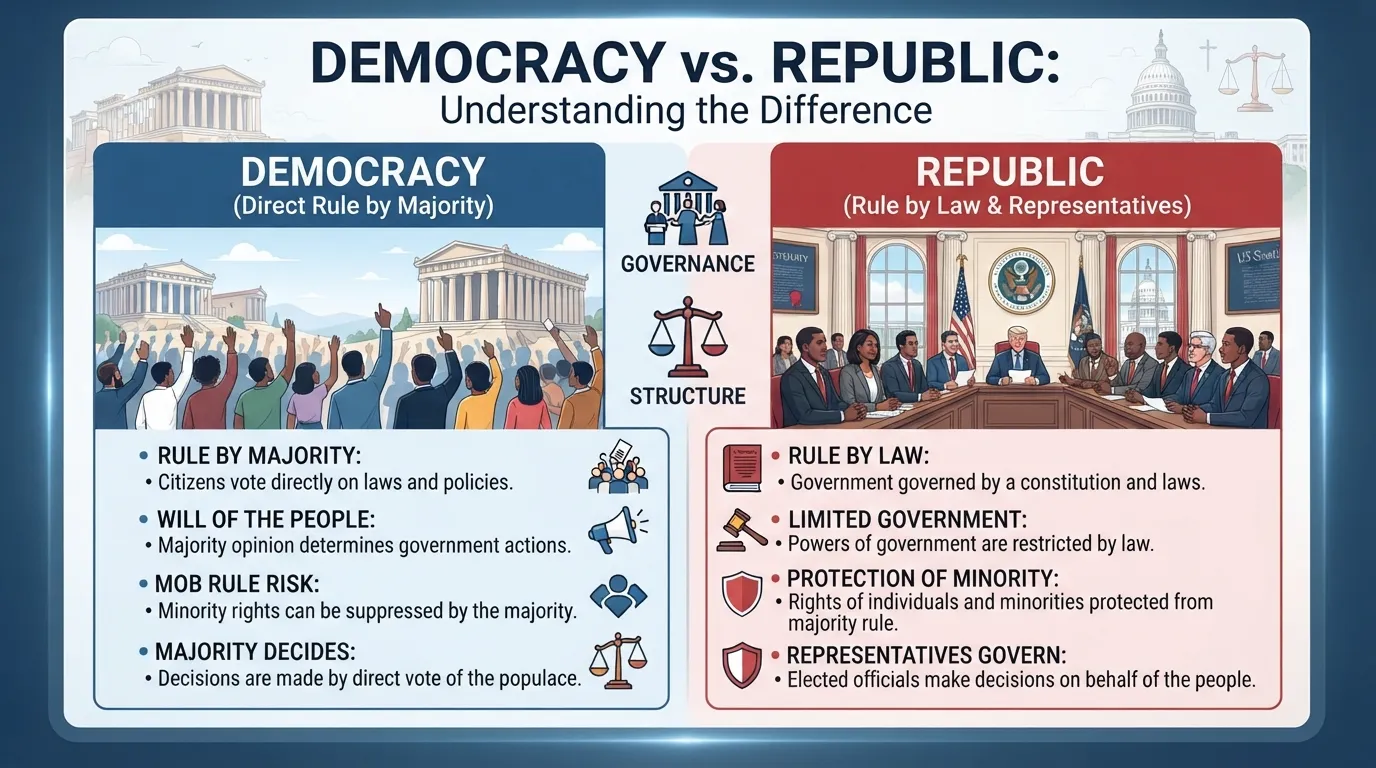
Democracy vs republic describes two related but different ideas about government. Democracy focuses on political power coming from the people, either directly or through representatives.
A republic generally refers to government organized around elected officials and a constitutional or legal framework. The United States is both a representative democracy and a constitutional republic.
Key Takeaways
- Democracy focuses on popular participation and the people’s authority.
- A republic emphasizes representative government and a legal or constitutional structure.
- A country can be both a democracy and a republic.
- The United States uses representative democratic elections within a constitutional republic.
- Direct democracy and representative democracy are different ways people can exercise political power.
What Is Democracy?
A democracy is a system of government in which political authority ultimately comes from the people. Citizens can exercise that authority directly or through representatives they choose in elections.
The word is often used broadly. It does not necessarily mean that citizens vote directly on every law. In a representative democracy, voters elect officials who make laws and decisions on their behalf. The National Archives describes representative democracy as a system in which citizens vote for government officials who make decisions for them.
This distinction matters when discussing the United States. Americans normally do not vote directly on every federal law. Instead, they elect members of Congress and other officials who perform government functions.
Direct Democracy
In a direct democracy, citizens participate more directly in government decisions. Instead of relying mainly on elected representatives to make a decision, citizens may vote on a specific law, policy, or public question.
Direct democratic practices can still exist within representative systems. For example, some U.S. states allow voters to decide certain ballot initiatives or referendums directly.
So, democracy does not have only one form. It can include both direct and representative participation.
Representative Democracy
A representative democracy allows citizens to choose people who will represent them in government.
The U.S. Constitution establishes a Congress made up of the House of Representatives and the Senate, while members of the House are chosen by voters.
This system makes representative government practical for a large country with millions of citizens.
What Is a Republic?
A republic is a form of government in which public authority is exercised through established institutions rather than a hereditary monarch.
In the United States, republican government is closely connected to representative institutions, constitutional rules, and limits on government power. The Constitution itself requires the United States to guarantee every state a “Republican Form of Government.”
The term republic comes from the Latin res publica, commonly translated as “public affair” or “public matter.”
A republic does not mean that citizens have no political power. Instead, citizens participate in government through institutions such as elections and representation.
How a Republic Works
A republic can have elections, legislatures, constitutions, courts, and other institutions that organize public power.
In the United States, the Constitution divides federal power among three branches:
- Legislative
- Executive
- Judicial
The Constitution also establishes checks and balances between these branches.
This structure means that government power is divided rather than concentrated in one institution.
Constitutional Republics
The United States is commonly described as a constitutional republic because its government operates under a written Constitution that establishes government powers and limits.
The Constitution is the supreme law of the land. It also establishes the structure of the federal government and protects certain rights.
This constitutional structure is one reason the terms republic and democracy should not automatically be treated as opposites.
Democracy vs Republic: Key Differences
The simplest way to understand democracy vs republic is to look at what each term emphasizes.
| Feature | Democracy | Republic |
| Main focus | Political power of the people | Organization of public government |
| Participation | Direct or representative | Usually through representatives |
| Elections | Common feature | Common feature |
| Constitution | May or may not define the system | Often central to constitutional republics |
| Direct voting | Possible | Not required |
| Representative government | Common | Central to many modern republics |
| U.S. example | Citizens elect government officials | Government operates under the Constitution |
These categories can overlap. A representative democracy can operate within a republic.
That is exactly why saying that a country must be either a democracy or a republic can create unnecessary confusion.
Is the United States a Democracy or a Republic?
The United States can accurately be described as both a democracy and a republic, although each word highlights a different part of the political system.
The National Archives describes American republicanism as a system based on popular sovereignty and representative government.
Why the U.S. Is a Republic
The United States has a written Constitution that establishes government institutions, distributes powers, and limits government authority.
Article IV, Section 4 specifically says that the United States shall guarantee every state a “Republican Form of Government.”
The federal government also operates through elected representatives and constitutional institutions rather than through a hereditary monarch.
Congress, for example, is composed of elected representatives and senators, with the Constitution establishing their roles and powers.
Why the U.S. Is Also a Democracy
The United States also has democratic characteristics because citizens participate in government through elections.
Americans elect representatives at federal, state, and local levels. USAGov provides information on elected representatives and the different levels of elected government.
The Constitution begins with “We the People,” reflecting the principle that government authority is connected to the people.
Modern descriptions of U.S. government therefore commonly use terms such as representative democracy and constitutional republic. These labels are describing different dimensions of the same system.
Direct Democracy vs Representative Democracy
One major source of confusion in the democracy vs republic discussion is the difference between direct and representative democracy.
In direct democracy, citizens participate directly in particular governmental decisions.
In representative democracy, citizens elect officials who make governmental decisions for them.
The United States primarily operates through representative government at the federal level. Citizens elect members of Congress, while the Constitution establishes the powers and responsibilities of those institutions.
This does not make the U.S. “less democratic” simply because citizens do not vote directly on every federal law. Representative democracy is itself a recognized form of democratic government. Pew Research Center defines representative democracy as a system where representatives elected by citizens decide what becomes law.
How the U.S. Constitution Combines Both Systems
The U.S. political system combines popular participation with constitutional limits and representative institutions.
For example, voters participate in elections, while elected officials exercise many governmental powers. At the same time, those officials operate within the constitutional system.
The Constitution separates federal power among the legislative, executive, and judicial branches. Checks and balances help prevent any single branch from becoming dominant.
This creates an important distinction:
Democratic principles explain the role of the people, while republican institutions help explain how governmental power is structured and limited.
The two concepts can therefore work together.
Common Misconceptions About Democracy vs Republic
“A Republic Is Not a Democracy”
This is an oversimplification.
A republic and a democracy are not necessarily competing categories. A government can be both republican and democratic. The United States is an example of this combination.
“Democracy Always Means Direct Majority Voting”
Not necessarily.
Modern representative democracies commonly allow citizens to elect representatives rather than vote directly on every government decision.
“Republic Means the People Have No Power”
That is also incorrect.
In the U.S. system, citizens participate through elections and choose representatives. Republican government describes the institutional and constitutional framework through which public power is exercised.
“Democracy and Republic Mean Exactly the Same Thing”
They are related, but they are not identical.
Democracy primarily describes the source and exercise of political authority by the people.
Republic describes a form of government organized around public institutions, representation, and, in the U.S. context, constitutional government.
Understanding that difference makes the terms easier to use accurately.
FAQs:
What is the difference between a democracy and a republic?
A democracy focuses on government authority coming from the people. A republic focuses on how public government is organized, typically through representatives and established laws or constitutional institutions. The two concepts can overlap, so a country can be both democratic and republican.
Is the United States a democracy or a republic?
The United States is both. It operates as a representative democracy because citizens elect government officials. It is also a constitutional republic because its government is organized and limited by the U.S. Constitution. The National Archives describes U.S. republicanism in terms of popular sovereignty and representative government.
Can a country be both a democracy and a republic?
Yes. Democracy and republic are not mutually exclusive categories. A country can use democratic elections and popular participation while also operating through a constitutional republic. The United States is an example of this combination.
What is a direct democracy?
A direct democracy is a system in which citizens participate directly in government decisions rather than relying entirely on elected representatives. Direct voting can also appear within representative systems through tools such as ballot initiatives and referendums.
What is a representative democracy?
A representative democracy is a system in which citizens elect people to represent them in government. Those representatives then make laws and other governmental decisions. The United States uses representative institutions at the federal level.
Final Thoughts:
The democracy vs republic question becomes much easier when the two terms are not treated as opposites.
Democracy describes the role of the people in government. A republic describes a form of government based on public institutions rather than hereditary monarchy, and in the United States it is closely connected to constitutional and representative government.
The United States combines these ideas. Citizens participate through elections, while elected officials and government institutions operate within the constitutional framework.
So, when discussing the United States, representative democracy and constitutional republic can both be accurate descriptions. They emphasize different features of the same political system.

I am Caleb Anderson, a Christian writer passionate about exploring deep biblical meanings and spiritual truths.
On Biblicaltribez.com, I share faith based insights to help readers grow closer to God through Scripture.
My writing focuses on making the Bible easy to understand, meaningful, and relevant to everyday life.