Skip to content
Featured Snippet Answer
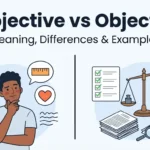
Subjective means based on personal feelings, opinions, experiences, or perspectives. Objective means based on facts, observations, measurements, or evidence that can be checked independently. In simple terms, subjective information reflects a person’s viewpoint, while objective information focuses on information that can be verified.
Key Takeaways
- Subjective information depends on personal feelings, opinions, or experiences.
- Objective information is based on observable facts, evidence, or measurements.
- An opinion is generally subjective, but it can be supported by objective facts.
- A statement can contain both subjective and objective elements.
- In grammar, subjective and objective can also refer to pronoun cases.
What Does Subjective Mean?
Subjective describes something influenced by a person’s individual feelings, beliefs, experiences, preferences, or point of view.
For example:
“This is the best pizza in town.”
This statement is subjective because “best” depends on personal taste. One person may love the pizza, while another may prefer a different restaurant.
Subjective judgments are common when people discuss art, food, entertainment, beauty, experiences, and personal preferences. Different people can reach different conclusions without one person necessarily being wrong.
The key idea is personal perspective.
Examples of Subjective Statements
- “That movie was boring.”
- “Blue is the most beautiful color.”
- “I think this restaurant has the best burgers.”
- “The book was fascinating.”
- “Winter is the most enjoyable season.”
- “The new design looks better.”
Each statement expresses a judgment, preference, or personal reaction.
Notice that subjective does not automatically mean incorrect. A person can honestly say that a movie was boring because that is their genuine experience. The statement is subjective because it depends on the person’s reaction.
What Does Objective Mean?
Objective describes information, observations, or judgments that are based on facts, evidence, measurements, or conditions that can be independently checked.
For example:
“The movie is 180 minutes long.”
The running time can be measured or checked against a reliable source. It does not depend on whether someone enjoyed the movie.
Other examples include:
- “The meeting begins at 3 p.m.”
- “The report contains 25 pages.”
- “The box weighs five pounds.”
- “The temperature is 72°F.”
- “The building has three floors.”
Objective information focuses on what can be observed, measured, documented, or verified.
However, “objective” does not always mean that a person has achieved perfect freedom from bias. In ordinary usage, it often describes an attempt to evaluate something according to evidence rather than personal preference.
Subjective vs Objective: Key Differences
| Feature | Subjective | Objective |
|---|---|---|
| Main basis | Personal perspective | Facts and evidence |
| Depends on feelings? | Often | Ideally not |
| Can vary between people? | Yes | Usually not when the facts are the same |
| Common language | “I think,” “I feel,” “best,” “boring” | Measurements, records, observations |
| Common uses | Reviews, opinions, personal experiences | Reports, research, factual descriptions |
| Example | “The test was difficult.” | “The test had 50 questions.” |
The easiest distinction is this:
Subjective = how someone experiences or interprets something.
Objective = information that can be checked independently.
This distinction is also reflected in established dictionary definitions. Merriam-Webster describes objective information as dealing with facts without distortion from personal feelings, while Cambridge defines subjective as influenced by personal beliefs or feelings rather than facts.
Subjective vs Objective Examples
Consider these pairs:
| Subjective | Objective |
|---|---|
| “This coffee tastes terrible.” | “This coffee contains 12 ounces.” |
| “The room is too cold.” | “The thermostat reads 65°F.” |
| “That was a long meeting.” | “The meeting lasted two hours.” |
| “This is the best phone.” | “This phone has 256 GB of storage.” |
| “The painting is beautiful.” | “The painting is six feet wide.” |
| “The assignment was difficult.” | “The assignment contained 20 questions.” |
The difference becomes clearer when you look at what makes each statement true.
“The room is too cold” depends on someone’s comfort level. But “the room is 65°F” gives a measurable temperature.
How to Tell if Something Is Subjective or Objective
When you are unsure, ask a few simple questions.
1. Can the statement be independently checked?
If you can verify the claim using measurements, records, direct observation, or reliable evidence, it is more likely to be objective.
For example:
“The store closes at 9 p.m.”
You can check the store’s posted hours.
2. Does the statement depend on personal taste?
Words such as best, worst, beautiful, boring, delicious, annoying, enjoyable, difficult, and amazing often signal a subjective judgment.
For example:
“The concert was amazing.”
That describes someone’s reaction rather than a measurable property.
3. Would reasonable people have different answers?
If different people can experience the same thing differently, the statement may be subjective.
For example, one person may find a three-hour movie exciting, while another may find it too long.
4. Is there evidence that can be checked?
Evidence does not automatically make every conclusion objective, but it can help separate factual claims from personal judgments.
For example:
“This restaurant is the best in the city because I love it.”
The preference is subjective. The supporting reason is personal rather than independently measurable.
Subjective vs Objective in Writing
The distinction is especially useful in academic, professional, and journalistic writing.
Objective writing focuses on evidence, observations, and information that readers can evaluate. Subjective writing allows the writer’s personal experiences, reactions, or judgments to play a central role.
For example:
Subjective:
“The new policy is unfair and completely unreasonable.”
More objective:
“The new policy increases the required application fee from $50 to $75.”
The second sentence gives a specific fact. A writer could then discuss whether the increase is fair, but that judgment would be an interpretation.
Purdue OWL similarly distinguishes facts from opinions and notes that objective language tends to focus on facts, while emotional language is more common in opinion-based material.
This does not mean good writing must remove every opinion. An opinion article, review, personal essay, or reflection may intentionally use subjective language. The important thing is to make clear when you are presenting a fact and when you are expressing an interpretation or judgment.
Can a Statement Be Both Subjective and Objective?
Yes.
This is one of the most important points that simple “fact vs. opinion” explanations can miss.
Consider:
“The movie lasts three hours, so it is too long.”
The first part, “The movie lasts three hours,” is objective if the running time can be verified.
The second part, “it is too long,” is subjective because whether three hours is too long depends on the viewer.
Another example:
“She scored 95%, so she is an excellent student.”
The score is objective. The conclusion that she is an “excellent student” is an interpretation that requires more information.
So, instead of asking whether an entire paragraph is automatically subjective or objective, examine each claim.
Subjective vs Objective in Grammar
There is another meaning of these terms that English learners should know.
In grammar, subjective case refers to pronouns used as the subject of a sentence. Objective case refers to pronouns used as the object of a verb or preposition. Purdue OWL lists examples such as I and we in the subjective case and me and us in the objective case.
Compare:
- I called Sarah.
- Sarah called me.
In the first sentence, I performs the action, so it is subjective case.
In the second sentence, me receives the action, so it is objective case.
This grammatical meaning is different from the broader distinction between subjective opinions and objective facts.
Common Mistakes to Avoid
Mistake 1: Thinking subjective means false
A subjective statement is not necessarily false. It describes a personal view or experience.
“I found the book confusing.”
That can be a genuine and meaningful personal experience.
Mistake 2: Thinking objective means absolutely unbiased
Objective language aims to minimize personal influence, but people can still select evidence, frame questions, or interpret information differently.
For this reason, strong factual writing should explain its evidence rather than simply calling itself objective.
Mistake 3: Treating every opinion as unsupported
An opinion can be based on evidence.
For example:
“I think this laptop is a good choice because it has long battery life and meets my budget.”
The conclusion is subjective, but the supporting details can be objectively checked.
Mistake 4: Confusing grammatical case with fact and opinion
“Subjective case” and “objective case” describe the grammatical function of pronouns. They do not mean that the sentence contains a subjective opinion or an objective fact.
Frequently Asked Questions
Is an opinion subjective or objective?
An opinion is generally subjective because it expresses a person’s belief, preference, judgment, or interpretation. However, an opinion can be supported by objective evidence. For example, “This is the best phone” is subjective, while battery-life measurements can provide objective evidence used to support that opinion.
Is subjective the same as false?
No. Subjective does not mean false. It means that a statement depends on an individual’s perspective, feelings, experience, or judgment. A personal experience can be genuine even though another person may experience the same situation differently.
Is objective the same as unbiased?
Not necessarily. Objective generally means based on facts, evidence, or observable information rather than personal feelings. A person can try to be objective while still making choices about which evidence to include or how to interpret it.
Can something be both subjective and objective?
Yes. A statement can contain both measurable facts and subjective judgments. For example, “The restaurant charges $25 for the meal, so it is too expensive” contains an objective price and a subjective judgment about whether that price is too high.
What is the easiest way to remember the difference?
Think of subjective as personal perspective and objective as verifiable information. If the statement mainly describes what someone feels, believes, prefers, or experiences, it is subjective. If it describes something that can be checked through evidence or measurement, it is objective.
Conclusion
The main difference between subjective vs objective is perspective. Subjective information reflects personal feelings, experiences, beliefs, preferences, or judgments. Objective information focuses on facts, observations, measurements, and evidence that can be independently checked.
The distinction is useful in everyday conversations, academic writing, journalism, research, reviews, and professional communication. Just remember that a single statement can contain both types of information. The best approach is to examine each claim and ask whether it expresses a personal judgment or provides something that can be independently verified.

I am Caleb Anderson, a Christian writer passionate about exploring deep biblical meanings and spiritual truths.
On Biblicaltribez.com, I share faith based insights to help readers grow closer to God through Scripture.
My writing focuses on making the Bible easy to understand, meaningful, and relevant to everyday life.