Skip to content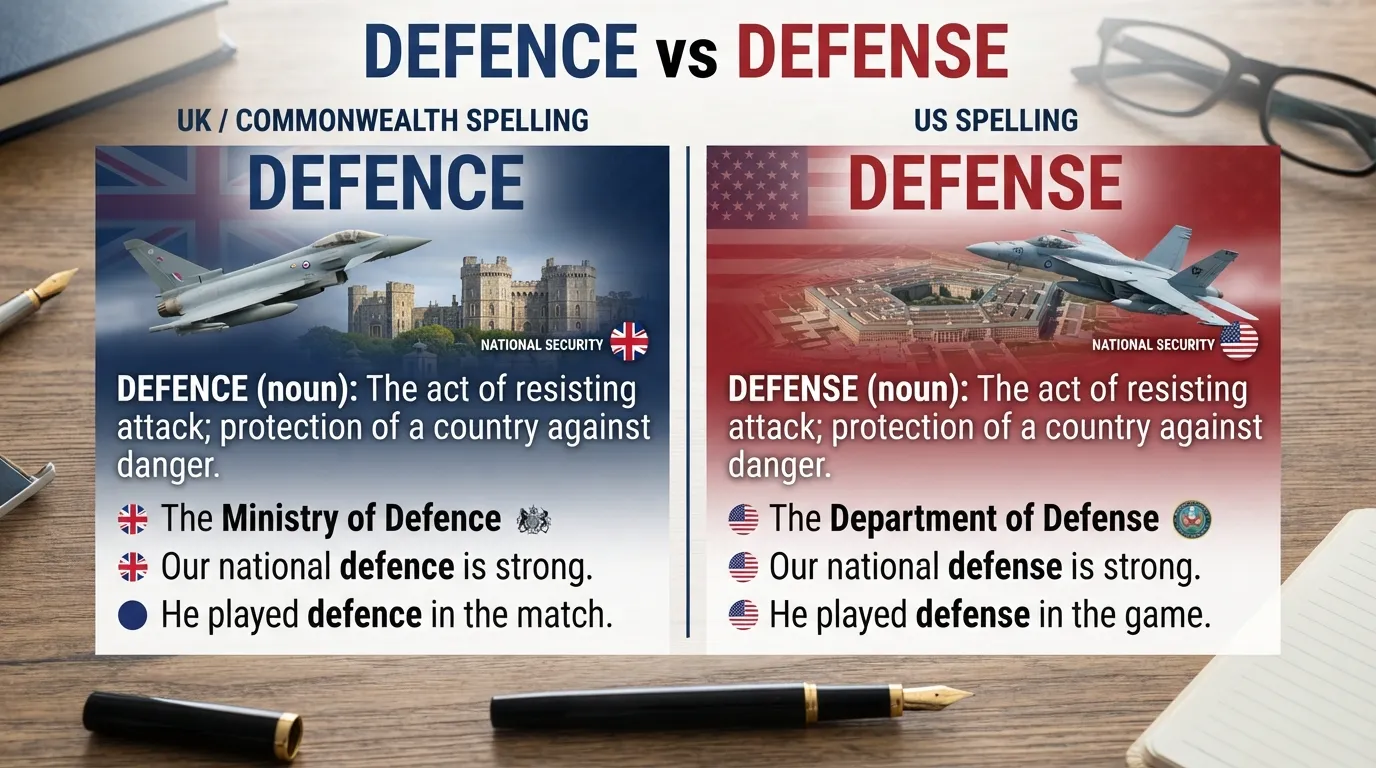
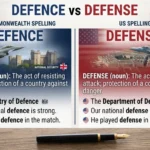
Defence and defense are two spellings of the same word. Defense is the standard spelling in American English, while defence is the standard spelling in British English.
Both mean protection against attack, harm, criticism, or accusation, and they are generally pronounced the same way.
Key Takeaways
- Defense is the standard American English spelling.
- Defence is the standard British English spelling.
- Both words have the same basic meaning.
- The pronunciation is essentially the same.
- Use defense when writing for a US audience.
- Related words such as defensive and defensible use s in both varieties.
Defence vs Defense: What Is the Difference?
The main difference between defence vs defense is spelling, not meaning.
Both words describe the act of protecting someone or something from attack, harm, criticism, or danger. They can also refer to a legal argument, a military organization, or the part of a sports team that tries to stop an opponent.
The spelling depends on the variety of English being used.
| Word | English variety | Example |
| defense | American English | The team has a strong defense. |
| defence | British English | The team has a strong defence. |
Cambridge lists defense as the US spelling of defence, while its British dictionary entry identifies defence as the UK form.
So, if you are writing for readers in the United States, defense is the spelling you normally want.
Defense vs Defence in American and British English
Defense in American English
For example:
The team improved its defense this season.
She spoke in defense of her decision.
The country increased its defense budget.
American dictionaries and style resources use defense for these meanings. Cambridge specifically identifies defense as the US spelling and gives examples involving protection, law, and sports.
If your website, school assignment, business document, or article is aimed at a US audience, choose defense.
Defence in British English
Defence is the standard British English spelling.
For example:
The team improved its defence this season.
She spoke in defence of her decision.
The country increased its defence budget.
The meaning remains the same. Only the regional spelling changes. Cambridge’s British English entry uses defence and identifies defense as its US equivalent.
Do Defence and Defense Have the Same Meaning?
Yes. In normal usage, defence and defense have the same meanings.
The word can be used in several different situations.
Military and National Protection
Both forms can describe protection of a country against threats or attack.
American English:
The government announced a new defense strategy.
British English:
The government announced a new defence strategy.
The words defense strategy and defence strategy refer to the same general idea. Cambridge includes military protection and national defense among the meanings of the word.
Legal Use
The word is also common in law.
A defense can be an argument or explanation used to respond to an accusation.
American English:
The lawyer prepared a strong defense.
British English:
The lawyer prepared a strong defence.
Again, the meaning does not change. Cambridge defines the word in both varieties as an argument or explanation used to show that someone is not guilty.
Sports
In sports, defense or defence describes the players or actions focused on stopping the opposing team from scoring.
American English:
Our defense played well tonight.
British English:
Our defence played well tonight.
This regional spelling difference appears in sports just as it does in legal and military contexts.
Everyday and Figurative Use
The word can also mean protecting an idea, person, decision, or position.
For example:
She wrote an article in defense of free speech.
In British English, this becomes:
She wrote an article in defence of free speech.
Both sentences express the same idea.
Is Defense or Defence Correct in the USA?
For a US audience, defense is the standard spelling.
So write:
- defense
- self-defense
- national defense
- defense attorney
- defense system
- defense strategy
- defense budget
If you are writing specifically for American readers, using defense throughout your article keeps your spelling consistent.
Defence is not the standard American spelling, but it is not a different word. It is the British spelling of the same term.
Common Phrases With Defense and Defence
The spelling changes in common phrases too.
| American English | British English |
| self-defense | self-defence |
| national defense | national defence |
| defense strategy | defence strategy |
| defense budget | defence budget |
| defense attorney | defence lawyer/attorney |
| defense system | defence system |
| in defense of | in defence of |
| defense against | defence against |
For example:
American:
He learned self-defense at a young age.
British:
He learned self-defence at a young age.
The underlying meaning is identical.
Self-Defense vs Self-Defence
Self-defense is the American spelling.
Self-defence is the British spelling.
Both describe protecting yourself from harm or attack.
Cambridge lists self-defense as the US form and self-defence as the UK form.
In Defense of vs In Defence of
Both expressions mean supporting or protecting someone, something, or an idea.
American English:
She spoke in defense of her friend.
British English:
She spoke in defence of her friend.
The choice is based on the English variety, not on a difference in meaning.
National Defense vs National Defence
US writing uses national defense.
British writing uses national defence.
This distinction is especially common in government, military, and news writing.
Why Are Defense and Defence Spelled Differently?
English has developed different spelling conventions in different regions.
Over time, American English established spelling preferences that differ from traditional British English in several groups of words.
For this particular word, American English uses -se:
defense
British English uses -ce:
defence
You can see a similar pattern in words such as:
- offense / offence
- pretense / pretence
However, it is better to treat these as individual spelling conventions rather than applying one rule to every English word ending in -se or -ce.
The difference between defense and defence is therefore historical and regional. It is not a difference in the word’s basic definition.
Defense vs Defence Pronunciation
In standard English, defense and defence are pronounced essentially the same.
The spelling changes, but the pronunciation does not normally change with the regional form. Cambridge gives the pronunciation as /dɪˈfens/ for both forms.
This is one reason the two spellings can be confusing when you hear the word rather than see it.
If someone says defense, you generally cannot tell from the pronunciation alone whether they would spell it with -se or -ce.
Related Words: Defensive, Defensible, and Defenseless
One useful point is that not every related word changes from s to c.
For example, both American and British English use:
- defensive
- defensible
- defensively
American English commonly uses:
- defenseless
British English commonly uses:
- defenceless
So don’t assume that every word connected to defense/defence follows exactly the same spelling pattern.
Common Mistakes to Avoid
The biggest mistake is treating defence and defense as words with different meanings.
They are generally two regional spellings of the same word.
Another common mistake is mixing spelling systems within the same piece of writing. For example, if your article is written in American English, use defense, offense, and other appropriate US spellings consistently.
Also remember that official names may have their own established spelling. If you are reproducing the official name of an organization, title, or document, keep its official spelling rather than changing it to match your preferred regional style.
FAQs:
Is defence British or American?
Defence is the standard British English spelling. Defense is the standard American English spelling. Both forms have the same basic meaning and are pronounced essentially the same way.
Is defense the correct American spelling?
Yes. Defense is the standard spelling in American English. For US-focused writing, use forms such as defense, self-defense, and national defense.
Are defence and defense the same word?
Yes. They are regional spellings of the same word. Both can refer to protection, a legal argument, military protection, or defensive play in sports.
Is “defence” wrong in American English?
It is not a different word or a spelling with a different meaning, but defence is not the standard US spelling. American English normally uses defense. If you are writing for a US audience, defense is the appropriate choice.
Are defense and defence pronounced the same?
Yes. The two forms are normally pronounced the same. Cambridge gives /dɪˈfens/ for both forms. The main difference is the written spelling used in different varieties of English.
Conclusion:
When comparing defence vs defense, the answer is simple: both are correct, but they belong to different English spelling systems.
Use defense for American English and defence for British English. The meaning, pronunciation, and major uses remain the same.
If your target audience is in the United States, choose defense and use it consistently throughout your writing.

I am Joseph Parker, a devoted Bible content writer dedicated to sharing God’s Word with clarity and purpose.
Through Biblicaltribez.com, I create inspirational and scripture-centered articles that strengthen faith.
My goal is to guide readers into a deeper understanding of biblical teachings and Christian living.