Skip to content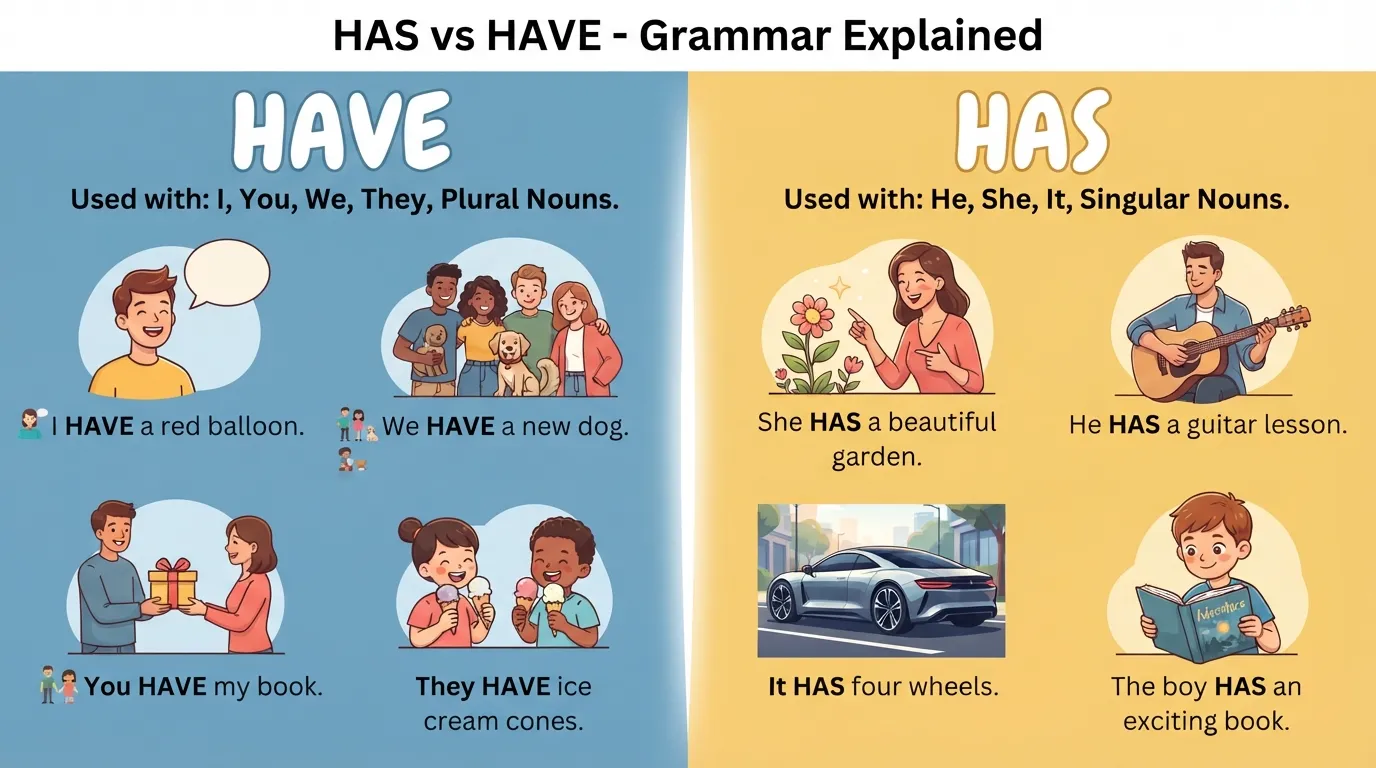
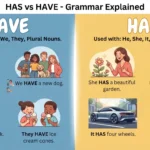
Has and have are forms of the verb “to have.” Use has with he, she, it, and singular third-person nouns.
Use have with I, you, we, they, and plural nouns. In questions and negatives with do/does, use the base form have, such as “Does she have a car?”
Key Takeaways
- Use has with he, she, it, and singular nouns.
- Use have with I, you, we, they, and plural nouns.
- You always takes have, whether it refers to one person or several.
- After do, does, or did, use have, not has.
- In the present perfect, use has/have + past participle.
What Is the Difference Between Has and Have?
Has and have are two forms of the same verb: to have. The basic difference is the subject of the sentence.
In the present tense, has is the third-person singular form. Have is used with first-person subjects, second-person subjects, and third-person plural subjects. Cambridge also identifies has as the present simple third-person singular form of have.
Compare these examples:
- She has a new phone.
- I have a new phone.
- They have a new phone.
- The phone has a large screen.
- The phones have large screens.
The meaning of have does not change simply because the form changes. The subject determines whether you need has or have.
When to Use Has
Use has with:
- He
- She
- It
- One person
- One thing
- Singular third-person nouns
Examples:
- He has a new job.
- Maria has a dog.
- The car has four doors.
- She has a question.
- The company has several offices.
When to Use Have
Use have with:
- I
- You
- We
- They
- Plural nouns
Examples:
- I have a question.
- You have a great idea.
- We have enough time.
- They have two children.
- The students have new books.
This subject-based pattern is the main rule behind has vs have.
Has vs Have: Quick Comparison
| Subject | Correct Form | Example |
| I | have | I have a car. |
| You | have | You have a choice. |
| He | has | He has a car. |
| She | has | She has a meeting. |
| It | has | It has four wheels. |
| We | have | We have a plan. |
| They | have | They have tickets. |
| Singular noun | has | The child has a toy. |
| Plural noun | have | The children have toys. |
One detail often surprises learners: I is singular, but it takes have, not has. You also takes have, whether you are speaking to one person or more than one person.
When to Use Has
Has With He, She, and It
In the present simple, use has with the third-person singular pronouns he, she, and it.
Examples:
- He has a blue jacket.
- She has a busy schedule.
- It has a broken handle.
The same rule applies when the subject is one named person:
- James has a new laptop.
- Sarah has three cats.
- My brother has a bicycle.
Has With Singular Nouns
A singular noun that refers to one person, animal, place, or thing normally takes has.
Examples:
- The teacher has a question.
- My friend has a new apartment.
- The dog has a long tail.
- The house has two bathrooms.
Be careful when a sentence contains several nouns. The verb agrees with the subject, not simply the noun closest to it.
For example:
The box of old books has a broken handle.
The subject is box, which is singular. Books is part of the phrase “of old books,” so it does not control the verb.
Has With Indefinite Pronouns
Some words may sound as if they refer to many people, but they are grammatically singular. Examples include everyone, someone, anyone, nobody, and everybody.
Therefore, use has:
- Everyone has a chance.
- Someone has left a message.
- Nobody has the answer.
- Everybody has a responsibility.
This is an important point because the meaning may involve many people, while the grammar treats the pronoun as singular.
When to Use Have
Have With I and You
Use have with both I and you.
Examples:
- I have a meeting today.
- I have two brothers.
- You have a good point.
- You have enough time.
Do not write:
- I has a question. ❌
- You has a car. ❌
Write:
- I have a question. ✅
- You have a car. ✅
Have With We and They
Use have with we and they.
Examples:
- We have a problem.
- We have enough food.
- They have a new house.
- They have several options.
Have With Plural Nouns
Plural subjects generally take have.
Examples:
- The students have homework.
- My parents have a new car.
- The dogs have plenty of food.
- These books have useful information.
Compare:
- The student has a book.
- The students have books.
The singular subject uses has, while the plural subject uses have.
Has vs Have in Questions and Negative Sentences
Questions and negatives can cause confusion because do and does change the structure.
Does + Have
After does, use have, not has.
Correct:
- Does she have a car?
- Does he have enough money?
- Does the school have a library?
Incorrect:
- Does she has a car? ❌
- Does he has enough money? ❌
Why? Does already carries the third-person singular marking. The main verb returns to its base form, have.
The same principle applies to negative sentences:
- She doesn’t have a car.
- He doesn’t have enough time.
- The store doesn’t have that size.
Not:
- She doesn’t has a car. ❌
Do + Have
Use do + have with subjects such as I, you, we, and they.
Examples:
- Do you have a pen?
- Do they have tickets?
- Do we have enough time?
- I don’t have any money.
Cambridge and the British Council both document the use of do/does + have in questions and negatives.
Has/Have as Helping Verbs
Has and have can also work as auxiliary, or helping, verbs. One major use is forming the present perfect.
Examples:
- She has finished her work.
- He has arrived.
- They have finished their work.
- I have seen that movie.
Here, has/have helps form the verb phrase rather than simply showing possession.
Has vs Have in the Present Perfect
The present perfect follows this basic structure:
Subject + has/have + past participle
Use has with third-person singular subjects:
- She has finished her homework.
- He has visited New York.
- The company has grown quickly.
Use have with I, you, we, they, and plural subjects:
- I have finished my homework.
- You have done a great job.
- We have visited New York.
- They have arrived.
- The students have completed the test.
Cambridge gives the present-perfect pattern as have/has + the -ed form or past participle, with have for I/you/we/they and has for he/she/it.
Common Mistakes With Has and Have
Here are some frequent errors:
| Incorrect | Correct | Why |
| She have a car. | She has a car. | “She” is singular. |
| They has a dog. | They have a dog. | “They” takes have. |
| I has a question. | I have a question. | “I” takes have. |
| Does he has a job? | Does he have a job? | Use base form after does. |
| She doesn’t has time. | She doesn’t have time. | “Doesn’t” already carries the tense/agreement. |
| Everyone have a choice. | Everyone has a choice. | “Everyone” is grammatically singular. |
The most useful habit is to identify the subject first. Then check whether another auxiliary, such as does, is already controlling the verb form.
Easy Trick to Remember Has vs Have
Use this simple pattern:
He → has
She → has
It → has
I → have
You → have
We → have
They → have
For nouns:
One person or thing → has
More than one → have
For questions and negatives with do/does:
do/does + have
For example:
- She has a car.
- Does she have a car?
- She doesn’t have a car.
Once you notice this pattern, most has vs have questions become much easier.
FAQs:
Is it “he has” or “he have”?
The correct form is “he has.” He is a third-person singular subject, so the present-tense form is has. For example, “He has a new phone” is correct. However, after does, use the base form: “Does he have a new phone?”
Is it “does he have” or “does he has”?
The correct form is “Does he have?” After does, the main verb uses its base form, so you need have, not has. For example: “Does he have a car?” and “Does she have enough time?” are correct.
Should I use “has” or “have” with everyone?
Use has with everyone because it is treated as a singular indefinite pronoun in standard English. For example, “Everyone has a seat” is correct. The fact that everyone refers to multiple people does not change its grammatical number.
Is “I have” correct?
Yes. I have is the correct form in standard English. Although I refers to one person, it takes have, not has. Examples include “I have a question,” “I have two brothers,” and “I have finished my work.”
What is the difference between has and have in the present perfect?
Both can act as helping verbs in the present perfect. Use has with he, she, it, and singular third-person subjects: “She has finished.” Use have with I, you, we, they, and plural subjects: “They have finished.”
Conclusion:
The main difference between has vs have is simple: the form depends on the subject and sentence structure.
Use has with he, she, it, and singular third-person nouns. Use have with I, you, we, they, and plural nouns. When do or does is used, the main verb stays in its base form, so we say “Does she have?”, not “Does she has?”
Once you learn to identify the subject before choosing the verb, has and have become much easier to use correctly.

I am Joseph Parker, a devoted Bible content writer dedicated to sharing God’s Word with clarity and purpose.
Through Biblicaltribez.com, I create inspirational and scripture-centered articles that strengthen faith.
My goal is to guide readers into a deeper understanding of biblical teachings and Christian living.