Skip to content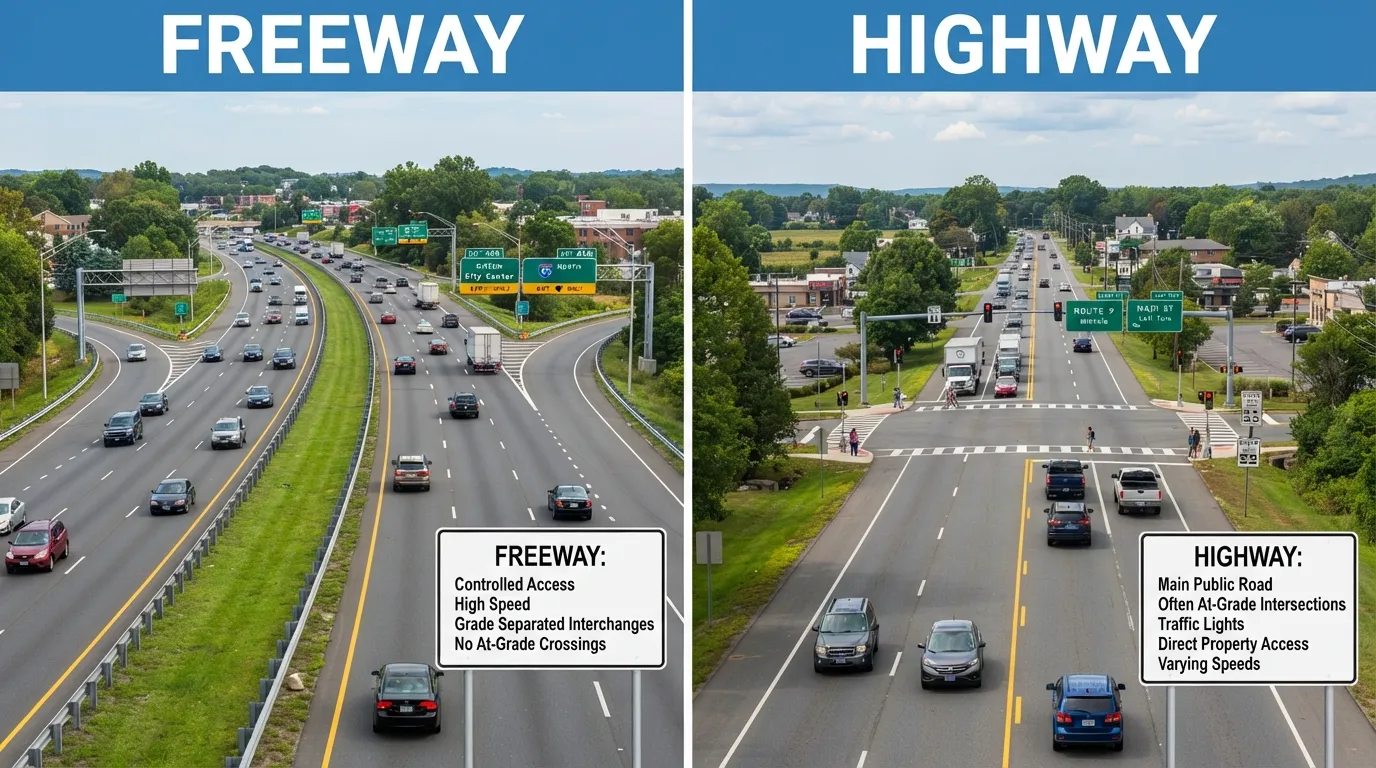
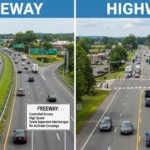
A highway is a broad term for a major road that carries traffic between places. A freeway is a specific type of highway with full control of access, meaning drivers normally enter and leave through ramps rather than traffic lights, driveways, or regular intersections.
In short, every freeway is a highway, but not every highway is a freeway.
Key Takeaways
- Highway is the broader term for a major roadway.
- A freeway is a highway with full access control.
- Freeways generally use entrance and exit ramps instead of regular intersections.
- A highway can have traffic lights, side roads, and direct driveway access.
- “Freeway” does not automatically mean a road has no toll.
- An Interstate is a route designation, not simply another word for freeway.
What Is a Highway?
A highway is a general term for a major road used to move people and vehicles over longer distances. In the United States, highways can connect cities, towns, suburbs, and rural areas.
The important point is that a highway does not have to follow one specific design.
For example, a highway may have one lane in each direction, multiple lanes, a median, traffic lights, or regular intersections. Some highways also allow direct access from nearby businesses, homes, or side streets.
This makes highway a much broader term than freeway.
A highway can be designed for relatively fast travel, but speed alone does not make it a freeway. The key difference is how access to the road is controlled.
Highway meaning in the U.S.
In everyday American English, people often use “highway” to describe an important road outside or inside a city.
You may hear phrases such as:
- “Take the highway north.”
- “The highway connects the two towns.”
- “There was an accident on the highway.”
- “The highway has two lanes in each direction.”
The exact design of that highway can vary considerably.
What Is a Freeway?
A freeway is a more specific type of highway. The Federal Highway Administration defines a freeway as a divided highway with full control of access and at least two lanes for through traffic in each direction.
In practical terms, this means a freeway is designed to keep through traffic moving without normal interruptions from intersections.
Drivers typically enter or leave through ramps. Cross streets usually pass over or under the freeway rather than meeting it at a standard traffic light.
Freeways are therefore built around uninterrupted movement. FHWA explains that full access control limits entry and exit to controlled locations, primarily ramps and grade-separated interchanges.
Full access control
Access control is one of the most important ideas when comparing a freeway with an ordinary highway.
On a typical freeway, you cannot simply turn into a business from the main roadway. You also cannot normally enter from a residential driveway or cross the road at a regular intersection.
Instead, you use designated entrance and exit points.
This design reduces conflicts between through traffic and vehicles entering or leaving the roadway.
Ramps and grade-separated intersections
Freeways commonly use grade-separated intersections.
That means one road passes above or below another road instead of both roads meeting at the same level.
For example, a freeway may pass over a local street while an entrance ramp connects drivers to the freeway.
This is one reason freeway travel can usually continue without stopping at conventional traffic signals.
Freeway vs Highway: Key Differences
The easiest way to understand freeway vs highway is to focus on access.
| Feature | Highway | Freeway |
| General meaning | Broad term for a major road | Specific type of highway |
| Access | May be open or controlled | Fully controlled |
| Traffic lights | May have them | Normally none on the mainline |
| Regular intersections | Possible | Generally replaced by interchanges |
| Direct driveways | May be allowed | Normally not allowed |
| Entrance/exit ramps | May or may not be used | Standard method of access |
| Directional separation | May or may not exist | Divided roadway |
| Through traffic | Varies | Designed for uninterrupted movement |
The most important distinction is access control, not simply the number of lanes or the speed limit. FHWA’s transportation definitions specifically distinguish freeways by their full control of access.
Access
A conventional highway may have several points where drivers can enter or leave.
A freeway limits those points.
You generally have to travel to an interchange and use a ramp to enter or exit. This creates a more controlled traffic environment.
Intersections and traffic lights
A highway may cross another road at a normal intersection.
You might see a stop sign or traffic signal.
A freeway normally avoids these types of intersections. Roads instead cross using bridges, underpasses, and interchanges.
Driveways and side-road access
A highway can sometimes have businesses, homes, gas stations, or other properties directly alongside it with access from the road.
A freeway generally does not provide this kind of direct access.
Instead, drivers leave the freeway at an interchange and use another road to reach nearby destinations.
Road design
Freeways are divided roads designed specifically for high-volume through traffic. FHWA describes freeways as divided facilities with multiple through lanes in each direction and full access control.
A highway does not necessarily have all of these features.
Traffic flow
Because freeways remove many common conflict points, their design is intended to support continuous movement.
That does not mean a freeway can never become congested.
A freeway can experience heavy traffic, crashes, construction, or other delays. FHWA specifically notes that “uninterrupted flow” describes the type of facility, not a promise that traffic will always move freely.
Is Every Freeway a Highway?
In the broad sense, yes: a freeway is a type of highway.
Think of it like this:
Highway → broad category
Freeway → specific type of highway
However, not every highway is a freeway.
A two-lane road connecting two towns can be called a highway even if it has traffic lights, intersections, or direct property access.
A freeway has stricter access-control characteristics.
This is why saying “freeway and highway mean exactly the same thing” can be misleading, even though Americans sometimes use the words interchangeably in everyday conversation.
Freeway vs Interstate
Freeway and Interstate describe different things.
A freeway is primarily a road design or functional type. An Interstate is a route belonging to the federally designated Interstate Highway System.
Most Interstate routes are built as controlled-access roads, and FHWA identifies Interstates as limited-access or controlled-access roadways.
But the terms should not be treated as perfect synonyms.
For example:
- Freeway describes characteristics of the roadway.
- Interstate identifies a route within a national highway system.
- Highway is a broader term that can describe many major roads.
So you can think of an Interstate as a named system of routes, while “freeway” describes how a road is designed and operated.
Freeway vs Expressway
An expressway is another related term that can cause confusion.
Federal transportation terminology distinguishes a freeway from an expressway based on access control. A freeway has full control of access, while an expressway generally has partial control of access.
That means an expressway can have some features similar to a freeway but may allow certain intersections or access points that a full freeway would not.
However, terminology can vary by state and in everyday speech. For example, California’s transportation glossary defines an expressway as a highway with partial access control and a freeway as a divided arterial highway with full access control and grade-separated intersections.
Are Freeways Always Free?
No.
This is one of the most common misunderstandings about the word freeway.
“Free” does not necessarily mean “free of charge.”
In transportation terminology, “freeway” refers to the free flow of traffic and controlled access, rather than guaranteeing that motorists pay no toll.
FHWA explicitly notes that a toll road can still meet the technical characteristics of a freeway.
So:
Freeway ≠ automatically toll-free
A toll road can still be a freeway if it has the appropriate controlled-access design.
How Americans Use “Freeway” and “Highway”
The terminology also depends on where you are in the United States.
In everyday conversation, people may use highway, freeway, expressway, interstate, or turnpike somewhat differently depending on their state or region.
For example, someone in California may commonly call a controlled-access road a “freeway,” while another person may use “highway” for the same type of road.
That does not necessarily mean the speakers disagree about the road.
It is often a matter of regional vocabulary.
The technical transportation definitions are more precise than everyday speech. For that reason, it helps to look at the road’s actual characteristics rather than its name alone.
Simple Examples
Imagine two roads connecting the same two cities.
Road A has:
- Two lanes in each direction
- Traffic lights
- Direct entrances to businesses
- Several intersections
- Some driveways
And, Road A can be a highway, but those features would generally prevent it from being a full freeway.
Road B has:
- Separate directions of travel
- Multiple lanes
- No normal traffic lights
- Entrance and exit ramps
- Bridges and underpasses at major crossings
- No direct driveway access
Road B fits the typical definition of a freeway.
The easiest question to ask is:
How do vehicles enter and leave the road?
If access is fully controlled through designated interchanges and ramps, you are likely dealing with a freeway.
FAQs:
Is a freeway the same as a highway?
Not exactly. A highway is the broader term, while a freeway is a specific type of highway with full access control. Freeways generally use ramps and grade-separated interchanges instead of regular intersections and direct driveway access.
Is an interstate a freeway?
Most Interstate routes are built as controlled-access facilities and function as freeways, but “Interstate” and “freeway” are not technically identical terms. Interstate identifies a route within the national Interstate Highway System, while freeway describes roadway characteristics.
Can a highway have traffic lights?
Yes. A highway can have traffic lights and conventional intersections. The term “highway” is broad and does not automatically mean that access is fully controlled.
Why is it called a freeway?
The term refers to a roadway designed to allow traffic to move with fewer conflicts caused by intersections and direct property access. The Federal Highway Administration traces the term’s development to urban planner Edward M. Bassett, who used “freeway” for a roadway with restricted access from adjoining properties.
What makes a road a freeway?
The defining feature is full control of access. A freeway is a divided roadway designed for through traffic, with access generally provided through ramps and grade-separated interchanges rather than ordinary intersections.
Conclusion:
The main difference in freeway vs highway is simple: highway is the broader term, while freeway is a specific type of highway with full access control.
A highway may have traffic lights, intersections, driveways, and direct access to nearby properties. A freeway is designed to limit those interruptions and normally uses ramps and interchanges instead.
It is also important not to confuse a freeway with an Interstate. An Interstate is part of a national route system, while freeway describes the roadway’s design and access characteristics.
Once you focus on access, intersections, ramps, and road design, the difference between a freeway and a highway becomes much easier to understand.

I am Caleb Anderson, a Christian writer passionate about exploring deep biblical meanings and spiritual truths.
On Biblicaltribez.com, I share faith based insights to help readers grow closer to God through Scripture.
My writing focuses on making the Bible easy to understand, meaningful, and relevant to everyday life.