Skip to content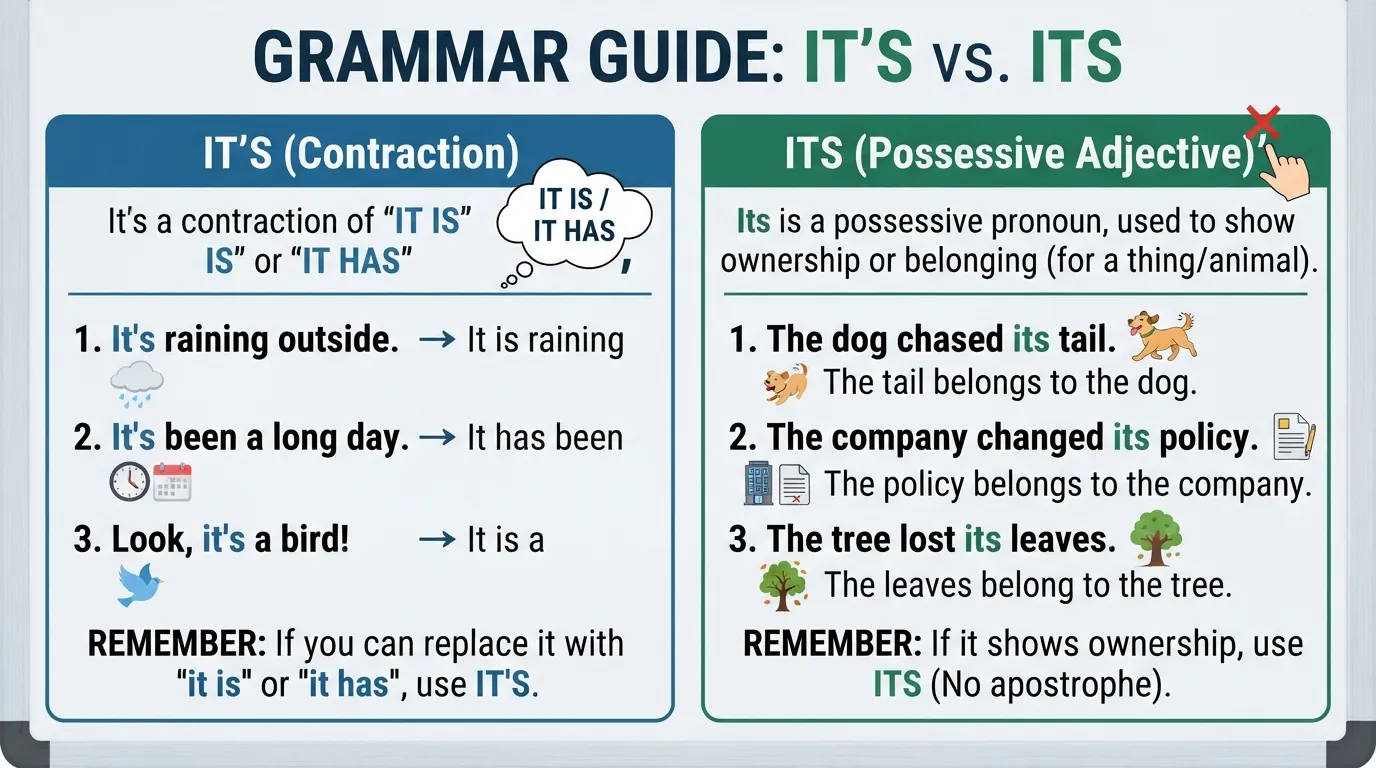
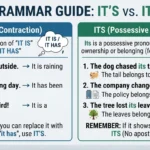
“Its” shows possession or a relationship to something, while “it’s” is a contraction of “it is” or “it has.”
Use its in phrases like “the dog wagged its tail.” Use it’s in sentences like “it’s cold” or “it’s been a long day.”
Key Takeaways
- Its means belonging to or associated with something.
- It’s means “it is” or “it has.”
- Its does not use an apostrophe.
- If you can replace it’s with “it is” or “it has,” it’s is correct.
- “Its’” is not the standard possessive form.
What Is the Difference Between Its and It’s?
The difference between its and it’s is simple once you understand what the apostrophe is doing.
Its is the possessive form of the pronoun it. It shows that something belongs to, comes from, or is associated with something already mentioned.
For example:
The dog wagged its tail.
The tail belongs to the dog, so its is correct.
It’s, on the other hand, is a contraction. It combines two words: it is or it has. Cambridge Dictionary gives the same distinction: “its” means “of it” or “belonging to it,” while “it’s” is short for “it is” or “it has.”
For example:
It’s raining outside.
This means:
It is raining outside.
The two forms usually sound the same when spoken, which is one reason writers often confuse them. The difference becomes clear in writing because the apostrophe changes the grammatical function.
What Does “Its” Mean?
Its shows possession or association.
It can refer to an animal, object, organization, place, idea, or other thing.
Examples:
- The cat cleaned its paws.
- The company changed its logo.
- The phone lost its signal.
- The tree dropped its leaves.
- The school updated its website.
In each sentence, its connects something to the thing mentioned before it.
What Does “It’s” Mean?
It’s has two possible meanings:
- It is
- It has
Examples of it is:
- It’s cold today.
- It’s a beautiful morning.
- It’s difficult to explain.
- It’s time to leave.
Examples of it has:
- It’s been a busy week.
- It’s already started.
- It’s changed a lot.
- It’s gotten much easier.
Purdue OWL also identifies it’s as a contraction for “it is” or “it has,” while its is the possessive form of “it.”
When to Use “Its”
Use its when you want to show possession or a connection between something and a noun.
Think of its as similar to:
- his
- her
- their
- our
For example:
The company announced its new product.
The product belongs to or is associated with the company.
You would not write:
The company announced it’s new product.
That would expand to:
The company announced it is new product.
That sentence does not make sense.
Possession or Association
Here are more examples:
| Correct sentence | Why? |
| The bird spread its wings. | The wings belong to the bird. |
| The car needs its tires replaced. | The tires belong to the car. |
| The restaurant changed its menu. | The menu belongs to the restaurant. |
| The phone lost its connection. | The connection is associated with the phone. |
| The computer restarted its system. | The system belongs to or is part of the computer. |
The important point is that its does not need an apostrophe to show possession. Possessive pronouns already indicate possession.
When to Use “It’s”
Use it’s when you mean “it is” or “it has.”
“It’s” = “It Is”
Try expanding it’s to it is.
For example:
It’s too late.
Becomes:
It is too late.
The sentence still makes sense, so it’s is correct.
More examples:
- It’s a good idea. → It is a good idea.
- It’s very cold. → It is very cold.
- It’s difficult to know. → It is difficult to know.
- It’s not my fault. → It is not my fault.
“It’s” = “It Has”
It’s can also mean “it has.”
For example:
It’s been a long day.
Expand it:
It has been a long day.
That works, so it’s is correct.
More examples:
- It’s been raining all morning.
- It’s already happened.
- It’s changed since last year.
- It’s become much easier.
Cambridge specifically lists both meanings for it’s, including examples where it means “it is” and “it has.”
Its vs It’s: Side-by-Side Comparison
| Feature | Its | It’s |
| Meaning | Belonging to or associated with it | It is or it has |
| Apostrophe | No | Yes |
| Function | Possessive form | Contraction |
| Example | The dog ate its food. | It’s very hungry. |
| Expansion | Cannot become “it is” or “it has” | Can become “it is” or “it has” |
A simple way to think about the difference is:
its = possession
it’s = it is / it has
That distinction is also reflected in standard grammar references from Cambridge and Purdue.
The Easy “It Is” or “It Has” Test
If you often confuse these words, use the replacement test.
Step 1: Try “It Is”
Look at the sentence:
It’s going to rain.
Replace it’s with it is:
It is going to rain.
The sentence works. Therefore, it’s is correct.
Now try:
The dog lifted it’s paw.
Replace it:
The dog lifted it is paw.
That does not work.
So the correct sentence is:
The dog lifted its paw.
Step 2: Try “It Has”
Sometimes it is does not work, but it has does.
Consider:
It’s been three hours.
Replace it:
It has been three hours.
That works, so it’s is correct.
This two-part test is useful because it’s does not only mean “it is.” It can also mean “it has.”
Common Its vs It’s Mistakes
Using “It’s” to Show Possession
This is one of the most common errors.
Incorrect:
The company changed it’s name.
Correct:
The company changed its name.
Why? The name belongs to or is associated with the company. You cannot replace its with “it is.”
Using “Its” Instead of “It’s”
The opposite mistake also happens.
Incorrect:
Its raining outside.
Correct:
It’s raining outside.
The sentence means:
It is raining outside.
So the apostrophe is necessary.
Writing “Its’”
Its’ is not the standard possessive form of “it.”
Incorrect:
The dog hurt its’ leg.
Correct:
The dog hurt its leg.
Purdue OWL specifically notes that possessive pronouns such as his, her, and its do not require apostrophes.
Its vs It’s Examples in Real Sentences
Here are some everyday examples:
Possession : its
The dog is chasing its ball.
Contraction : it’s = it is
It’s time for dinner.
Possession : its
The business improved its customer service.
Contraction : it’s = it is
It’s easy to use.
Possession : its
The phone lost its charge.
Contraction : it’s = it has
It’s been charging for an hour.
Possession : its
The museum is known for its large collection.
Contraction : it’s = it is
It’s one of the most popular museums in the city.
A useful pattern appears in these examples: its is normally connected to a noun, while it’s functions as part of a verb phrase when it means “it is” or “it has.”
Is “Its” Possessive?
Yes. Its is the possessive form of it.
For example:
The company increased its prices.
The prices are associated with the company.
The tricky part is that its does not follow the same apostrophe pattern as many possessive nouns.
Compare:
the dog’s toy
but:
the dog played with its toy
The apostrophe in dog’s marks possession for the noun dog. But its is already a possessive pronoun/determiner, so another apostrophe is not needed. Purdue explains that possessive pronouns do not use apostrophes.
FAQs:
Is it’s always a contraction?
Yes. In standard English, it’s is a contraction of either “it is” or “it has.” For example, “It’s cold” means “It is cold,” while “It’s been fun” means “It has been fun.”
Why does its not have an apostrophe?
Its is already a possessive form of the pronoun it. Possessive pronouns such as his, hers, ours, theirs, and its do not need apostrophes to show possession.
Can it’s mean it has?
Yes. It’s can mean “it has.” For example, “It’s been a long day” means “It has been a long day.”
Is “its’” ever correct?
In standard modern English, its’ is not the correct possessive form. Use its when showing possession.
What is the easiest way to remember its vs it’s?
Use the expansion test. If you can replace the word with “it is” or “it has,” choose it’s. If you are showing possession or association, choose its.
Conclusion:
The difference between it’s vs its comes down to one simple rule.
Use its when you mean belonging to it:
The cat cleaned its paws.
Use it’s when you mean it is or it has:
It’s getting late.
It’s been a long day.
When you are unsure, expand it’s to “it is” or “it has.” If the sentence works, keep the apostrophe. If it does not, its is probably the form you need.
Once you remember that the apostrophe in “it’s” signals a contraction, not possession, this commonly confused pair becomes much easier to use correctly.

I am Samuel Brooks, a Christian author who enjoys breaking down complex Bible concepts into simple truths. At Biblicaltribez.com, I write content that inspires faith, hope, and spiritual growth. I aim to help readers connect Scripture with real life challenges in a meaningful way.