Skip to content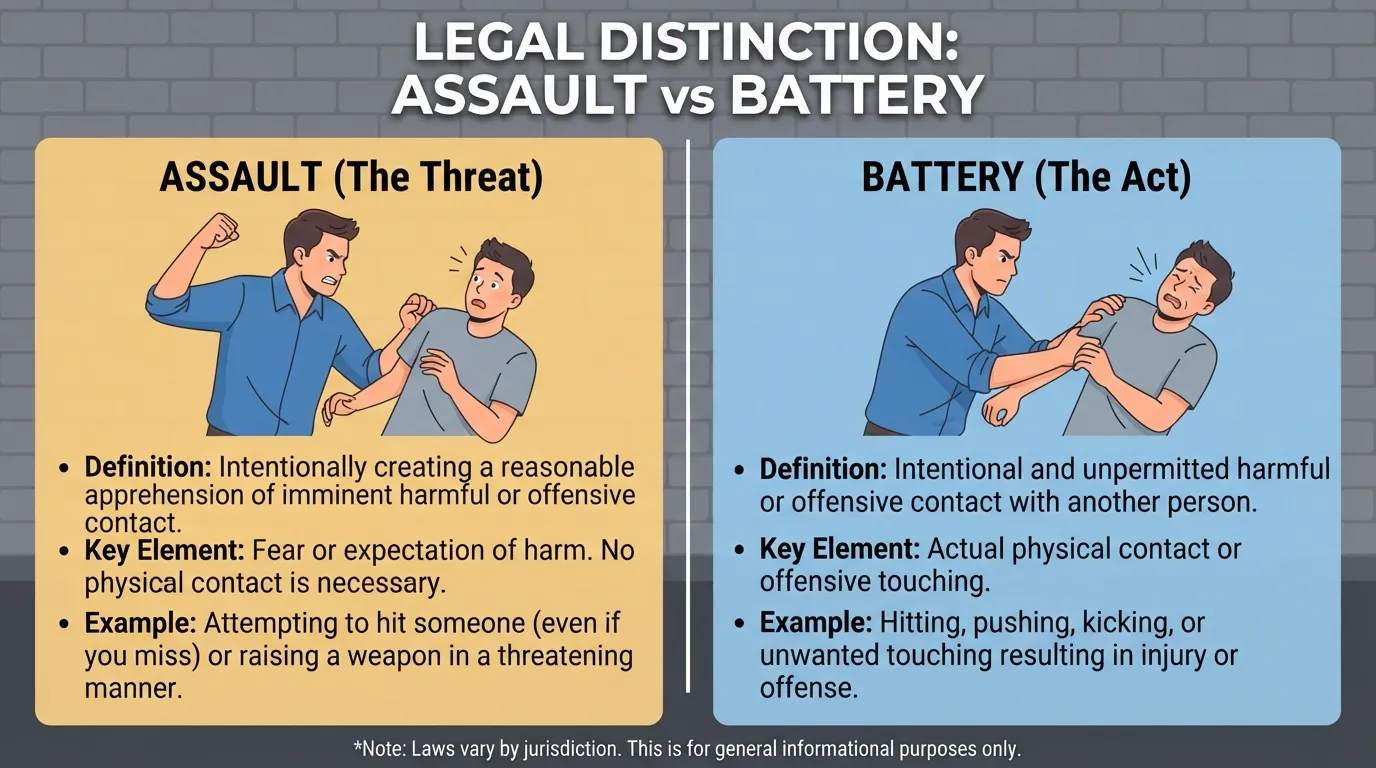
Battery vs assault traditionally comes down to what happened: assault generally involves an act that creates a reasonable fear or apprehension of imminent harmful contact, while battery generally involves actual harmful or offensive physical contact.
However, U.S. states define these offenses differently, and some states combine them under an assault statute.
Key Takeaways
- Assault traditionally involves a threat or act that creates reasonable apprehension of imminent harmful contact.
- Battery traditionally involves actual harmful or offensive physical contact.
- Battery does not necessarily require a visible physical injury.
- Assault can occur without physical contact under the traditional distinction.
- State criminal laws vary, so the exact definition depends on the jurisdiction.
What Is the Difference Between Battery and Assault?
The simplest way to understand battery vs assault is to look at the difference between threatened contact and actual contact.
Under traditional legal terminology, assault occurs when someone intentionally acts in a way that causes another person to reasonably anticipate imminent harmful or offensive contact. Battery occurs when the harmful or offensive contact actually happens.
For example, imagine one person raises a fist and moves toward another person as if preparing to punch them. If the circumstances create a reasonable apprehension of immediate harm, that may fit the traditional concept of assault.
If the person then punches the other person, the physical contact may constitute battery under a jurisdiction that recognizes battery as a separate offense.
The important point is that U.S. law is not completely uniform. Some states keep assault and battery as separate offenses, while others use the word “assault” for conduct that traditionally would have been described as battery.
What Is Assault?
Traditionally, assault is an intentional act that puts another person in reasonable apprehension of imminent harmful or offensive contact.
Physical contact is not necessarily required under this traditional definition. The focus is on the conduct and the resulting apprehension of immediate harm.
For example:
- A person raises a fist and moves toward someone as though about to strike.
- Someone points what appears to be a weapon at another person.
- A person makes a threatening movement while apparently having the ability to carry it out.
Whether conduct legally qualifies as assault depends on the applicable law and the facts of the situation.
A verbal statement alone does not automatically constitute assault under every legal system. The circumstances, intent, immediacy of the threat, and applicable statute can all matter.
What Is Battery?
Traditionally, battery refers to intentional harmful or offensive physical contact with another person without legal justification or consent.
Importantly, battery does not always require a serious physical injury. In jurisdictions that recognize battery as a separate offense, unwanted or offensive physical contact may be enough. Cornell’s Legal Information Institute notes that some criminal jurisdictions define battery as unlawful force resulting in bodily injury or offensive contact.
Examples may include:
- Punching another person.
- Slapping someone.
- Intentionally pushing someone.
- Making unwanted physical contact that is legally considered offensive.
- Intentionally causing bodily harm.
The exact elements vary by state.
For example, Florida’s 2026 statute defines battery to include intentionally touching or striking another person against that person’s will, or intentionally causing bodily harm.
Battery vs Assault: Key Differences
| Difference | Assault | Battery |
| Traditional focus | Threat or apprehension of imminent harmful contact | Actual harmful or offensive contact |
| Physical contact | Not necessarily required | Generally required under the traditional distinction |
| Injury | Not necessarily required | Not necessarily a visible injury |
| Example | Raising a fist as if about to strike | Actually punching someone |
| Legal terminology | Varies by state | Varies by state |
| Can occur together? | Yes | Yes |
This table describes the traditional distinction, not a universal rule for every U.S. state.
Physical Contact
Physical contact is one of the clearest traditional differences.
Assault can occur without contact when the conduct causes reasonable apprehension of imminent harmful or offensive contact.
Battery traditionally involves the contact itself.
However, a state’s criminal statute may use different terminology. Cornell’s Wex explains that many jurisdictions merge assault and battery into a single offense or use “assault” to cover conduct historically associated with battery.
Threat or Apprehension of Harm
Traditional assault focuses on whether the victim reasonably apprehends imminent harmful or offensive contact.
This does not mean that every angry statement is assault. The legal requirements depend on the jurisdiction and circumstances.
For example, Florida defines assault as an intentional and unlawful threat by word or act to commit violence, combined with an apparent ability to do so and conduct creating a well-founded fear that the violence is imminent.
Intent
Intent can also matter.
Traditional assault and battery concepts generally involve intentional conduct rather than an accidental physical event. But modern statutes may establish different mental-state requirements, including intentional, knowing, or reckless conduct.
That is why it is important to examine the specific statute involved rather than relying only on a general dictionary definition.
Injury
Battery does not necessarily mean that the victim suffered a major injury.
In some jurisdictions, intentionally making harmful or offensive physical contact can satisfy the physical-contact element even when there is no serious injury. Florida, for example, expressly includes intentional touching or striking against another person’s will in its battery statute.
More serious injuries or other aggravating circumstances can lead to more serious charges, depending on state law.
Can You Be Charged With Assault Without Touching Someone?
Yes, potentially.
Under the traditional distinction, assault can occur without physical contact. The essential issue is whether the person’s intentional conduct created a reasonable apprehension of imminent harmful or offensive contact.
For example, suppose someone aggressively raises a fist and moves toward another person but stops before making contact. In a jurisdiction following the traditional approach, those facts could support an assault allegation even though no punch occurred.
But the exact criminal offense depends on the state’s statute and the facts. Some jurisdictions use “assault” more broadly and may include physical contact within the offense.
Can Assault and Battery Happen Together?
Yes.
Under traditional terminology, one event can involve both concepts.
For example, suppose a person threatens to punch someone, causing that person to reasonably fear an immediate punch. The person then follows through and punches them.
The first conduct can fit the traditional concept of assault, while the completed physical contact can constitute battery.
This is one reason the phrase “assault and battery” became common. However, modern statutes do not always preserve this exact division. Cornell’s Legal Information Institute notes that jurisdictions may define assault, battery, or combined offenses differently.
How State Laws Treat Assault and Battery
There is no single criminal definition of assault and battery that applies identically throughout the United States.
Florida provides a useful example of a state that separately defines the two offenses. Under Florida’s current statutes, assault involves an intentional unlawful threat coupled with an apparent ability to carry it out and conduct creating a well-founded fear of imminent violence. Battery includes intentionally touching or striking another person against that person’s will or intentionally causing bodily harm.
Other jurisdictions use broader assault statutes. Cornell’s Wex notes that some states have merged the traditional concepts or use “assault” to refer to conduct that historically would have been called battery.
This difference is important if you are researching an actual criminal charge. The name of an offense, required elements, available defenses, and possible penalties can depend on the state.
Assault vs Battery in Civil Law
Assault and battery are not limited to criminal law.
They can also appear in civil tort law. In that setting, the purpose of a lawsuit is generally to seek a legal remedy, such as damages, rather than impose criminal punishment.
Traditional civil-law concepts also distinguish assault from battery. Assault involves apprehension of imminent harmful or offensive contact, while battery involves the actual harmful or offensive contact.
Civil and criminal cases can therefore use similar terminology while applying different legal standards and procedures.
Common Misunderstandings About Assault and Battery
Misunderstanding 1: Battery always means serious injury.
Not necessarily. In jurisdictions recognizing battery separately, unlawful or offensive contact can be enough even without a major visible injury.
Misunderstanding 2: Assault always requires touching someone.
Under the traditional distinction, it does not. Assault can involve conduct that creates reasonable apprehension of imminent harmful contact.
Misunderstanding 3: Assault and battery mean exactly the same thing in every state.
They do not. State statutes can define the terms differently or combine the traditional offenses.
Misunderstanding 4: Battery is always a more serious crime than assault.
There is no nationwide rule that allows this simple comparison. The classification and potential punishment depend on the applicable state law and circumstances.
FAQs:
Is battery worse than assault?
There is no universal answer because U.S. states classify and define these offenses differently. In the traditional distinction, battery involves actual physical contact while assault involves apprehension of imminent harmful contact. The seriousness of a specific criminal charge depends on the jurisdiction, facts, aggravating circumstances, prior convictions, and applicable statute.
Does battery always cause an injury?
No. Battery does not necessarily require a serious or visible injury. In jurisdictions that recognize battery as a separate offense, intentional harmful or offensive physical contact may be sufficient. For example, Florida’s battery statute includes intentional touching or striking against another person’s will.
Can words alone be assault?
Words alone do not automatically constitute assault under the traditional legal definition. The circumstances, intent, immediacy of the threatened harm, and applicable state law matter. Florida, for example, expressly refers to a threat “by word or act” but also requires an apparent ability to commit the violence and conduct creating a well-founded fear that the violence is imminent.
Can you have assault without battery?
Yes, under the traditional distinction. A person can allegedly commit assault by intentionally creating reasonable apprehension of imminent harmful or offensive contact without actually making physical contact. Modern state statutes may use the terms differently.
Are assault and battery the same everywhere in the U.S.?
No. State criminal laws differ. Some jurisdictions maintain separate assault and battery offenses, while others combine or redefine them. For that reason, the specific state statute is more important than relying on a general nationwide definition.
Conclusion:
The basic battery vs assault distinction is straightforward: traditional assault concerns conduct that creates reasonable apprehension of imminent harmful or offensive contact, while traditional battery concerns the actual harmful or offensive physical contact.
However, U.S. criminal law is state-specific. Some states maintain separate offenses, while others use broader assault statutes or combine concepts that were historically treated separately.
If you are researching an actual allegation or charge, check the law of the state involved and the specific statute cited in the case. General definitions are useful for understanding the terms, but they cannot replace the applicable jurisdiction’s law.

I am Joseph Parker, a devoted Bible content writer dedicated to sharing God’s Word with clarity and purpose.
Through Biblicaltribez.com, I create inspirational and scripture-centered articles that strengthen faith.
My goal is to guide readers into a deeper understanding of biblical teachings and Christian living.