Skip to content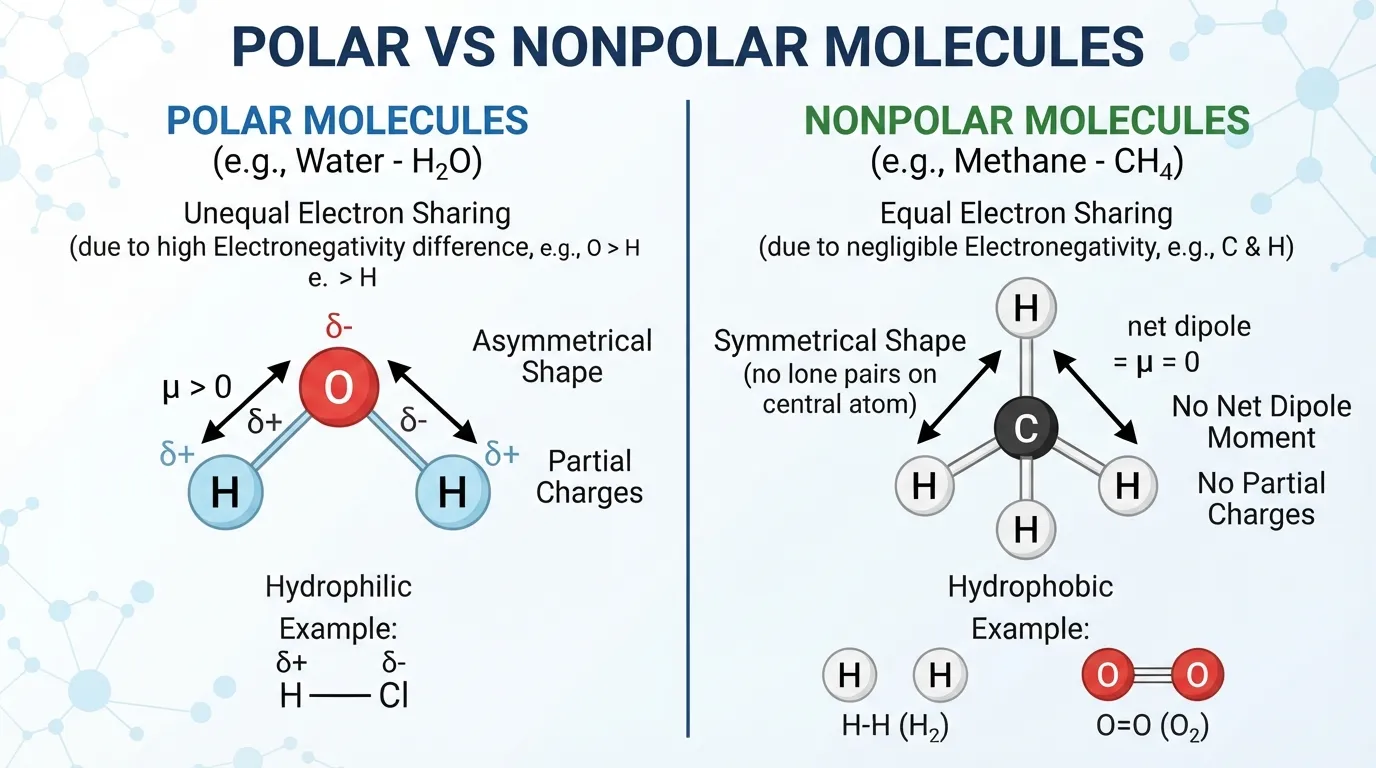
Polar vs nonpolar describes how electrical charge is distributed in a molecule. Polar molecules have an uneven charge distribution and a net dipole, while nonpolar molecules have no overall charge separation.
To determine polarity, look at the electronegativity of the bonds and the molecule’s three-dimensional shape. Symmetrical molecules can have polar bonds that cancel out.
Key Takeaways
- Polar molecules have an uneven distribution of electrical charge.
- Nonpolar molecules have no overall permanent charge separation.
- Electronegativity determines whether an individual bond is polar.
- Molecular geometry determines whether bond dipoles cancel.
- H₂O and NH₃ are common polar molecules, while CO₂ and CH₄ are common nonpolar molecules.
What Does Polar Mean in Chemistry?
A polar molecule has an uneven distribution of electrical charge. One part of the molecule is slightly more negative, while another part is slightly more positive.
This happens because atoms do not always attract shared electrons equally. The ability of an atom to attract bonding electrons is called electronegativity.
For example, oxygen attracts electrons more strongly than hydrogen. In a water molecule, the electrons in each O–H bond are pulled closer to oxygen. This gives oxygen a partial negative charge and the hydrogen atoms partial positive charges.
These partial charges are written as δ− and δ+.
However, having polar bonds does not automatically make an entire molecule polar. The shape of the molecule also matters.
Polar Bonds
A polar covalent bond forms when two atoms share electrons unequally because they have different electronegativities.
For example, the O–H bonds in water are polar. Oxygen attracts the shared electrons more strongly than hydrogen.
The greater the difference in electronegativity, the greater the tendency for the bond to have charge separation. OpenStax describes bond dipole moment as being related to the electronegativity difference between the bonded atoms.
Polar Molecules
A molecule is polar when its individual bond dipoles do not cancel each other.
Water is a classic example. H₂O has two polar O–H bonds, but its bent shape prevents those bond dipoles from canceling. The molecule therefore has a net dipole moment.
What Does Nonpolar Mean in Chemistry?
A nonpolar molecule has no overall permanent separation of electrical charge.
This can happen in two main ways.
First, the molecule may contain bonds between atoms with the same or very similar electronegativity. H₂ is a simple example because both hydrogen atoms attract the shared electrons equally.
Second, a molecule can contain polar bonds but still be nonpolar if its bond dipoles cancel because of its shape.
Carbon dioxide, or CO₂, demonstrates the second case. Its C=O bonds are polar, but the molecule is linear. The two bond dipoles point in opposite directions and cancel, giving CO₂ no net dipole moment.
This distinction between bond polarity and molecular polarity is one of the most important ideas to understand when comparing polar vs nonpolar substances.
Polar vs Nonpolar: Key Differences
| Feature | Polar | Nonpolar |
| Charge distribution | Uneven overall | Balanced overall |
| Net dipole | Present | Zero or effectively absent |
| Bond electrons | Often shared unequally | Often shared equally, or bond dipoles cancel |
| Molecular shape | Often asymmetrical | Often symmetrical, but not always |
| Partial charges | Usually present | No permanent overall separation |
| Example | H₂O | CO₂ |
| Water interaction | Often strong | Usually weaker |
The key difference is overall charge distribution, not simply whether the molecule contains a polar bond.
For example, CO₂ contains polar C=O bonds but is a nonpolar molecule because its linear structure causes the bond dipoles to cancel.
How to Tell If a Molecule Is Polar or Nonpolar
You can use a simple four-step process.
Step 1: Draw the Lewis Structure
Start by drawing the molecule’s Lewis structure. Show the central atom, surrounding atoms, bonds, and lone pairs.
The Lewis structure helps you understand how electrons are arranged around the central atom.
Step 2: Check Electronegativity
Next, compare the electronegativities of the bonded atoms.
If the atoms have different electronegativities, the bond may be polar. If the atoms have the same electronegativity, the bond is nonpolar.
For example, H–H is nonpolar because the two hydrogen atoms have the same electronegativity.
Step 3: Find the Molecular Shape
Now determine the molecule’s three-dimensional shape.
This is where VSEPR theory becomes important. VSEPR uses the arrangement of bonding pairs and lone pairs around a central atom to predict molecular geometry.
Common shapes include:
- Linear
- Trigonal planar
- Tetrahedral
- Bent
- Trigonal pyramidal
- Octahedral
Step 4: Check Whether the Dipoles Cancel
Finally, look at the direction of the bond dipoles.
If the dipoles cancel each other, the molecule is nonpolar.
If they do not cancel, the molecule is polar.
This is why molecular shape is so important. The overall molecular dipole is the vector sum of the individual bond dipoles.
Polar vs Nonpolar Examples
H₂O: Polar
Water is polar.
Each O–H bond is polar because oxygen attracts the shared electrons more strongly than hydrogen. The molecule also has a bent shape because of the lone pairs on oxygen.
The two bond dipoles therefore point in directions that do not cancel.
Result: H₂O is polar.
CO₂: Nonpolar
Carbon dioxide is nonpolar overall.
Each C=O bond is polar because oxygen is more electronegative than carbon. However, CO₂ has a linear structure.
The two bond dipoles point in opposite directions and cancel.
Result: CO₂ is nonpolar.
This is an especially useful example because it proves that polar bonds do not always create a polar molecule.
NH₃: Polar
Ammonia, NH₃, is polar.
Nitrogen is more electronegative than hydrogen, so the N–H bonds are polar. NH₃ also has a trigonal pyramidal molecular shape because nitrogen has a lone pair.
The bond dipoles do not cancel.
Result: NH₃ is polar.
CH₄: Nonpolar
Methane, CH₄, is generally treated as nonpolar.
Its four C–H bonds are arranged in a symmetrical tetrahedral structure. The individual bond dipoles cancel overall.
Result: CH₄ is nonpolar.
CCl₄ and BF₃: Nonpolar
CCl₄ and BF₃ provide two more useful examples.
CCl₄ has four C–Cl bonds arranged symmetrically around carbon in a tetrahedral structure. BF₃ has three B–F bonds arranged in a symmetrical trigonal planar structure.
Although these bonds have polarity, their symmetrical arrangements allow the dipoles to cancel.
Result: CCl₄ and BF₃ are nonpolar. OpenStax uses highly symmetrical molecules such as BF₃ and CH₄ to illustrate how identical bond dipoles can cancel.
Why Molecular Shape Matters
Molecular shape is often the step students overlook.
Imagine two molecules that both contain polar bonds. Their final polarity can still be different because their bonds point in different directions.
CO₂ is linear:
O = C = O
The two bond dipoles point in opposite directions, so they cancel.
Water is bent:
H–O–H
The bond dipoles point toward oxygen but are not directly opposite each other. They therefore produce a net dipole.
This is why you should not decide that a molecule is polar simply by looking for an electronegative atom.
You need to consider both bond polarity and molecular geometry.
Polar vs Nonpolar and Solubility
Polarity also helps explain why some substances mix well while others do not.
A common chemistry guideline is “like dissolves like.” Polar substances tend to interact well with polar solvents, while nonpolar substances tend to interact better with nonpolar solvents.
Water is polar, so many polar substances and ionic compounds interact strongly with it. Nonpolar substances such as many hydrocarbons generally have much weaker interactions with water.
However, this is a guideline rather than a rule that predicts every solubility result. Molecular size, intermolecular forces, hydrogen bonding, and other properties can also affect whether a substance dissolves.
Polar and nonpolar interactions are therefore important in chemistry, biology, pharmaceuticals, and everyday materials.
Common Mistakes About Polarity
Mistake 1: “Every molecule with polar bonds is polar.”
Not true. CO₂ has polar C=O bonds but is nonpolar overall because the dipoles cancel.
Mistake 2: “A symmetrical-looking Lewis structure is always enough.”
You need the three-dimensional molecular geometry, not just the flat drawing.
Mistake 3: “A molecule is nonpolar if all of its bonds are nonpolar.”
That is one way to get a nonpolar molecule, but it is not the only way. A molecule can have polar bonds and still be nonpolar.
Mistake 4: “Lone pairs do not matter.”
Lone pairs can change molecular geometry and therefore affect whether bond dipoles cancel.
Frequently Asked Questions
Is water polar or nonpolar?
Water, H₂O, is polar. Its O–H bonds are polar because oxygen attracts electrons more strongly than hydrogen. Its bent molecular shape prevents the two bond dipoles from canceling, leaving water with a net dipole moment.
Is CO₂ polar or nonpolar?
CO₂ is nonpolar overall. Its two C=O bonds are polar, but the molecule is linear. The bond dipoles point in opposite directions and cancel, producing a net dipole moment of zero.
Can a molecule have polar bonds but be nonpolar?
Yes. This is one of the most important ideas in molecular polarity. CO₂, BF₃, CH₄, and CCl₄ can have bonds with polarity, but their molecular geometries allow the bond dipoles to cancel overall.
Is CH₄ polar or nonpolar?
CH₄, or methane, is nonpolar. Its four C–H bonds are arranged symmetrically in a tetrahedral structure. The individual bond dipoles cancel, so the molecule has no overall permanent dipole.
How can I quickly identify a polar molecule?
First, identify whether the bonds are polar by comparing electronegativities. Then determine the molecule’s three-dimensional shape. Finally, check whether the bond dipoles cancel. If they do not cancel, the molecule is polar. If they cancel, it is nonpolar.
Conclusion
Understanding polar vs nonpolar molecules becomes easier when you look at two things: bond polarity and molecular shape.
Polar bonds form when atoms share electrons unequally, but that does not always make the whole molecule polar. The molecule’s shape determines whether its bond dipoles cancel or create a net dipole.
Water (H₂O) is polar because its bent shape prevents its O–H bond dipoles from canceling. Carbon dioxide (CO₂), however, is nonpolar because its linear shape causes the two bond dipoles to cancel.
When identifying a molecule, check its electronegativity differences, molecular geometry, and overall dipole. These simple steps can help you quickly determine whether a molecule is polar or nonpolar.

I am Caleb Anderson, a Christian writer passionate about exploring deep biblical meanings and spiritual truths.
On Biblicaltribez.com, I share faith based insights to help readers grow closer to God through Scripture.
My writing focuses on making the Bible easy to understand, meaningful, and relevant to everyday life.