Skip to content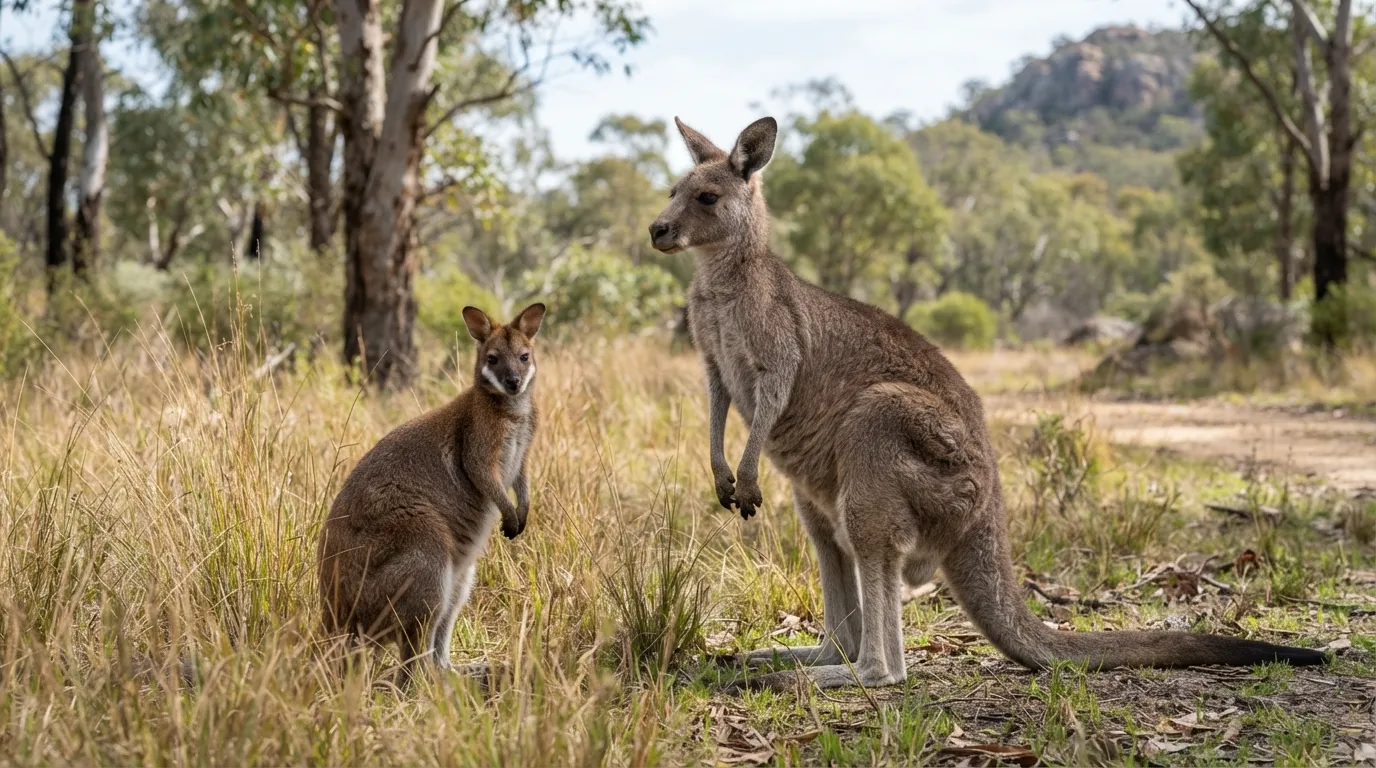
The main difference between a wallaby and a kangaroo is usually size and body build. Kangaroos are generally larger, with longer legs and feet suited to traveling across open ground.
Wallabies are usually smaller and more compact, with many species adapted to forests, scrub, or rocky areas. Both are Australian marsupials in the family Macropodidae.
Key Takeaways
- Kangaroos are generally much larger than wallabies.
- Wallaby and kangaroo are common names, not strict scientific categories.
- Kangaroos often have longer legs and feet for efficient movement across open areas.
- Wallabies are commonly smaller and more compact, with many species living in forests, scrub, or rocky habitats.
- Both are macropods and share traits such as powerful hind legs, long tails, hopping movement, and pouches.
What Is the Difference Between a Wallaby and a Kangaroo?
The easiest way to understand the wallaby vs kangaroo difference is to start with size.
Kangaroo is commonly used for the larger members of the kangaroo and wallaby family. Wallaby is generally used for smaller or medium-sized macropods. However, this is not a strict scientific dividing line. The two names can cover animals from different genera.
Both belong to the family Macropodidae. The name macropod means “large foot,” which fits these animals because their powerful hind feet help them hop.
So, a wallaby is not simply a baby kangaroo. A wallaby is a different animal, although the two are close relatives.
Why the Names Can Be Confusing
Common animal names do not always match neat scientific groups.
“Kangaroo” generally refers to the larger macropods, while “wallaby” is a broad common name used for many smaller macropods. Because of this, there is no single body weight or height that officially changes an animal from a wallaby into a kangaroo.
This is also why the term wallaroo exists. Wallaroos are commonly described as being intermediate in size between kangaroos and wallabies.
Wallaby vs Kangaroo: Quick Comparison
| Feature | Kangaroo | Wallaby |
| General size | Larger | Smaller to medium-sized |
| Body shape | Tall and long-legged | More compact |
| Hind legs | Long and powerful | Powerful but usually shorter |
| Feet | Large and elongated | Generally more compact |
| Common habitat | Grasslands, open woodland, arid areas | Forests, scrub, rocky areas, and other habitats |
| Diet | Mostly plant material, often grasses | Plant material, including leaves, grasses, and shrubs depending on species |
| Movement | Powerful hopping over open ground | Hopping and agile movement through varied terrain |
| Family | Macropodidae | Macropodidae |
| Young | Joeys | Joeys |
These are general differences. Individual species can vary considerably because “wallaby” covers many different animals.
1. Size and Body Shape
Size is usually the quickest way to tell a wallaby from a kangaroo.
Large kangaroos can become very tall and heavy. For example, the red kangaroo is the largest living marsupial, while eastern grey kangaroos can also reach substantial sizes.
Wallabies are generally much smaller. However, their size varies because the word wallaby applies to many species.
A black-striped wallaby, for example, is described by the Australian Museum as a medium-sized wallaby with a body length of about 82 centimeters.
Kangaroo Size
Large kangaroos have a tall, stretched appearance. Their long hind legs and large feet make their bodies look especially suited to covering open ground.
The red kangaroo can have a body length of up to about 1.4 meters in males, with a tail reaching about 1 meter.
Wallaby Size
Wallabies are generally shorter and more compact. Some species are small enough to look surprisingly different from the large kangaroos people commonly see in photographs.
That variation is important. There is no single “standard wallaby size.”
2. Legs, Feet, and Movement
Both animals are famous for hopping, but their body proportions can differ.
Kangaroos have very powerful hind legs and large hind feet. Their long limbs help them move efficiently across open landscapes. Their muscular tails also help with balance during movement.
Many wallabies have shorter, more compact legs. This body shape can help them move through dense vegetation or uneven terrain.
The difference is not simply about speed. It reflects the different environments and lifestyles of the many species called kangaroos or wallabies.
Both can hop because they share the basic macropod body plan. Their large hind limbs provide the main force for this movement.
3. Habitat
Habitat is another useful clue in a wallaby vs kangaroo comparison.
Large kangaroos are often associated with open grasslands, plains, woodland, and arid regions. The red kangaroo, for example, is strongly associated with Australia’s arid zone.
Wallabies occupy a wider range of smaller-scale habitats. Depending on the species, they can live in forests, dense vegetation, rocky areas, scrub, and other environments.
For example, red-necked wallabies occur in coastal forests of eastern and southeastern Australia, while some rock-wallabies are adapted to rocky environments.
This means you should not identify one only by habitat. Size, body shape, and species-specific features are also important.
4. Diet
Both kangaroos and wallabies are herbivores, but their exact diets vary by species.
Macropodids can be grazers or browsers. Grazers mainly feed on grasses and other ground vegetation, while browsers often eat leaves, shoots, and other plant material.
Many large kangaroos are strongly associated with grazing on grasses.
Wallabies can have more varied diets depending on their habitat. Some eat grasses, while others make greater use of leaves, shrubs, and other vegetation.
So, it is not accurate to say that every kangaroo eats only grass or every wallaby eats only leaves.
5. Appearance and Fur
A kangaroo often has a tall body, long hind legs, large feet, and a thick tail.
Wallabies generally have a smaller, more compact appearance. Their coats can also show a wider range of colors and markings depending on the species.
For example, the black-striped wallaby has a distinctive black stripe extending from its forehead down its back.
Because there are many wallaby species, coat color is not a reliable rule by itself.
When identifying an animal, look at its overall size, proportions, face, tail, feet, and habitat together.
6. Are Wallabies and Kangaroos Related?
Yes. Wallabies and kangaroos are closely related members of the family Macropodidae.
They are also marsupials. Female macropods have a pouch where their young, called joeys, continue developing after birth.
They share several important physical features:
- Powerful hind limbs
- Large hind feet
- Long tails
- Small forelimbs
- Hopping movement
- Herbivorous diets
- Pouches in females
- Joeys
The family also includes other familiar animals, including wallaroos and tree-kangaroos.
7. What Is a Wallaroo?
A wallaroo is another common name used for certain medium-sized macropods.
Think of the names as a rough size-based naming system:
Wallaby → Wallaroo → Kangaroo
But this should not be treated as a strict scientific scale.
A wallaroo is not simply a hybrid between a wallaby and kangaroo. It refers to particular macropods that are commonly associated with an intermediate size.
This is one reason the wallaby vs kangaroo question can be more complicated than simply asking which animal is smaller.
8. What Do Wallabies and Kangaroos Have in Common?
Despite their differences, wallabies and kangaroos have a lot in common.
Both are macropods with strong hind limbs designed for hopping. Their tails help with balance and movement, and their young are called joeys.
They are also native to Australia and related regions, although particular species have different geographic ranges. Macropodids occur in Australia, New Guinea, and nearby islands.
Their shared features explain why the two animals can look almost identical at first glance.
The biggest visual clue is usually scale. Once you look more closely, body proportions, habitat, markings, and species-specific traits become more useful.
Wallaby vs Kangaroo: Which One Is Easier to Identify?
For a quick identification, start with size.
A very large, tall animal with long legs and huge hind feet is likely to be a kangaroo. A much smaller, compact animal may be a wallaby.
But size alone is not enough for scientific identification because “wallaby” and “kangaroo” are common names rather than perfectly defined taxonomic groups.
If you need to identify a particular species, look at its geographic range, markings, body proportions, habitat, and other physical features.
FAQs:
Is a wallaby a small kangaroo?
Not exactly. Wallabies and kangaroos are related macropods, but “wallaby” is a common name used for many smaller macropod species. They do not all belong to the same genus as kangaroos. So, a wallaby is better understood as a smaller relative, not simply a young or miniature kangaroo.
Which is bigger, a wallaby or a kangaroo?
A kangaroo is generally bigger. Large kangaroo species can reach more than 1.5 meters in overall body length and can weigh many times more than smaller wallabies. Wallabies vary greatly in size, so there is no single size that applies to every wallaby species.
Do wallabies and kangaroos eat the same food?
They can eat some of the same plants, but diets vary by species. Many large kangaroos are important grazers, while some wallabies browse more heavily on leaves, shrubs, and other vegetation. Macropodids as a whole include both grazers and browsers.
Can wallabies jump like kangaroos?
Yes. Wallabies use powerful hind limbs for hopping, just like kangaroos. Their smaller and often more compact bodies can also help many species move through dense vegetation or uneven terrain. The exact style of movement varies among species.
Are wallabies and kangaroos in the same family?
Yes. Both belong to the family Macropodidae. This family includes kangaroos, wallabies, wallaroos, tree-kangaroos, and other related macropods.
Final Thoughts:
The wallaby vs kangaroo difference is mainly about size, body proportions, habitat, and common naming.
Kangaroos are generally the larger members of the group, with long legs and large feet that help them travel across open ground.
Wallabies are generally smaller and more compact, and many species live in forests, scrub, or rocky environments.
Both are fascinating Australian marsupials with powerful hind legs, muscular tails, and a shared macropod heritage.
The important point is that “wallaby” and “kangaroo” are common names, so nature does not draw a perfectly sharp line between the two.

I am Caleb Anderson, a Christian writer passionate about exploring deep biblical meanings and spiritual truths.
On Biblicaltribez.com, I share faith based insights to help readers grow closer to God through Scripture.
My writing focuses on making the Bible easy to understand, meaningful, and relevant to everyday life.