Skip to content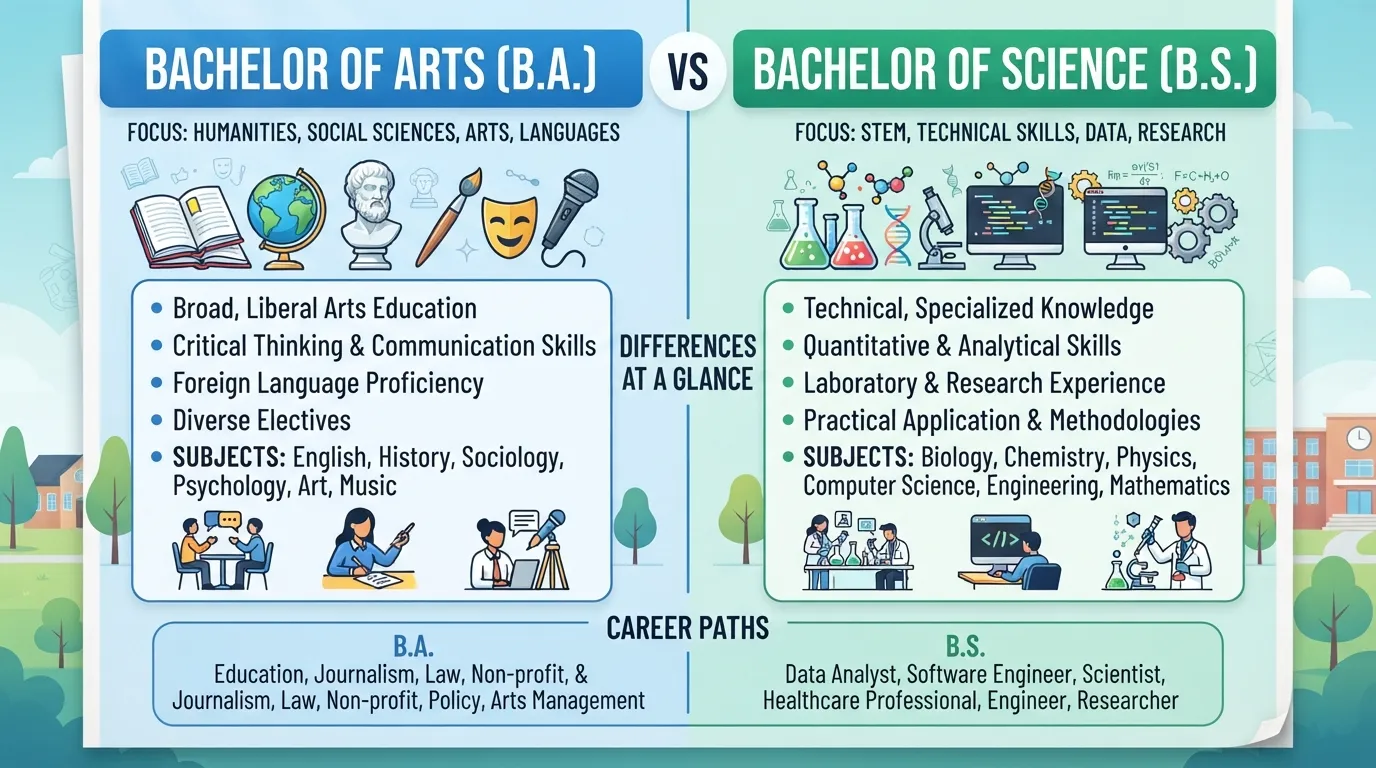
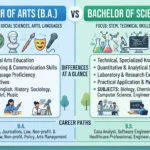
A BA (Bachelor of Arts) usually provides a broader education with more emphasis on liberal arts, humanities, social sciences, and electives.
A BS (Bachelor of Science) generally focuses more deeply on technical, scientific, mathematical, or quantitative coursework.
However, requirements vary by college and major, so the actual curriculum matters more than the degree title.
Key Takeaways
- BA stands for Bachelor of Arts, while BS stands for Bachelor of Science.
- BA programs often provide more flexibility and liberal arts coursework.
- BS programs generally include more technical, scientific, mathematical, or major-specific courses.
- Some subjects, such as psychology and business, may be available as either a BA or BS.
- Neither degree is automatically better; the right choice depends on your major, courses, and career or education goals.
What Is a BA Degree?
A BA, or Bachelor of Arts, is an undergraduate degree that usually gives students a broad education. BA programs often include courses in humanities, social sciences, communication, languages, and other liberal arts subjects.
The goal is not simply to study one narrow area. Students may have room to explore subjects outside their major through electives, minors, or additional areas of study.
For example, a BA in psychology may combine psychology courses with classes in sociology, writing, history, or other areas. The exact requirements depend on the university.
Many colleges use the BA format for subjects such as English, history, sociology, languages, communication, and some psychology or business programs. However, these examples are not universal.
What BA Coursework Looks Like
A BA may give you more freedom to choose courses outside your main field. Some programs also include language, humanities, or social science requirements.
This broader structure can be useful if you want to combine different interests. For example, a student could study economics while also taking courses in communication or political science.
Penn State notes that BA programs generally place greater emphasis on humanities, arts, and social sciences, while also providing broader educational requirements.
Common BA Majors
Examples of majors that are commonly offered as BA programs include:
- English
- History
- Sociology
- Communication
- Languages
- Political science
- Some psychology programs
- Some business programs
The important point is that a major’s degree type depends on the university.
What Is a BS Degree?
A BS, or Bachelor of Science, is an undergraduate degree that generally places greater emphasis on scientific, mathematical, technical, analytical, or quantitative study.
BS programs often require more courses directly related to the major. Depending on the field, students may complete mathematics, statistics, laboratory work, computer science, research, or other technical courses.
For example, a BS in biology may include substantial coursework in biology, chemistry, mathematics, laboratory methods, and related sciences.
What BS Coursework Looks Like
A BS usually has a more structured curriculum within the student’s field. There may be fewer free electives because more credits are reserved for major-specific or technical courses.
This does not mean every BS program is heavily focused on laboratory science. A BS in business, psychology, economics, or another subject can also emphasize statistics, quantitative analysis, technology, or specialized coursework.
Arizona State University explains that BA programs often provide greater elective flexibility, while BS programs may include additional mathematics, science, or statistics coursework.
Common BS Majors
BS degrees are commonly associated with fields such as:
- Biology
- Chemistry
- Physics
- Computer science
- Engineering
- Mathematics
- Data science
- Information technology
- Some psychology programs
- Some business programs
Again, these are common patterns rather than universal rules.
BA vs BS: What Is the Difference?
The biggest difference between a BA and BS is usually how the curriculum is structured.
A BA tends to provide more breadth and flexibility. A BS tends to provide more depth in technical, scientific, mathematical, or major-specific areas.
But there is no single national rule that defines every BA or BS program. Colleges create their own degree requirements.
For example, Oregon State University describes its BA requirements as providing broader preparation across humanities, arts, social sciences, and sciences, while its BS requirements emphasize scientific and quantitative approaches.
Coursework and Curriculum
BA students often take a wider mix of courses. BS students may spend more of their credit hours on courses directly connected to their major.
Imagine two students studying psychology.
The BA student might have more room for language, humanities, or other social science courses. The BS student might take additional statistics, research methods, biology, or quantitative courses.
The exact difference depends on the school.
Flexibility and Electives
A BA often gives students more elective space. This can make it easier to explore another subject, add a minor, or sometimes pursue a second major.
A BS may have fewer free electives because students need more major-specific courses.
However, this is not guaranteed. Some BS programs offer considerable flexibility, while some BA programs have strict requirements.
Math, Science, and Technical Requirements
A BS commonly includes more quantitative or technical coursework.
Depending on the major, this may include:
- Mathematics
- Statistics
- Laboratory science
- Programming
- Data analysis
- Research methods
- Technical applications
A BA can also include these subjects. The difference is usually the amount and role they play in the overall curriculum.
Specialization
BS programs often allow students to develop deeper technical knowledge in a particular field.
BA programs may provide a broader academic foundation that crosses multiple disciplines.
Neither approach is automatically better. They simply provide different academic structures.
BA vs BS Comparison Table
| Feature | BA | BS |
| Full name | Bachelor of Arts | Bachelor of Science |
| General focus | Broad and interdisciplinary | Technical and specialized |
| Common emphasis | Humanities, arts, social sciences | Science, math, technology, quantitative work |
| Electives | Often more flexibility | Often fewer free electives |
| Math requirements | Varies; often less intensive | Often more quantitative |
| Lab work | Depends on major | More common in science-based programs |
| Major coursework | Broad to moderate | Often more concentrated |
| Graduate study | Possible | Possible |
| Typical completion | Often about four years | Often about four years |
Many U.S. bachelor’s programs require around 120 credits and take about four years of full-time study, but individual programs can differ.
Can the Same Major Have a BA and BS?
Yes. A college may offer the same subject as both a BA and a BS.
Psychology is one common example. A BA in psychology might provide greater exposure to liberal arts and related social sciences. A BS in psychology might require more statistics, research, biology, or other scientific coursework.
Business, economics, anthropology, and other subjects can also have different BA and BS pathways.
That means you should not assume that the letters alone tell you exactly what you will study.
Instead, compare the degree plans.
Look at the required courses, elective space, math and science requirements, internships, research opportunities, and concentrations.
Colorado State University also emphasizes that the distinction can vary by program and that some BA degrees can be relatively technical.
Is a BA or BS Better?
There is no universal answer.
A BA may fit you better if you want broader coursework, more electives, or the ability to explore several academic areas.
A BS may fit you better if you want more concentrated study in technical, scientific, mathematical, or quantitative subjects.
Your career goal can also influence the decision. If a particular graduate program or career requires specific prerequisite courses, those requirements should take priority over whether the degree is labeled BA or BS.
Penn State notes that BA and BS degrees are generally perceived similarly, with the student’s goals and interests being important factors in choosing between them.
Is a BS Harder Than a BA?
Not necessarily.
A BS may contain more mathematics, statistics, laboratory work, or technical courses. A BA may require more writing, reading, language, humanities, or social science work.
The difficulty depends on the student, major, university, and individual courses.
Calling one degree universally “harder” would be misleading. Two programs can require similar amounts of time and effort while challenging students in different ways. Oregon State University, for example, describes its BA and BS options as having comparable demands of time and effort while using different academic requirements.
How to Choose Between a BA and BS
If your college offers both options, start by comparing the actual degree requirements.
Ask yourself:
- What courses do I enjoy?
Do you prefer writing, communication, and broad subjects, or do you enjoy math, science, data, and technical work? - How much flexibility do I want?
Check how many elective credits each program provides. - What career am I considering?
Identify the education and course requirements for your intended career. - Will I attend graduate school?
Check the prerequisites for the graduate programs you may want later. - What does the university require?
Compare the official degree plans instead of relying only on the BA or BS label.
ASU specifically recommends comparing the required courses and learning outcomes when both BA and BS options exist in the same subject.
Does a BA or BS Matter for Your Career?
It can matter in some situations, but the degree title is only one part of your education.
Employers and graduate programs may also consider your major, relevant coursework, experience, internships, research, skills, certifications, and other qualifications.
For example, a technical employer may care about your programming, statistics, engineering, or data skills. A communications-related employer may place more emphasis on writing, presentation, research, or interpersonal skills.
The best approach is to identify what your target career or graduate program actually requires and then select the degree program that helps you meet those requirements.
FAQs:
Is a BA or BS better for graduate school?
Neither is automatically better. Both can lead to graduate study. What matters is whether your bachelor’s program includes the prerequisites required by the graduate program you want to enter. Always check the specific admission requirements before choosing between a BA and BS.
Does a BA or BS take four years?
Many U.S. bachelor’s programs take about four years of full-time study. The exact timeline can vary based on credit requirements, course availability, transfer credits, part-time enrollment, and the student’s academic progress.
Can you change from a BA to a BS?
In some universities, students can change between BA and BS pathways if both are offered for the same major. However, the process and graduation impact depend on the school. Before changing, compare the additional courses and credits you would need.
Which degree has more career options?
Neither degree automatically provides more career options. Career opportunities depend heavily on the major, skills, experience, industry, and employer requirements. A BA may provide broader academic preparation, while a BS may provide deeper technical preparation.
Conclusion:
The main difference in BA vs BS is usually the structure of the curriculum. A BA generally offers broader study and more liberal arts flexibility, while a BS generally provides deeper technical, scientific, mathematical, or quantitative coursework.
However, the distinction is not identical at every U.S. college.
If you are choosing between the two, do not focus only on the letters after your name. Compare the actual courses, credit requirements, electives, major requirements, and prerequisites for your future career or graduate program.
The right degree format is the one whose curriculum matches what you want to learn and where you want your education to take you.

I am Samuel Brooks, a Christian author who enjoys breaking down complex Bible concepts into simple truths. At Biblicaltribez.com, I write content that inspires faith, hope, and spiritual growth. I aim to help readers connect Scripture with real life challenges in a meaningful way.