Skip to content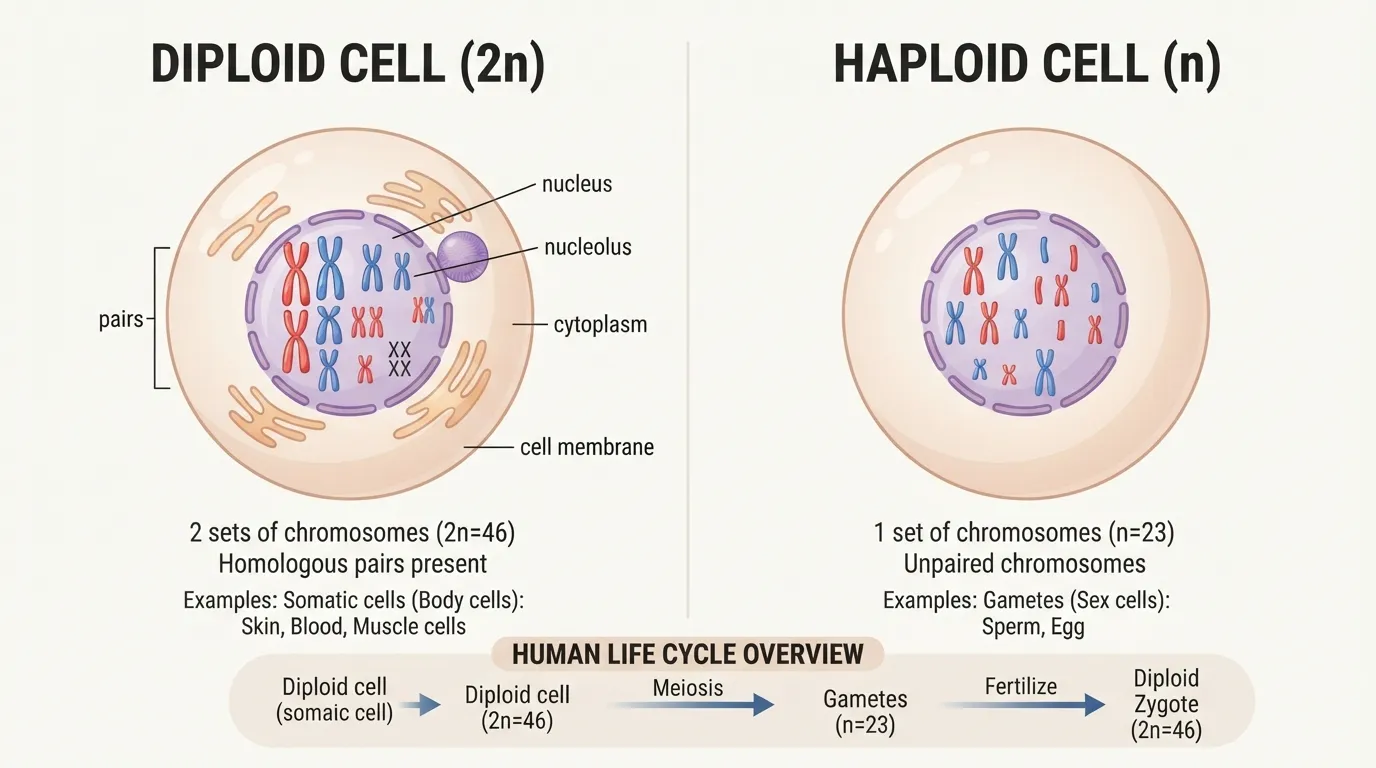
Diploid cells have two complete sets of chromosomes, while haploid cells have one complete set. In humans, most body cells are diploid with 46 chromosomes, arranged in 23 pairs.
Sperm and egg cells are haploid with 23 chromosomes. Meiosis produces haploid cells, while fertilization combines two haploid gametes to form a diploid zygote.
Key Takeaways
- Diploid = two sets of chromosomes (2n).
- Haploid = one set of chromosomes (n).
- Most human body cells are diploid and contain 46 chromosomes.
- Human sperm and egg cells are haploid and contain 23 chromosomes.
- Meiosis makes haploid gametes, while fertilization restores the diploid chromosome number.
What Does Diploid Mean?
Diploid describes a cell that contains two complete sets of chromosomes. These two sets usually come from the two biological parents. In humans, a typical diploid cell contains 46 chromosomes, organized into 23 pairs.
Each chromosome pair contains corresponding chromosomes called homologous chromosomes. One chromosome in a pair came from the mother and the other came from the father.
Most cells in the human body are diploid. These include many cells found in tissues such as the skin, muscles, and organs. These ordinary body cells are called somatic cells.
The diploid number is written as 2n. For humans:
2n = 46
This means that humans normally have two sets of 23 chromosomes in their diploid cells.
Diploid Cells in Humans
A simple way to picture a diploid human cell is to imagine 23 chromosome pairs:
- 23 chromosomes come from the mother.
- 23 chromosomes come from the father.
- Together, they make 46 chromosomes.
The two copies are not necessarily identical because they can carry different versions of genes. However, they are corresponding chromosomes and contain the same general groups of genes.
What Does Haploid Mean?
Haploid describes a cell that contains one complete set of chromosomes.
In humans, a haploid cell has 23 chromosomes, rather than the 46 found in most diploid body cells. The haploid number is represented by n. Therefore:
n = 23 in humans
Human sperm and egg cells are haploid. These cells are also called gametes, or sex cells. Each gamete carries one chromosome from each chromosome pair.
Having one set is important because sperm and egg cells later join during fertilization. If each gamete carried 46 chromosomes, the chromosome number would double with every generation.
Haploid Cells in Humans
The two main human haploid cells are:
- Sperm cells
- Egg cells
Each contains 23 chromosomes.
When a sperm cell and an egg cell combine, their chromosome sets join. The resulting cell has 46 chromosomes.
Diploid vs Haploid: Key Differences
The main difference between diploid and haploid cells is the number of chromosome sets.
| Feature | Diploid | Haploid |
| Chromosome sets | Two | One |
| Symbol | 2n | n |
| Human chromosome number | 46 | 23 |
| Common human cells | Most body cells | Sperm and egg cells |
| Chromosomes | Usually in homologous pairs | One chromosome from each pair |
| Main role | Growth, repair, and normal body functions | Sexual reproduction |
| Produced by meiosis? | No, meiosis starts with a diploid cell | Yes |
| Example | Skin cell | Sperm cell |
In simple terms, diploid means two sets, while haploid means one set. The exact chromosome numbers depend on the species. Humans have 46 chromosomes in typical diploid cells and 23 in haploid gametes.
Why Are Human Cells 46 or 23 Chromosomes?
Humans generally have 23 different chromosome types, but most body cells contain two copies of each type. That gives a total of 46 chromosomes.
One set is inherited from the mother and the other from the father.
Sperm and egg cells contain only one set. Each has 23 chromosomes.
During fertilization, the sperm contributes 23 chromosomes and the egg contributes 23 chromosomes:
23 + 23 = 46
The newly formed fertilized egg, called a zygote, is therefore diploid. It can then divide and develop into an organism with diploid body cells.
This pattern helps maintain the chromosome number from one generation to the next.
How Meiosis Changes Diploid Cells Into Haploid Cells
Meiosis is a special type of cell division that produces haploid reproductive cells.
The starting cell is diploid. It has two sets of chromosomes. Through meiosis, the chromosome sets are separated so that the resulting gametes receive one set.
In humans, meiosis ultimately produces cells with 23 chromosomes.
This reduction is important for sexual reproduction. Without it, the chromosome number would keep increasing after every fertilization.
Meiosis also contributes to genetic variation. Processes such as crossing over and independent assortment create different combinations of genetic material in gametes.
A simplified sequence looks like this:
Diploid cell (46) → meiosis → haploid gametes (23)
The process is more complex than this simple arrow suggests, but it captures the main chromosome-number change.
How Fertilization Changes Haploid Cells Into a Diploid Cell
Fertilization reverses the chromosome-number change created by meiosis.
A human sperm cell contains 23 chromosomes. A human egg cell also contains 23 chromosomes. When they fuse, the two haploid sets combine.
23 + 23 = 46
The resulting zygote is diploid.
The zygote then undergoes repeated cell divisions as development continues. Its descendants generally retain the diploid chromosome number in their nuclei.
So, sexual reproduction can be viewed as a cycle:
Diploid → meiosis → haploid → fertilization → diploid
This cycle allows organisms to reproduce sexually while maintaining a stable chromosome number across generations.
Diploid vs Haploid: n vs. 2n
You may see n and 2n when studying genetics or cell biology.
n represents one complete set of chromosomes. This is the haploid number.
2n represents two complete sets. This is the diploid number.
For humans:
- n = 23
- 2n = 46
The letters do not always represent the same numerical value in every species. For example, another species may have a haploid number of 10 and a diploid number of 20.
So it is better to remember the concept rather than memorize the human numbers alone:
n = one chromosome set
2n = two chromosome sets
Common Examples of Diploid and Haploid Cells
In humans, most ordinary body cells are diploid.
Examples include many:
- Skin cells
- Muscle cells
- Liver cells
- Nerve cells
- Other somatic cells
Human reproductive cells are haploid:
- Sperm cells
- Egg cells
There are important biological exceptions across different organisms. Some organisms have life cycles in which haploid cells make up a large part of the organism, and some organisms have more than two chromosome sets. Therefore, “diploid = every body cell” is not a universal rule for all life.
Common Misunderstandings About Diploid and Haploid
Does DNA Replication Double the Chromosome Number?
No. This is an important distinction.
Before cell division, a cell may copy its DNA. Each chromosome then consists of two sister chromatids joined together. This does not automatically change a diploid cell from 46 chromosomes to 92 chromosomes.
Chromosome counting is based on the centromeres, not simply on how many DNA copies are present.
So a human cell can still be considered diploid after DNA replication even though the amount of DNA has doubled.
Are All Cells in Humans Diploid?
No.
Most human body cells are diploid, but mature sperm and egg cells are haploid. Some specialized cells can also have unusual chromosome arrangements or numbers.
For basic biology, however, the key distinction is:
Most somatic cells = diploid
Sperm and egg cells = haploid
FAQs:
Is 23 haploid or diploid?
In humans, 23 is the haploid chromosome number. A human sperm or egg cell normally contains 23 chromosomes, representing one complete chromosome set. Most human body cells are diploid and contain 46 chromosomes, or two sets of 23.
Is 46 haploid or diploid?
In humans, 46 is the diploid chromosome number for a typical somatic cell. These chromosomes are organized into 23 pairs, with one chromosome in each pair inherited from each biological parent.
Are sperm and egg cells haploid?
Yes. Human sperm and egg cells are haploid. Each normally contains 23 chromosomes. When a sperm and egg combine during fertilization, their chromosome sets form a diploid zygote containing 46 chromosomes.
Why are gametes haploid?
Gametes are haploid so that fertilization can combine one chromosome set from each parent without continually doubling the chromosome number. In humans, each gamete contributes 23 chromosomes, producing a zygote with 46 chromosomes after fertilization.
Does meiosis produce haploid cells?
Yes. Meiosis reduces the chromosome number and produces haploid cells. In humans, a diploid starting cell undergoes meiosis to produce cells with one chromosome set. Meiosis also helps create genetic variation through chromosome assortment and recombination.
Conclusion:
The difference between diploid vs haploid comes down to chromosome sets.
A diploid cell has two complete sets of chromosomes, represented as 2n. A haploid cell has one complete set, represented as n. In humans, that means 46 chromosomes in a typical diploid body cell and 23 chromosomes in a haploid sperm or egg cell.
Meiosis changes diploid cells into haploid reproductive cells, while fertilization combines two haploid cells and restores the diploid state. Understanding this simple cycle makes concepts such as chromosomes, gametes, meiosis, and sexual reproduction much easier to understand.

I am Samuel Brooks, a Christian author who enjoys breaking down complex Bible concepts into simple truths. At Biblicaltribez.com, I write content that inspires faith, hope, and spiritual growth. I aim to help readers connect Scripture with real life challenges in a meaningful way.