Skip to content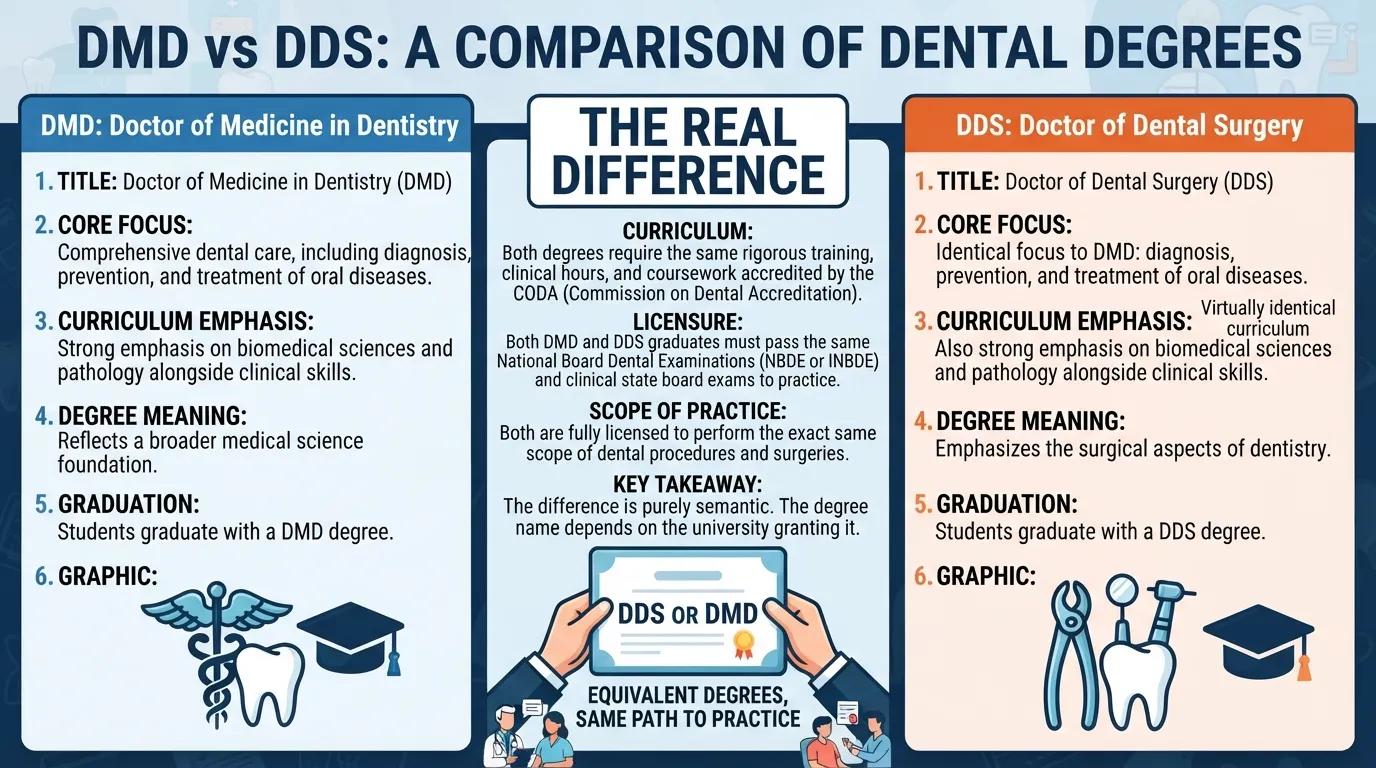
DMD and DDS are equivalent dental degrees in the United States. DMD means Doctor of Dental Medicine, while DDS means Doctor of Dental Surgery.
Both degrees require dental education and clinical training at an accredited dental school, and both qualify graduates for the same general dentistry profession after meeting state licensing requirements.
Key Takeaways
- DMD means Doctor of Dental Medicine.
- DDS means Doctor of Dental Surgery.
- The two degrees are professionally equivalent in the United States.
- Dental schools decide whether to award a DMD or DDS.
- Neither degree is inherently better, more advanced, or more surgical than the other.
- A dentist’s specialty depends on additional training, not whether the dentist has a DMD or DDS.
What Does DMD Mean?
DMD stands for Doctor of Dental Medicine. It may also be described as Doctor of Medicine in Dentistry, depending on the institution and wording used.
A DMD is a professional dental degree earned after completing dental school. It prepares graduates to diagnose, prevent, and treat oral health conditions and provide general dental care.
The name can sometimes make people think a DMD is more closely connected to medicine than a DDS. In practice, that is not the case. The American Dental Association states that DMD and DDS graduates receive the same type of dental education and use the same curriculum requirements.
So, if you visit a dentist whose name ends in DMD, the letters do not mean that the dentist has a different or higher level of dental qualification than a dentist with DDS.
What Does DDS Mean?
DDS stands for Doctor of Dental Surgery.
It is another professional degree awarded to dentists after they complete dental school. Despite the word “surgery,” a DDS is not a degree that is specifically limited to surgical dentistry.
A DDS dentist can practice general dentistry after meeting the applicable licensing requirements. General dental care can include examinations, fillings, crowns, extractions, preventive care, and other procedures within the dentist’s scope of practice.
The word “surgery” in the degree title does not mean that DDS dentists receive a separate surgical qualification from DMD dentists.
DMD vs DDS: What Is the Difference?
The main difference between DMD vs DDS is the name of the degree.
| Feature | DMD | DDS |
| Full name | Doctor of Dental Medicine | Doctor of Dental Surgery |
| Degree type | Professional dental degree | Professional dental degree |
| Dental education | Equivalent | Equivalent |
| Curriculum requirements | Same standards | Same standards |
| General dentistry | Yes | Yes |
| U.S. state licensure | Accepted as applicable | Accepted as applicable |
| Specialty potential | Requires additional training | Requires additional training |
The ADA explains that universities determine which degree title they award. Both degrees follow the curriculum requirements established for accredited dental education programs.
This means the letters after a dentist’s name do not, by themselves, tell you which dentist received better training.
Are the Education and Training the Same?
Yes. DMD and DDS students receive professional dental education covering areas such as biomedical sciences, oral health, diagnosis, treatment planning, and clinical care.
Generally, students complete about four years of dental school after their undergraduate preparation. The exact educational path and admission requirements can vary by school.
The Commission on Dental Accreditation, or CODA, accredits dental education programs in the United States. The ADA describes CODA as the national programmatic accrediting agency for dental and dental-related education programs.
Therefore, the important distinction is not whether the diploma says DMD or DDS. The quality and accreditation of the dental program, along with the dentist’s individual training and experience, provide more useful information.
Why Are There Two Different Dental Degrees?
The two names come from the history of dental education.
The DDS title has historical roots in the development of dental surgery education in the United States. The first DDS degree was established by the Baltimore College of Dental Surgery in 1840.
Harvard later used the Latin-based title Dentariae Medicinae Doctor, which became DMD. Harvard’s dental school was established in 1867.
Over time, different dental schools continued using different degree titles.
That is why you can see DMD after one dentist’s name and DDS after another’s name even though both completed comparable professional dental education.
Do DMD and DDS Dentists Have the Same License?
Both DMD and DDS graduates can pursue dental licensure in the United States.
Licensing requirements are established by individual states and territories. The ADA explains that nearly all states require a DMD or DDS from a university-based dental education program accredited by CODA, along with examination requirements.
All U.S. licensing jurisdictions require applicants to pass the Integrated National Board Dental Examination (INBDE) as part of the national written assessment process, although the complete licensing pathway can vary by jurisdiction.
So, a DMD is not a different type of dental license from a DDS.
The exact license a dentist holds depends on the state and the dentist’s completion of that state’s requirements.
Can Both DMD and DDS Dentists Perform the Same Procedures?
Generally, yes, when they are licensed and the procedure falls within their scope of practice.
A DMD or DDS dentist may provide general dental services such as:
- Dental examinations
- Preventive care
- Fillings
- Crowns
- Extractions
- Treatment planning
- Diagnosis of oral conditions
- Other procedures permitted by state law
The degree title itself does not determine whether one dentist can perform a procedure that another cannot.
However, individual dentists may have different experience, training, interests, and practice areas. State laws also define the scope of dental practice.
Does DMD or DDS Affect Dental Specialization?
No. A dentist does not become an orthodontist, periodontist, or oral and maxillofacial surgeon simply because they have a DMD or DDS.
Dental specialists complete additional postgraduate education after dental school.
For example, orthodontic programs provide advanced education in areas such as malocclusion, diagnosis, treatment planning, and correction of dental and facial abnormalities. Oral and maxillofacial surgery also requires substantial additional training beyond the initial dental degree.
In other words, the important distinction is DMD or DDS versus additional specialty training, not DMD versus DDS.
A dentist’s professional qualifications should therefore be considered as a whole.
DMD vs DDS: Which One Is Better?
There is no inherent professional advantage to choosing the DMD title over the DDS title, or vice versa.
The ADA and ADEA both describe the degrees as equivalent. Universities decide which title they award, while accredited programs follow applicable dental education standards.
For someone choosing a dental school, factors such as accreditation, curriculum, location, tuition, clinical opportunities, admissions requirements, and personal career goals may be more relevant.
For a patient choosing a dentist, the degree letters alone usually provide little information about which dentist is the right fit.
What Should You Look for When Choosing a Dentist?
If you are a patient, focus on information that is more useful than the DMD or DDS abbreviation.
Consider:
- State licensure: Confirm that the dentist is properly licensed where they practice.
- Relevant experience: Look at experience with the type of treatment you need.
- Specialty training: If you need specialized care, check whether the dentist has appropriate specialty training.
- Accredited education: Consider the dentist’s educational background and professional credentials.
- Communication: Choose a dentist who explains treatment options clearly.
- Practice needs: Consider location, services, appointment availability, and whether the practice accepts your insurance or payment method.
A dentist with DMD after their name is not automatically different from a dentist with DDS after their name. The degree title is only one small part of a dentist’s professional background.
FAQs:
Is a DMD better than a DDS?
No. In the United States, DMD and DDS are equivalent professional dental degrees. The university determines which title it awards. Both degrees follow the applicable dental education requirements and can lead to general dental practice after licensure.
Is DDS more focused on surgery?
No. The word “surgery” in Doctor of Dental Surgery does not mean that DDS programs are surgical programs while DMD programs are medical programs. The two degrees represent equivalent dental education.
Can a DMD dentist perform surgery?
A licensed DMD dentist can perform procedures within their legal scope of practice and training. More advanced surgical procedures may require additional education or referral to a dental specialist, depending on the procedure and applicable state rules.
Do DMD and DDS dentists earn different salaries?
The degree title itself does not establish a different salary category. Dentist income can vary based on factors such as practice type, location, experience, specialty, hours worked, and ownership status. DMD versus DDS is not, by itself, a reliable explanation for differences in earnings.
How long does it take to earn a DMD or DDS?
Dental school generally takes about four years after the required undergraduate preparation, although individual educational pathways can vary. The ADA notes that becoming a general dentist generally involves three or more years of undergraduate education followed by four years of dental school.
Conclusion:
When comparing DMD vs DDS, the most important point is simple: they are equivalent dental degrees in the United States.
DMD means Doctor of Dental Medicine, while DDS means Doctor of Dental Surgery. The different names come from the history and traditions of individual dental schools, not from a difference in professional level.
Both degrees can prepare graduates for general dentistry, and both can lead to dental licensure when the applicable requirements are met. If you are choosing a dentist, look beyond the letters after the name and consider licensing, education, experience, specialty training, and the type of care you need.

I am Samuel Brooks, a Christian author who enjoys breaking down complex Bible concepts into simple truths. At Biblicaltribez.com, I write content that inspires faith, hope, and spiritual growth. I aim to help readers connect Scripture with real life challenges in a meaningful way.