Skip to content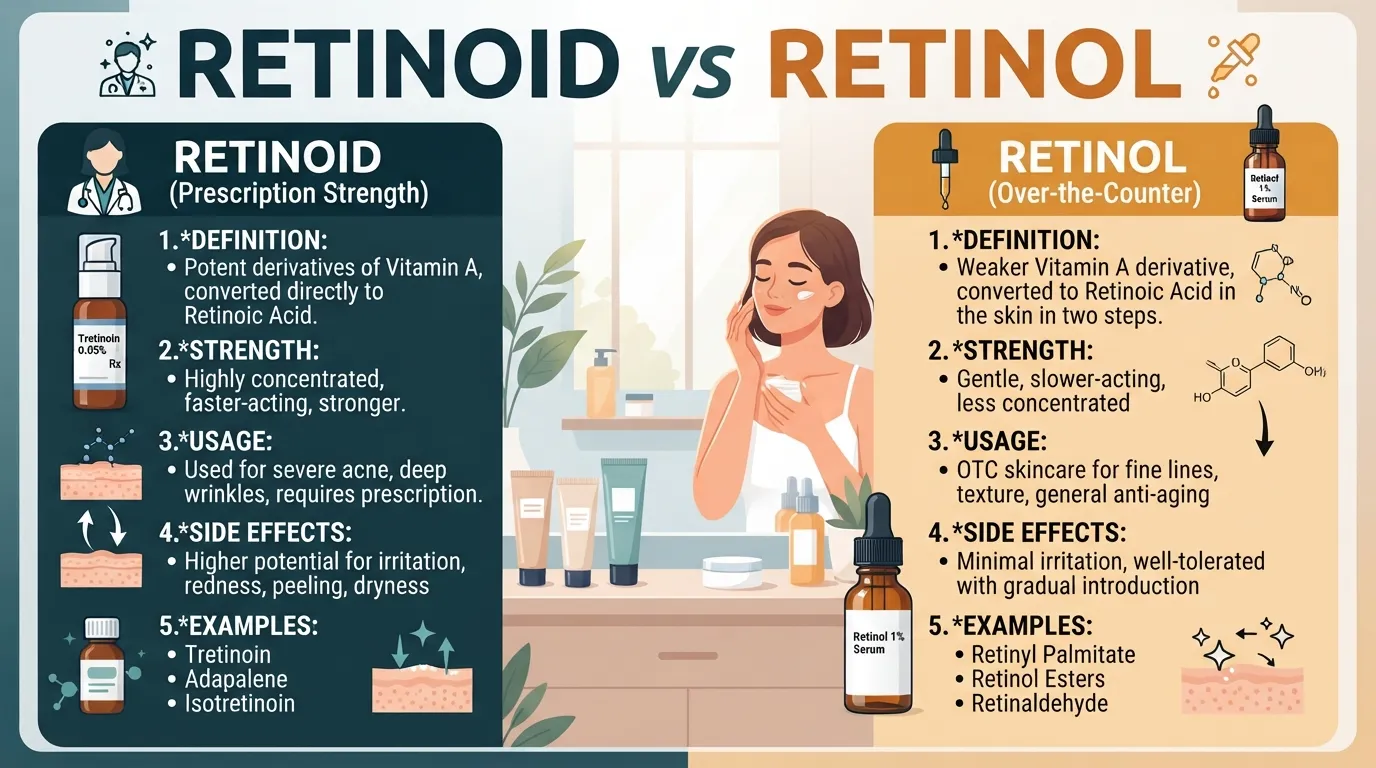
Retinoid vs retinol is not really a comparison between two unrelated ingredients. Retinol is a type of retinoid, and both come from the vitamin A family.
The main difference is that retinol is generally an over-the-counter, milder form that must be converted by the skin into retinoic acid, while some retinoids, such as tretinoin, are already in an active form.
Key Takeaways
- Retinol is a type of retinoid, not a completely separate ingredient.
- Retinol is commonly sold over the counter and is generally milder than prescription retinoids.
- Prescription retinoids such as tretinoin can work more directly because they are already in an active retinoic acid form.
- Both can help with concerns such as acne, uneven skin tone, fine lines, and skin texture.
- Dryness, peeling, redness, and irritation can occur with topical retinoids, especially when starting.
- Topical retinoids should generally be avoided during pregnancy.
What Is a Retinoid?
A retinoid is a broad term for compounds related to vitamin A that are used in skincare and dermatology.
Think of “retinoid” as the family name. Retinol is one member of that family.
Other examples include tretinoin, adapalene, tazarotene, and trifarotene. Different retinoids have different strengths, uses, and availability. Some are found in over-the-counter skincare products, while others are prescription medicines.
Retinoids are widely used because they can affect skin-cell turnover and help with concerns such as acne, fine lines, wrinkles, pigmentation, and uneven texture.
Common Types of Retinoids
The retinoid family includes several forms:
- Retinol: Commonly found in over-the-counter skincare.
- Retinaldehyde (retinal): Another vitamin A derivative used in skincare.
- Tretinoin: A prescription retinoid that is already retinoic acid.
- Adapalene: A topical retinoid commonly used for acne and available without a prescription in the U.S.
- Tazarotene: A prescription topical retinoid.
- Trifarotene: A prescription topical retinoid used for acne.
This is why the word “retinoid” can be confusing. It describes a large group rather than one specific product.
What Is Retinol?
Retinol is a form of retinoid and a vitamin A derivative.
It is commonly used in over-the-counter skincare products for concerns such as fine lines, uneven skin tone, and skin texture. The American Academy of Dermatology also describes retinoid as an umbrella term that includes different vitamin A-based products and notes that retinol can be found in skincare products.
The key difference is how retinol becomes active.
Retinol must go through conversion steps in the skin before becoming retinoic acid, the active form that interacts with skin cells. Tretinoin, by comparison, is already retinoic acid and does not need that conversion.
That helps explain why retinol is generally considered less potent and often easier to tolerate than prescription-strength options.
Retinoid vs Retinol: What’s the Difference?
The simplest answer is this:
Retinol is a retinoid.
So, saying “retinoid vs retinol” is similar to comparing a broad category with one member of that category.
However, in everyday skincare conversations, people sometimes use “retinoid” to mean a stronger or prescription retinoid such as tretinoin. That is where the real comparison usually comes from.
Strength and Potency
Retinol is generally less potent than prescription retinoids because it needs to be converted into retinoic acid before becoming active.
Tretinoin is already retinoic acid. Because it acts without the same conversion step, it is generally more potent and can also be more irritating.
But stronger does not automatically mean better for everyone.
A product that causes severe irritation may be difficult to use consistently. Your skin type, concern, tolerance, and medical needs all matter.
Prescription vs. Over-the-Counter
Many retinol products are available without a prescription in the United States.
Some topical retinoids are prescription medicines. Adapalene is an important exception because certain adapalene products are available over the counter in the U.S.
So you should not assume that every product containing a retinoid requires a prescription.
How They Work
Retinoids ultimately influence processes in the skin related to cell turnover and other cellular activity.
Retinol has to be converted into retinoic acid before it can produce its full retinoid activity. Prescription tretinoin does not need that conversion.
This difference affects potency, speed of action, and the likelihood of irritation.
Side Effects and Tolerance
Both retinol and other topical retinoids can cause irritation.
Common problems include:
- Dryness
- Peeling
- Redness
- Burning or stinging
- Increased sensitivity
These effects can be especially noticeable when someone first starts using a retinoid. Mayo Clinic notes that retinoids can cause dryness, redness, burning, or rash and can increase sensitivity to sunlight.
Retinoid vs Retinol Comparison Table
| Feature | Retinol | Other Retinoids |
| What is it? | A type of retinoid | Broad family of vitamin A-related compounds |
| Common availability | Often OTC | OTC or prescription, depending on the type |
| Conversion needed? | Yes, to retinoic acid | Depends on the specific retinoid |
| Typical strength | Generally milder | Varies from mild to prescription-strength |
| Common uses | Fine lines, texture, uneven tone | Acne, wrinkles, pigmentation, texture |
| Irritation | Usually lower than stronger options | Varies by ingredient and strength |
| Example | Retinol serum | Tretinoin, adapalene, tazarotene |
The important point is that “retinoid” alone does not tell you how strong a product is. You need to know the specific retinoid.
What Are Retinoids Used For?
Retinoids have several established uses in dermatology and skincare.
Acne
Topical retinoids can help prevent clogged pores and are commonly used as acne treatments. Prescription options include tretinoin, adapalene, and tazarotene.
Because acne treatment can depend on severity and skin type, a healthcare professional can help determine which option is appropriate.
Fine Lines and Wrinkles
Retinoids are also widely used to improve the appearance of fine lines and wrinkles.
They can influence processes related to collagen and skin structure. Retinol is commonly included in over-the-counter products designed to improve the appearance of aging skin.
Results are not instant. Consistent use over time is generally needed before changes become noticeable.
Dark Spots and Uneven Texture
Retinoid products may also help improve uneven skin tone and texture.
The American Academy of Dermatology lists retinoids among ingredients that can help with fine lines, wrinkles, acne, dark spots, and skin texture.
What Is Retinol Best For?
Retinol is often chosen by people who want an over-the-counter vitamin A option for general skin concerns such as fine lines, uneven tone, or texture.
It can also be a practical starting point for someone who wants to introduce a retinoid into a skincare routine without immediately using a prescription product.
However, “beginner-friendly” does not mean irritation-free. Retinol can still cause dryness and irritation.
If your main concern is moderate or persistent acne, significant skin changes, or a condition that needs medical treatment, an OTC cosmetic retinol may not be the most appropriate option.
Which Should You Use: Retinoid or Retinol?
There is no single choice that is right for everyone.
For Beginners
Someone new to vitamin A skincare may prefer an OTC retinol because it is generally milder than stronger prescription retinoids.
Start slowly and follow the product directions. Using more product does not necessarily produce better results.
For Acne
Certain retinoids are specifically used to treat acne.
Adapalene, tretinoin, and other topical retinoids have established roles in acne treatment. The appropriate choice depends on factors such as acne severity, skin tolerance, and other treatments being used.
For Aging Skin
Retinol can be useful for people focused on fine lines, texture, and uneven pigmentation.
Prescription retinoids may also be used for cosmetic skin concerns, but their greater potency can come with a greater risk of irritation.
The goal should be an effective routine that you can tolerate consistently, rather than simply choosing the strongest available product.
How to Use Retinoid or Retinol Safely
If you are starting a topical retinoid, follow the product label or your healthcare professional’s instructions.
A few basic principles can help:
- Start gradually. Your skin may need time to adjust.
- Use only the recommended amount. More is not necessarily better.
- Moisturize. This can help manage dryness and irritation.
- Protect your skin from the sun. Retinoids can increase sun sensitivity, so sunscreen is important.
- Avoid adding several irritating products at once. This can make it harder to identify what is causing irritation.
- Stop and seek medical advice if you develop severe or persistent irritation.
If you have a skin condition, are taking other medications, or are unsure which product is appropriate, talk with a dermatologist or other qualified healthcare professional.
Can You Use Retinoids During Pregnancy?
Topical retinoids are generally advised against during pregnancy.
Mayo Clinic specifically recommends avoiding topical retinoids during pregnancy, and it also notes that oral isotretinoin can cause birth defects.
If you are pregnant, trying to become pregnant, or breastfeeding and are unsure about a skincare ingredient, discuss it with your healthcare professional rather than assuming an OTC product is automatically safe.
FAQs:
Is retinol the same as a retinoid?
Not exactly. Retinol is a type of retinoid. “Retinoid” is the broader term for vitamin A-related compounds used in skincare and medicine. Retinol is one specific form, commonly found in OTC skincare products.
Is a retinoid stronger than retinol?
Not necessarily, because retinol itself is a retinoid. If someone uses “retinoid” to mean prescription retinoids such as tretinoin, those products are generally more potent than retinol. The exact strength depends on the specific ingredient and formulation.
Is retinol better for beginners?
Retinol may be easier for some beginners to tolerate because it is generally less potent than prescription tretinoin. However, it can still cause dryness, peeling, and irritation. A gradual approach and appropriate skin care can help reduce problems.
What is the difference between retinol and tretinoin?
Both are retinoids, but they are not the same ingredient. Retinol must be converted by the skin into retinoic acid, while tretinoin is already retinoic acid. Tretinoin is prescription-strength and generally more potent than OTC retinol.
Do retinoids help acne and wrinkles?
Yes. Different retinoids are used for acne and for improving the appearance of fine lines and wrinkles. The specific product matters because retinoids vary in strength, formulation, availability, and approved or established uses.
Conclusion:
The biggest point in the retinoid vs retinol discussion is simple: retinol is a retinoid.
Retinoid is the broader family name, while retinol is one specific vitamin A derivative commonly used in OTC skincare. Prescription options such as tretinoin are different retinoids and can be considerably more potent.
Choosing between them depends on your skin concern, tolerance, goals, and whether you need medical treatment. If you are unsure, a dermatologist can help you select an appropriate option and reduce the risk of unnecessary irritation.

I am Caleb Anderson, a Christian writer passionate about exploring deep biblical meanings and spiritual truths.
On Biblicaltribez.com, I share faith based insights to help readers grow closer to God through Scripture.
My writing focuses on making the Bible easy to understand, meaningful, and relevant to everyday life.