Skip to content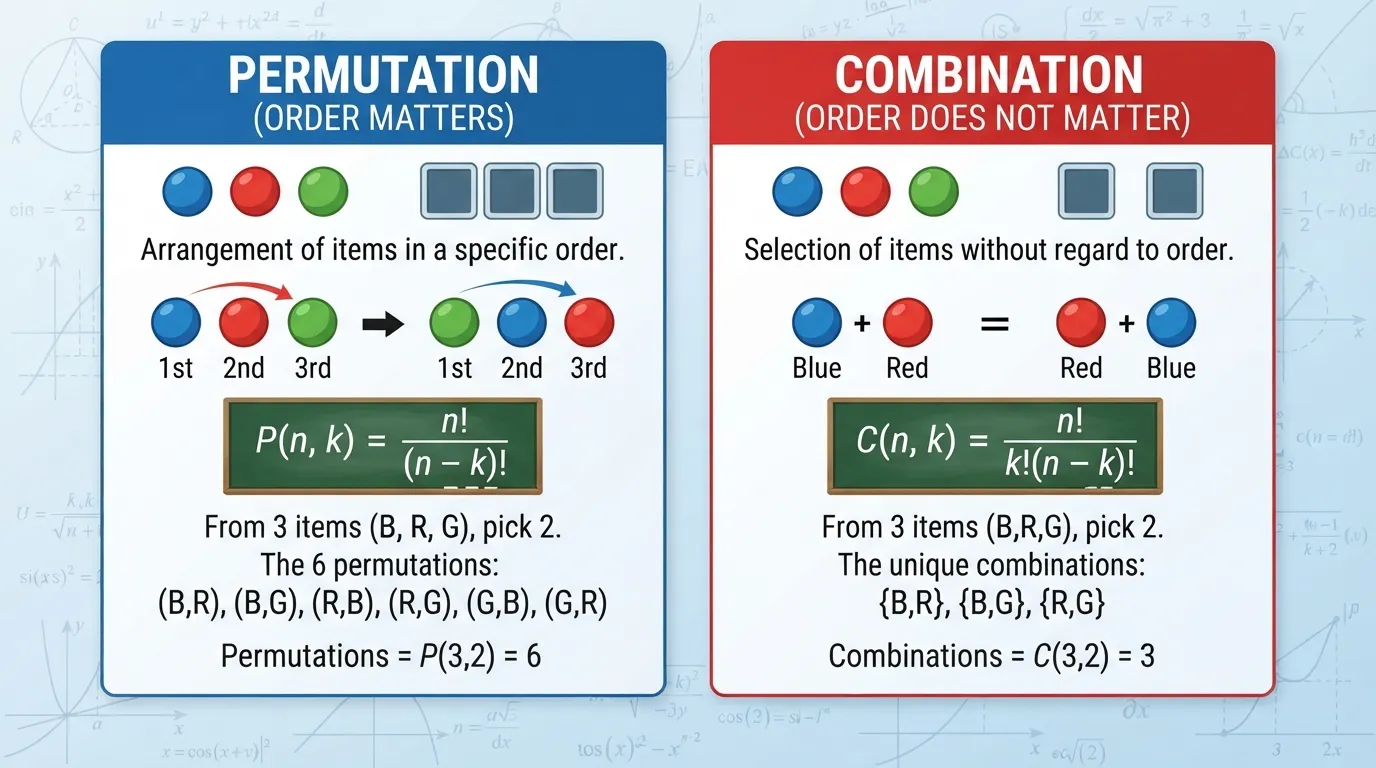
The main difference between a permutation and a combination is whether order matters. A permutation counts different arrangements of the same items, while a combination counts different selections.
For example, choosing A, B, and C for first, second, and third places uses a permutation. Choosing three people for a team uses a combination.
Key Takeaways
- Permutation: order matters.
- Combination: order does not matter.
- Use nPrnPr when you are arranging items.
- Use nCrnCr when you are selecting items.
- Both formulas use factorials, but they answer different counting questions.
What Is the Difference Between Permutation and Combination?
The easiest way to understand permutation vs combination is to ask one question:
Does the order of the selected items matter?
If the answer is yes, you usually need a permutation.
If the answer is no, you usually need a combination.
Suppose you have three letters: A, B, and C.
If you arrange them, these are different:
- ABC
- ACB
- BAC
- BCA
- CAB
- CBA
Here, changing the order creates a new result. That is a permutation.
Now suppose you simply choose two letters from A, B, and C.
Choosing A and B gives the same group as choosing B and A. You are selecting the letters, not arranging them. That is a combination.
The role of order
Think of these two words:
- Permutation = position
- Combination = collection
A permutation cares about where each item goes. A combination only cares about which items were chosen.
For example, assigning three students to first, second, and third place requires a permutation because each position is different.
Choosing three students for a committee requires a combination because the committee does not change when the same students are listed in another order.
What Is a Permutation?
A permutation is an arrangement of objects where the order of the objects matters.
Permutations are useful when dealing with:
- Race positions
- Password arrangements
- Seating arrangements
- Ranking contestants
- Assigning people to different positions
- Arranging letters or numbers
Permutation formula
When choosing and arranging rr objects from nn total objects, the formula is:
nPr=n!(n−r)!nPr = \frac{n!}{(n-r)!}
The symbol ! means factorial.
For example:
5!=5×4×3×2×1=1205! = 5 \times 4 \times 3 \times 2 \times 1 = 120
Permutation example
Imagine five students are competing for three different positions:
- First place
- Second place
- Third place
Because the positions are different, order matters.
Using the permutation formula:
5P3=5!(5−3)!5P3 = \frac{5!}{(5-3)!} =5!2!= \frac{5!}{2!} =1202= \frac{120}{2} =60= 60
There are 60 possible arrangements for the three positions.
The order ABC is different from BAC because the positions have changed.
What Is a Combination?
A combination is a selection of objects where the order does not matter.
Combinations are useful when you are choosing:
- Members of a team
- People for a committee
- Items from a group
- Questions to answer
- Lottery numbers
- A group of products
Combination formula
When choosing rr objects from nn total objects, the combination formula is:
nCr=n!r!(n−r)!nCr = \frac{n!}{r!(n-r)!}
The extra r!r! in the denominator removes the different arrangements of the same selected items.
Combination example
Suppose five students are available, and you need to choose three students for a team.
The order does not matter. A team containing Alice, Bob, and Carlos is the same team as one listed as Carlos, Alice, and Bob.
Use the combination formula:
5C3=5!3!(5−3)!5C3 = \frac{5!}{3!(5-3)!} =1206×2= \frac{120}{6 \times 2} =10= 10
So there are 10 possible teams.
Permutation vs Combination: Side-by-Side Comparison
| Feature | Permutation | Combination |
| Main idea | Arrangement | Selection |
| Does order matter? | Yes | No |
| Common use | Ranking or arranging | Choosing a group |
| Formula | nPr=n!(n−r)!nPr=\frac{n!}{(n-r)!} | nCr=n!r!(n−r)!nCr=\frac{n!}{r!(n-r)!} |
| Example | Assigning 1st, 2nd, and 3rd place | Choosing three team members |
| ABC vs BAC | Different | Same selection |
The biggest difference is therefore order.
If changing the order creates a new outcome, use a permutation.
If changing the order does not create a new outcome, use a combination.
How Do You Know Which Formula to Use?
A quick decision rule can make these problems much easier.
Use permutation when order matters
Look for words or situations involving:
- Arrange
- Rank
- Position
- Order
- Seat
- Schedule
- Assign
- First, second, third
For example:
In how many ways can six runners finish first, second, and third?
The answer depends on who finishes in each position. So this is a permutation problem.
Use combination when order does not matter
Look for situations involving:
- Choose
- Select
- Group
- Team
- Committee
- Set
- Pick
For example:
In how many ways can you choose three students from six students for a committee?
The committee does not change based on the order of the names. So this is a combination problem.
Permutation vs Combination Example With the Same Numbers
Using the same numbers can make the difference clearer.
Suppose you have four people: A, B, C, and D, and you need to select two.
If order matters
Imagine the two people are assigned to two different positions.
AB and BA are different because A and B have different positions.
The possible arrangements are:
- AB
- AC
- AD
- BA
- BC
- BD
- CA
- CB
- CD
- DA
- DB
- DC
There are 12 permutations.
4P2=4!(4−2)!=124P2 = \frac{4!}{(4-2)!}=12
If order does not matter
Now imagine you are simply choosing two people for a team.
AB and BA represent the same team.
The possible groups are:
- AB
- AC
- AD
- BC
- BD
- CD
There are 6 combinations.
4C2=4!2!(4−2)!=64C2 = \frac{4!}{2!(4-2)!}=6
The people are the same, but the question changes. That is why the answer changes.
Common Mistakes to Avoid
One common mistake is assuming that selecting something automatically means using a combination.
The word “select” alone is not enough. You need to determine whether the selected items have different positions or roles.
For example, choosing a president and vice president from five people is a permutation because the two positions are different.
Choosing two people for a committee is a combination because the two people have equal status within the group.
Another mistake is forgetting that order matters in ranking problems.
If Alex finishes first and Jordan finishes second, that result is different from Jordan finishing first and Alex finishing second.
A useful habit is to ask:
“Would switching the order create a different result?”
If yes, think permutation.
If no, think combination.
Relationship Between Permutations and Combinations
Permutations and combinations are closely connected.
A combination first chooses the items, while a permutation also considers every possible order of those selected items.
The relationship is:
nPr=nCr×r!nPr = nCr \times r!
Why?
A group of rr selected objects can be arranged in r!r! different ways.
For example, if you choose three people for a group, those three people can be arranged in:
3!=63! = 6
different orders.
This is why permutation counts are generally larger than combination counts when rr is greater than 1.
FAQs:
Is permutation order important?
Yes. Order matters in a permutation. For example, ABC and BAC are different permutations because the positions of the letters have changed.
Is combination order important?
No. Order does not matter in a combination. Choosing A, B, and C gives the same combination as choosing C, A, and B because the same three items were selected.
What is the easiest way to remember permutation vs combination?
Remember P = Position and C = Collection. If different positions create different outcomes, use a permutation. If you are simply creating a group or collection, use a combination.
What are nPrnPr and nCrnCr?
nPrnPr is the notation for permutations, where order matters. nCrnCr is the notation for combinations, where order does not matter. Both formulas count ways to select items from a larger group, but they treat order differently.
Conclusion:
Understanding permutation vs combination becomes much easier when you focus on one question: Does order matter?
Use a permutation when you are arranging, ranking, positioning, or assigning items. Use a combination when you are simply selecting a group and the order has no effect.
When solving a problem, identify what makes one outcome different from another. If changing the order creates a new outcome, use nPrnPr. If the same selected items remain the same outcome regardless of order, use nCrnCr.

I am Samuel Brooks, a Christian author who enjoys breaking down complex Bible concepts into simple truths. At Biblicaltribez.com, I write content that inspires faith, hope, and spiritual growth. I aim to help readers connect Scripture with real life challenges in a meaningful way.