Skip to content
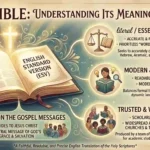
The ESV Bible meaning is English Standard Version. It is a modern English translation of the Bible first published in 2001. The ESV follows an “essentially literal” translation approach, aiming to preserve the wording and meaning of the original Hebrew, Aramaic, and Greek texts while maintaining clear, readable English.
Key Takeaways
- ESV stands for English Standard Version.
- Crossway published the ESV in 2001.
- The translation emphasizes word-for-word correspondence while accounting for differences between languages.
- It is suitable for personal Bible reading, memorization, preaching, and in-depth study.
- Its wording can feel more formal than some other modern translations, such as the NIV.
What Does ESV Stand for in the Bible?
ESV stands for English Standard Version. It is the name of an English translation of the Bible, not a separate book or a special biblical teaching.
The ESV translates biblical writings into contemporary English while aiming to preserve the wording, meaning, and literary style of the original texts. Its translators describe their approach as “essentially literal,” meaning they try to stay close to the original wording without ignoring English grammar or clarity.
For example, when you see “ESV” printed on a Bible cover or displayed in a Bible app, it tells you which English translation you are reading.
The ESV contains the Old Testament and New Testament. Its Old Testament draws primarily on Hebrew texts, with some passages in Aramaic, while its New Testament translates Greek texts.
What Does the ESV Bible Mean in Simple Terms?
In simple terms, the ESV Bible is an English version designed to communicate the Bible’s message while staying relatively close to the wording of its original languages.
Different Bible translations make different choices. Some prioritize preserving sentence structure and individual words, while others focus more on expressing the same ideas in natural, everyday English.
The ESV generally follows the first approach. This can help readers examine repeated words, follow connections between passages, and study the wording of Scripture.
However, the ESV is not a word-for-word replacement of every Hebrew or Greek word. Languages have different grammar, expressions, and sentence structures. Translators must sometimes change the wording to communicate the intended meaning clearly.
How Was the ESV Bible Created?
Crossway first published the English Standard Version in 2001. A team of more than 100 evangelical scholars and pastors worked on the translation.
The ESV builds on the history of English Bible translation, particularly the Revised Standard Version (RSV), whose 1971 text provided its starting point. The translators sought to retain the strengths of traditional English Bible language while making appropriate updates and corrections.
The project aimed to balance three goals:
- Accuracy: Represent the meaning of the original biblical texts faithfully.
- Readability: Use English that modern readers can understand.
- Literary quality: Preserve the distinctive style, rhythm, and tone of biblical writing where possible.
These goals help explain why the ESV uses modern English but sometimes retains formal or traditional expressions.
Source: Official ESV introduction and translation information.
What Is the ESV Translation Philosophy?
The ESV uses an “essentially literal” approach, commonly associated with formal equivalence. This approach seeks to preserve the wording and structure of the original text as far as English grammar and meaning allow.
The translators also aim to preserve important recurring terms and connections between related passages. This can be useful when studying a biblical theme across several books.
Word-for-word versus thought-for-thought
Bible translations generally use different balances between formal wording and natural communication.
A word-for-word approach tries to stay close to the original wording and sentence structure. A thought-for-thought approach places greater emphasis on expressing the original meaning in natural, understandable language.
Neither approach guarantees perfect accuracy in every passage. A very literal rendering can sound unclear in English, while a smoother rendering may make more interpretive choices.
The ESV favors close correspondence with the source text, but it still considers grammar, idioms, and context. Its translation philosophy is one reason many readers choose it for detailed Bible study.
ESV vs. NIV vs. KJV: What Is the Difference?
The ESV, NIV, and KJV are three English Bible translations. They differ in language, translation approach, and reading experience.
| Feature | ESV | NIV | KJV |
|---|---|---|---|
| Full name | English Standard Version | New International Version | King James Version |
| First published | 2001 | 1978 | 1611 |
| General approach | Essentially literal | Meaning-focused balance | Traditional formal translation |
| Language style | Modern, sometimes formal | Generally natural modern English | Traditional English |
| Often chosen for | Close study and memorization | Everyday reading and study | Traditional wording and literary heritage |
The NIV first appeared in 1978, with a major revision in 2011. The KJV was first published in 1611 and retains language that may feel unfamiliar to modern readers.
The ESV often appeals to people who want to examine the wording of biblical passages closely. The NIV may suit readers who prefer more natural contemporary phrasing, while the KJV appeals to readers who value traditional English.
These are general differences, not absolute rules. All three translations can support personal reading and study. Comparing them can also help readers notice differences in wording and interpretation.
Is the ESV Bible Easy to Understand?
The ESV is understandable for many readers, but its language can feel more formal than that of some other modern translations.
Readers who already have some experience with the Bible may find its style helpful for studying passages and memorizing verses. New readers can also use it, although certain expressions and theological terms may require explanation.
If you are just starting to read the Bible, try this simple approach:
- Read a short passage in the ESV.
- Look up unfamiliar words or phrases.
- Read the same passage in another translation, such as the NIV.
- Compare the wording and consider the surrounding context.
This method can help you understand the passage without assuming that one English translation captures every nuance perfectly.
Is the ESV Bible Accurate?
The ESV was designed to represent the original biblical texts as closely as possible. Its translation philosophy emphasizes preserving wording, meaning, and literary features.
However, no English translation can reproduce every nuance of Hebrew, Aramaic, and Greek perfectly. Some original words have several possible meanings, and translators must consider grammar, context, and historical usage when choosing English equivalents.
The label “word-for-word” also does not automatically make one translation the most accurate in every passage. Accuracy depends on how well the translation communicates the intended meaning in context.
For deeper study, compare the ESV with other established translations and consult reliable study notes or biblical-language resources. The BibleProject’s guide to Bible translation explains why reading multiple translations can provide a fuller understanding.
Who Should Read the ESV Bible?
The ESV may be a good choice for several types of readers:
- Bible students: Its close attention to wording can support detailed study.
- Church leaders and teachers: Its language can be useful for teaching, preaching, and preparing lessons.
- People memorizing Scripture: Its consistent wording and literary style may help with memorization.
- Regular Bible readers: It offers a modern English option that retains some traditional phrasing.
- Readers comparing translations: It provides a useful point of comparison with versions that prioritize natural, everyday English.
Beginners do not need to avoid the ESV. If you find its wording difficult, use a second translation alongside it rather than giving up on reading.
Frequently Asked Questions
1. What does ESV stand for in the Bible?
ESV stands for English Standard Version. It is a modern English Bible translation first published in 2001 by Crossway. The translation aims to preserve the wording and meaning of the original biblical texts while maintaining clear English.
2. What does ESV mean in simple terms?
In simple terms, ESV means an English version of the Bible that tries to stay close to the wording of the original languages. It is designed for reading, memorization, worship, and in-depth study.
3. Is the ESV a word-for-word translation?
The ESV is commonly described as an essentially literal translation. It seeks close correspondence with the original wording but also considers grammar, context, idioms, and natural English expression. Therefore, it is not a mechanically literal translation of every word.
4. Is the ESV Bible good for beginners?
Yes. Beginners can read the ESV, but some passages may feel formal or difficult. If you prefer simpler, more conversational language, compare it with the NIV or another modern translation to find the reading style that works best for you.
5. What is the difference between ESV and NIV?
The ESV generally places greater emphasis on preserving the wording and structure of the original text. The NIV puts more emphasis on communicating the meaning in natural contemporary English. Both aim to convey the biblical message accurately, but their wording can differ.
6. Who publishes the ESV Bible?
Crossway publishes the English Standard Version. The translation was first published in 2001 and developed by a team of evangelical scholars and pastors.
Final Thoughts on ESV Bible Meaning
The ESV Bible meaning is straightforward: ESV stands for English Standard Version. It is a modern English translation that emphasizes close correspondence with the original biblical texts while maintaining readable language.
The ESV can be especially useful for detailed Bible study, Scripture memorization, and regular reading. However, the best translation for you depends on your reading level, purpose, and preferred style.
If you are unsure, begin with a passage in the ESV and compare it with the NIV or another established translation. Reading carefully and considering the context will help you understand Scripture more fully.

I am Caleb Anderson, a Christian writer passionate about exploring deep biblical meanings and spiritual truths.
On Biblicaltribez.com, I share faith based insights to help readers grow closer to God through Scripture.
My writing focuses on making the Bible easy to understand, meaningful, and relevant to everyday life.