Skip to content
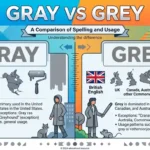
Gray and grey are two spellings of the same color. In American English, gray is the standard spelling, while grey is mainly used in British English and some other varieties. They have the same meaning and pronunciation. For a US audience, choose gray and use it consistently unless a proper name or fixed term uses grey.
Key Takeaways
- Gray is the standard spelling in American English.
- Grey is the usual spelling in British English.
- Both words refer to the same color and are pronounced /ɡreɪ/.
- The spelling difference continues in forms such as graying/greying and grayish/greyish.
- Some names and fixed terms keep their established spelling, regardless of regional English.
- The scientific unit is officially spelled gray, with the symbol Gy.
Gray vs Grey: What Is the Difference?
The main difference between gray and grey is spelling, not meaning.
Both words describe a color between black and white. They can describe clothing, hair, clouds, walls, animals, eyes, paint, and many other things.
For example:
The sky is gray.
The British version is:
The sky is grey.
Nothing about the color changes. The difference comes from regional English conventions.
Cambridge identifies gray as the US spelling of grey, while its British-oriented entry labels grey as mainly UK and says US English usually uses gray. Both entries give the same pronunciation, /ɡreɪ/.
Gray in American English
If you are writing for readers in the United States, gray is the normal choice.
You will commonly see it in American schoolwork, business writing, websites, books, newspapers, and everyday conversation.
Examples:
- She wore a gray jacket.
- The clouds turned gray before the storm.
- His hair is beginning to turn gray.
- We painted the walls light gray.
- The car is available in dark gray.
- The cat has soft gray fur.
Cambridge’s US dictionary entry uses gray for the color, gray hair, gray weather, and the expression gray area.
So, if your target audience is American, gray should normally be your default spelling.
Grey in British English
In British English, grey is the usual spelling.
For example:
- She wore a grey coat.
- The sky was grey all morning.
- His hair is turning grey.
- They painted the room grey.
- The horse had a grey coat.
Oxford also lists grey as the normal British form and notes that US English usually uses gray.
The important point is that grey is not an incorrect version of the word. It is simply the preferred spelling in British English.
Gray vs Grey: Quick Comparison
| Feature | American English | British English |
|---|---|---|
| Color | gray | grey |
| Hair | gray hair | grey hair |
| Weather | gray sky | grey sky |
| Unclear situation | gray area | grey area |
| Becoming gray | graying | greying |
| Slightly gray | grayish | greyish |
| Pronunciation | /ɡreɪ/ | /ɡreɪ/ |
The distinction is therefore mostly geographical. It is not a difference in color or pronunciation.
Do Gray and Grey Mean the Same Thing?
Yes, in their ordinary color-related use, gray and grey mean the same thing.
Both can describe the neutral color associated with mixtures of black and white, clouds, ash, smoke, and similar shades. Cambridge gives the same basic color definition for both forms.
The words can also have figurative meanings.
For example:
The situation is a gray area.
Here, gray area means something that is unclear or does not fit neatly into a definite category.
British English normally writes:
The situation is a grey area.
Again, the meaning remains the same.
Gray vs Grey Pronunciation
There is no standard pronunciation difference between gray and grey.
Both are pronounced:
/ɡreɪ/
This is the same vowel sound heard in words such as:
- day
- say
- play
- way
So if someone says gray and someone else says grey, you generally cannot tell which spelling they are using just from the sound.
This is one reason the spelling difference can be confusing for English learners.
Gray vs Grey in Common Expressions
The regional spelling normally carries over into related expressions.
Gray/Grey Hair
In American English:
My father is getting gray hair.
In British English:
My father is getting grey hair.
Both describe hair that has become gray or white, usually with age. Cambridge lists both the color sense and the hair-related use.
Gray/Grey Area
A gray area is an unclear situation where the rules or answer are not completely definite.
American English:
The law leaves a gray area.
British English:
The law leaves a grey area.
This expression is especially common in discussions of rules, ethics, law, and uncertain decisions.
Gray/Grey Matter
American English generally uses:
gray matter
British English commonly uses:
grey matter
The phrase refers to the gray-colored tissue of the brain and spinal cord.
The same regional spelling principle applies. It does not indicate two different kinds of brain tissue.
Graying vs Greying
The difference also appears when the word is used as a verb.
American English:
His hair is graying.
British English:
His hair is greying.
The same pattern appears in related forms:
| American English | British English |
|---|---|
| gray | grey |
| grayed | greyed |
| graying | greying |
| grayish | greyish |
| grayness | greyness |
| grayer | greyer |
Oxford lists greying as the British form and gives gray as the usual US equivalent.
Why Are There Two Spellings?
The two forms are not a modern invention. They have a long history in English.
The Oxford English Dictionary traces the word back to Old English and explains that different spelling patterns continued for centuries. The two spelling types remained in use for a long period before gray became the standard US form and grey became the general British form.
Oxford’s learner dictionary gives the origin as Old English grǣg, with Germanic connections including Dutch and German forms.
This history is worth knowing because it corrects a common misconception: gray was not simply invented as a completely new American word. Both spellings have deep roots in English.
When Should You Use Gray or Grey?
The easiest rule is to match your audience.
Writing for the United States?
Use gray.
For example:
The company launched a new gray laptop.
Writing for the United Kingdom?
Use grey.
For example:
The company launched a new grey laptop.
Writing for an international audience?
Choose a consistent style based on your main audience or your organization’s style guide.
If your website primarily targets US readers, gray is the better default.
If you are writing for a British publication, use grey.
The key is consistency. Randomly switching between gray and grey in the same piece can make your writing look inconsistent.
Special Cases: Names and Fixed Terms
Not every word containing gray or grey should be changed simply because of your regional spelling preference.
Proper names and established titles should normally keep their official spelling.
For example, Earl Grey is the established name of the tea. Changing it to Earl Gray would change the name rather than simply adapting ordinary US spelling.
The same principle applies to names of people, organizations, books, films, products, places, and other fixed names.
So a useful rule is:
Use your regional spelling for ordinary words, but preserve the official spelling of proper names and fixed titles.
This is an important distinction that simple “A for America, E for England” memory tricks do not always explain.
There is also a technical exception worth knowing. The international SI unit for absorbed radiation is officially spelled gray, with the symbol Gy. The Bureau International des Poids et Mesures defines one gray as one joule per kilogram.
In that context, gray is the official unit name, not merely an American color spelling.
Is Gray the Correct Spelling in the United States?
Yes. Gray is the standard American English spelling.
That does not mean grey is an impossible or universally incorrect spelling in the US. You may encounter grey in proper names, titles, quotations, international publications, or writing influenced by British English.
But if you are writing normal American English and need to choose between the two, gray is the safest choice.
For a US-focused article, you would normally write:
- gray hair
- gray eyes
- gray clouds
- gray sweater
- gray paint
- gray area
- gray matter
- graying hair
Frequently Asked Questions
Is grey wrong in American English?
No. Grey is a recognized English spelling, but gray is the standard US form. You may still see grey in names, titles, quotations, or writing that follows British conventions. For ordinary American English, however, gray is the preferred choice.
Is gray wrong in British English?
No. Gray is not inherently wrong, but British English generally prefers grey. Oxford notes that grey is the standard British form while US English usually uses gray.
Is it gray hair or grey hair?
Both are correct. Use gray hair in American English and grey hair in British English. The meaning is identical.
Is it graying or greying?
Use graying in American English and greying in British English. Both forms mean becoming gray or grey, especially when talking about hair.
Is the scientific unit gray or grey?
The official SI unit is gray, symbol Gy. It measures absorbed dose of ionizing radiation and equals one joule per kilogram. This spelling is fixed by the international SI system.
Do gray and grey sound the same?
Yes. Both are normally pronounced /ɡreɪ/. The spelling changes by regional convention, but the standard pronunciation does not.
Conclusion
Gray vs grey is mainly a question of regional spelling, not meaning.
Use gray when writing standard American English and grey when following British English. Both describe the same color, have the same pronunciation, and can be used in the same grammatical ways.
For a US audience, the simple rule is:
American English → gray
British English → grey
Once you choose the appropriate variety of English, keep the spelling consistent. And when you encounter an established name such as Earl Grey or a specialized term such as the SI unit gray, preserve the form that belongs to that name or technical system.

I am Joseph Parker, a devoted Bible content writer dedicated to sharing God’s Word with clarity and purpose.
Through Biblicaltribez.com, I create inspirational and scripture-centered articles that strengthen faith.
My goal is to guide readers into a deeper understanding of biblical teachings and Christian living.