Skip to content
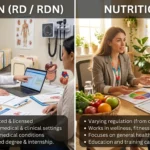
The main difference between a nutritionist and a dietitian in the U.S. is professional regulation and training. Registered dietitians (RDs or RDNs) must meet specific education, supervised-practice, and examination requirements.
“Nutritionist” is a broader term whose meaning and legal requirements vary by state and by the person’s credentials.
Key Takeaways
- Dietitian is the standard U.S. spelling; “dietician” is a common spelling variation.
- RDs and RDNs have standardized professional education, supervised training, and examination requirements.
- Nutritionist is a broader title and does not have one standardized meaning across the U.S.
- Some nutritionists have advanced education or professional credentials, while others may have less formal training.
- For nutrition care related to a medical condition, an appropriately credentialed registered dietitian nutritionist is often the most suitable choice.
What Is the Difference Between a Nutritionist and Dietitian?
At first glance, a nutritionist and dietitian may seem like the same professional. Both can provide advice about food, healthy eating, and nutrition.
The important difference is how the titles are defined and regulated.
In the United States, registered dietitian (RD) and registered dietitian nutritionist (RDN) are legally protected professional credentials. People using these credentials must complete specific education and supervised-practice requirements, pass a national examination, and maintain their professional requirements.
The word nutritionist is different. There is no single standardized national definition for the title. Its meaning and requirements can vary by state. Some states have laws that regulate who can use the term or practice nutrition.
So, the biggest difference is not simply what each person talks about. It is the training, credentialing, and legal scope behind the professional title.
Why “Dietitian” Is the Standard U.S. Term
If you searched nutritionist vs dietician, you may have noticed that both spellings appear online.
In the United States, the professional term is dietitian. The spelling “dietician” is commonly used by the public, but professional organizations generally use “dietitian.”
That means:
- Dietitian = standard professional spelling
- Dietician = common spelling variation
- Registered Dietitian (RD) = professional credential
- Registered Dietitian Nutritionist (RDN) = another professional credential used by qualified dietitians
For search purposes, “nutritionist vs dietician” and “nutritionist vs dietitian” can refer to the same question.
Nutritionist vs Dietitian: Key Differences
The clearest way to understand the difference is to look at education, credentials, regulation, and professional practice.
| Factor | Dietitian / RDN | Nutritionist |
| Title | Registered Dietitian (RD) or RDN | Meaning varies |
| Education | Standardized professional requirements | Varies by person and state |
| Supervised practice | Required for RDN eligibility | Depends on credential |
| National exam | Required for RDN credential | Depends on certification |
| State rules | May include state licensure | Varies by state |
| Clinical nutrition | Trained for professional nutrition care | Depends on education and credential |
| Medical nutrition therapy | Within appropriate professional scope | Depends on qualifications and state law |
| Credential meaning | Standardized | Not one universal standard |
The Academy of Nutrition and Dietetics explains that RD/RDN credentials require specific academic and supervised-practice requirements, while the meaning of “nutritionist” varies.
This distinction matters because two people calling themselves nutritionists may have very different levels of education and professional training.
What Is a Registered Dietitian Nutritionist?
A Registered Dietitian Nutritionist (RDN) is a food and nutrition professional who has met requirements established for the credential.
RDNs work in many settings, including health care, community programs, education, research, government, business, and private practice.
Their work can include nutrition counseling, nutrition assessment, meal planning, and nutrition care related to health conditions.
Education and Training
The requirements for becoming an RDN have become more rigorous.
For people seeking eligibility for the dietitian registration examination for the first time since January 1, 2024, the minimum degree requirement is a graduate degree from an appropriately accredited institution. Candidates must also complete required nutrition and dietetics coursework and supervised practice through an approved pathway.
After meeting the eligibility requirements, candidates take the registration examination administered through the Commission on Dietetic Registration.
State licensure may also be required, depending on where the dietitian practices.
What RDNs Can Do
An RDN may help people with many different nutrition needs.
For example, someone may work with an RDN to:
- Improve overall eating habits
- Develop a practical meal plan
- Manage nutrition during a health condition
- Understand food choices after a medical diagnosis
- Meet nutrition needs during different life stages
- Address nutrition-related concerns
- Support a treatment plan created by a health care team
The exact services and legal scope can depend on the professional’s credentials, specialty, and state rules.
What Does a Nutritionist Do?
“Nutritionist” is a much broader term.
A nutritionist may provide general nutrition education, wellness guidance, meal-planning support, or other nutrition-related services. But the person’s actual qualifications can vary considerably.
For example, one nutritionist might have an advanced degree and a specialized nutrition credential. Another person might have completed a shorter educational program. In some locations, the title may have specific legal requirements.
That is why you should not assume that every nutritionist has the same training.
The Academy of Nutrition and Dietetics specifically notes that the definition and requirements for “nutritionist” vary, and some states have laws that define the scope of practice for people using the designation.
In other words, the word alone does not tell you enough about someone’s qualifications.
Nutritionist vs Dietitian: Which One Should You Choose?
For many people, the choice depends on what kind of help they need.
If you simply want general guidance about healthy eating, a qualified nutrition professional may be appropriate.
But if your nutrition needs are connected to a medical condition, a registered dietitian nutritionist may be the better starting point.
For example, you might consider an RDN if you need nutrition support related to:
- Diabetes
- Kidney disease
- Digestive problems
- Heart health
- Food allergies or intolerances
- Malnutrition
- Weight-related health concerns
- Nutrition during medical treatment
The reason is that RDNs have standardized education and supervised practice designed to prepare them for professional nutrition and dietetics practice.
This does not mean every nutritionist is unqualified. It means you should look beyond the title and check the person’s actual education, credentials, and legal scope.
When Should You See a Dietitian?
A dietitian can be especially useful when you need individualized nutrition advice rather than general information.
For example, imagine you have recently been diagnosed with diabetes. You may already know that food choices matter, but you may not know how to build meals that fit your lifestyle and health needs.
An RDN can assess your nutrition needs and help create practical strategies that fit your situation.
The same applies when your diet is affected by a medical condition, medication, treatment plan, or specific nutritional requirement.
Dietitians also work outside hospitals. The U.S. Bureau of Labor Statistics lists hospitals, outpatient care centers, nursing facilities, government organizations, and other settings among the workplaces for dietitians and nutritionists.
When Might a Nutritionist Be a Good Choice?
A nutritionist may be useful when your goal is general nutrition education or wellness support, provided the person has appropriate qualifications for the service you need.
Before making an appointment, ask:
- What degree or training do you have?
- Do you hold a professional certification?
- Are you licensed in my state, if licensing applies?
- What types of clients do you work with?
- Do you have experience with my specific nutrition goal?
- Can you coordinate with my doctor or other health professionals when needed?
These questions help you evaluate the individual rather than relying only on the word “nutritionist.”
How to Choose a Qualified Nutrition Professional
Check Credentials
If you want a dietitian, look for RD or RDN credentials.
The Academy of Nutrition and Dietetics notes that these are legally protected credentials. They indicate that the practitioner has completed the required education, supervised practice, examination, and ongoing requirements.
Check State Requirements
Nutrition and dietetics laws can vary between states.
A person who provides nutrition services in one state may face different requirements in another. Before hiring someone, check the rules that apply where you live.
The Academy also advises people to review their state’s specific licensing requirements because regulations can change.
Ask About Experience
Credentials are important, but experience also matters.
If you need help with sports nutrition, digestive issues, pregnancy nutrition, or a specific medical condition, ask whether the professional regularly works in that area.
A good match can make nutrition advice more practical and easier to follow.
FAQs:
Is a dietitian the same as a nutritionist?
Not always. Dietitian and nutritionist can overlap in everyday language, but they do not have the same standardized meaning in the U.S. RD and RDN are specific professional credentials with defined education, supervised-practice, examination, and maintenance requirements. “Nutritionist” is a broader term whose requirements vary by state and credential.
Is a dietitian better than a nutritionist?
Neither title automatically makes one person better than another. The key is the individual’s education, credentials, experience, and legal scope of practice. For medical nutrition needs, an appropriately credentialed registered dietitian nutritionist can be a strong choice because the RDN credential has standardized professional requirements.
What is the difference between an RD and an RDN?
RD means Registered Dietitian, while RDN means Registered Dietitian Nutritionist. The Academy of Nutrition and Dietetics recognizes both as credentials for qualified dietitians. In practice, you may see either designation after a dietitian’s name.
Can a nutritionist call themselves a dietitian?
Not simply because they use the word “nutritionist.” Dietitian-related professional titles and credentials have specific requirements. RD and RDN are legally protected credentials, and state laws may also regulate dietitian practice. A person should meet the applicable requirements before using a protected title.
Do nutritionists need a degree?
It depends on the person’s title, credential, and state. There is no single nationwide education requirement attached to the word “nutritionist.” Some nutrition professionals have bachelor’s, master’s, or doctoral degrees and additional credentials, while the requirements for others may differ. Always check the individual’s qualifications rather than assuming the title tells you their education.
Conclusion:
The nutritionist vs dietician question is really about credentials, training, and regulation.
In the U.S., dietitian is the standard professional term, and RD/RDN credentials represent a defined pathway involving graduate education, nutrition and dietetics coursework, supervised practice, and a registration examination.
“Nutritionist” is broader. A nutritionist may be highly qualified, but the title alone does not tell you what education or professional credential that person has.
If you need nutrition advice for a medical condition, start by looking for an appropriately credentialed registered dietitian nutritionist. For general wellness needs, compare the professional’s education, certification, experience, and state requirements before choosing.

I am Samuel Brooks, a Christian author who enjoys breaking down complex Bible concepts into simple truths. At Biblicaltribez.com, I write content that inspires faith, hope, and spiritual growth. I aim to help readers connect Scripture with real life challenges in a meaningful way.