Skip to content
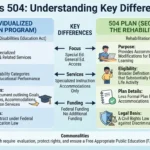
An IEP and a 504 plan both support students with disabilities, but they serve different purposes. An IEP provides specialized instruction, related services, accommodations, and measurable goals under IDEA. A 504 plan mainly provides accommodations and other supports that give a student equal access to general education under Section 504.
Key Takeaways
- An IEP is designed for students who need special education and specialized instruction.
- A 504 plan usually provides accommodations that remove barriers to learning.
- IEPs are covered by IDEA, while 504 plans are based on Section 504 of the Rehabilitation Act.
- A student may qualify for a 504 plan without qualifying for an IEP.
- Neither plan is automatically “better.” The right choice depends on the student’s educational needs.
What Is the Difference Between an IEP and a 504 Plan?
The biggest difference between an IEP vs 504 plan is what kind of support a student needs.
An IEP is designed for a student who needs specially designed instruction because of a qualifying disability. It can include special education, related services, accommodations, modifications, and measurable annual goals.
A 504 plan is mainly designed to provide equal access to education. It often gives a student accommodations without changing the basic instruction being provided.
For example, a student with ADHD may be able to learn grade-level material but struggle to stay focused during long tests. Extra test time, a quiet testing area, or scheduled breaks may help. A 504 plan may be appropriate if accommodations are enough.
Another student may have the same condition but need specialized instruction to make meaningful educational progress. In that situation, an IEP may be more appropriate.
The key question is not simply, “Which plan is better?” It is, “What does this student need to succeed in school?”
IEP vs 504: Side-by-Side Comparison
| Feature | IEP | 504 Plan |
| Main law | Individuals with Disabilities Education Act (IDEA) | Section 504 of the Rehabilitation Act |
| Main purpose | Provides special education and specialized instruction | Provides equal access and accommodations |
| Eligibility | Requires a qualifying IDEA disability and need for special education | Uses a broader disability standard involving substantial limitation of a major life activity |
| Specialized instruction | Yes, when needed | Usually no |
| Accommodations | Yes | Yes |
| Related services | Can include related services | Can include aids and services when needed |
| Measurable annual goals | Required | Not generally required |
| Progress monitoring | Required as part of the IEP process | Not structured like IEP progress monitoring |
| General education access | May include general education and special education settings | Usually supports access to general education |
| Parent role | Specific participation rights under IDEA | Rights and procedures differ under Section 504 |
| Evaluation | Formal IDEA evaluation process | Section 504 evaluation process |
The two plans can look similar on the surface because both may include accommodations. However, their legal purpose and eligibility requirements are different.
What Is an IEP?
IEP stands for Individualized Education Program.
It is a written plan created under the Individuals with Disabilities Education Act, commonly called IDEA. IDEA is the federal special education law.
An IEP is for a student who meets IDEA’s eligibility requirements and needs special education or specially designed instruction because of a disability.
The plan is individualized. It is based on the student’s strengths, needs, present levels of performance, goals, services, and educational setting.
An IEP may include:
- Specialized instruction
- Speech-language services
- Occupational therapy
- Physical therapy
- Assistive technology
- Accommodations
- Modifications when appropriate
- Measurable annual goals
- Progress-monitoring information
- Details about educational services and placement
The exact services depend on the student’s evaluation and individual needs.
Who Qualifies for an IEP?
A student does not automatically qualify for an IEP simply because they have a diagnosis.
Under IDEA, the student must meet the requirements for one of the disability categories recognized by the law. The disability must also create an educational need for special education or specially designed instruction.
This distinction is important.
For example, having ADHD, dyslexia, autism, or another condition does not by itself determine whether a student receives an IEP. The school must evaluate the student’s educational needs and determine whether the IDEA requirements are met.
What Is a 504 Plan?
A 504 plan is based on Section 504 of the Rehabilitation Act of 1973.
Unlike IDEA, Section 504 is a civil rights law. It protects qualified individuals with disabilities from discrimination in programs and activities covered by the law.
In schools, a 504 plan is commonly used to document accommodations and other supports that help a student access education.
Common accommodations may include:
- Extra time on tests
- Preferential seating
- A quiet testing location
- Short breaks
- Written or repeated directions
- Assistive technology
- Changes in how assignments are presented
- Access to class notes
- Other reasonable supports based on the student’s needs
A 504 plan generally does not provide the specialized instruction that is central to an IEP.
Who Qualifies for a 504 Plan?
Section 504 uses a broader disability standard than IDEA.
Generally, a student may be protected when a physical or mental impairment substantially limits one or more major life activities. In education, learning is one example of a major life activity.
This means a student might not qualify for an IEP but may still qualify for a 504 plan.
For example, imagine a student who has a condition that makes concentration difficult but who can keep up with grade-level instruction when given extra time, breaks, and a quieter testing environment.
That student may not need specialized instruction. A 504 plan may provide the accommodations needed to access school successfully.
IEP vs 504: Eligibility Differences
Eligibility is one of the most important differences between an IEP and a 504 plan.
For an IEP, the school must determine that the student meets IDEA’s disability criteria and needs special education.
For a 504 plan, the disability definition is broader. The focus is whether the student’s impairment substantially limits a major life activity and whether supports are needed to provide appropriate educational access.
This is why a student can be denied an IEP and still qualify for a 504 plan.
However, a medical diagnosis alone does not automatically guarantee either plan. Schools must consider evaluation information and the student’s individual educational needs.
IEP vs 504: Accommodations and Services
Both an IEP and a 504 plan can include accommodations.
An accommodation changes how a student accesses or completes learning without necessarily changing what the student is expected to learn.
For example, giving a student extra time on a test is an accommodation.
Specialized instruction is different.
Suppose a student has significant difficulty reading. Simply giving that student more time may not solve the underlying educational problem. The student may need systematic, specialized reading instruction.
That type of support points more toward an IEP because the student may need specially designed instruction.
An IEP can also include accommodations. Therefore, the difference is not that “IEPs have accommodations and 504 plans do not.” Both can have them.
The bigger distinction is that an IEP can provide special education and specialized instruction, while a 504 plan generally focuses on access and accommodations.
Is an IEP Better Than a 504 Plan?
No. An IEP is not automatically better than a 504 plan.
The better question is whether the plan matches the student’s needs.
A student who can succeed in general education with accommodations may not need an IEP. A 504 plan can provide meaningful support without adding specialized instruction that the student does not need.
On the other hand, a student who requires specialized instruction may need an IEP. In that case, accommodations alone may not be enough.
Think of the difference this way:
504: “What barriers are preventing this student from accessing school?”
IEP: “What specialized instruction and services does this student need to make educational progress?”
That simple distinction can make the two plans much easier to understand.
IEP or 504 for ADHD?
Students with ADHD may qualify for either an IEP or a 504 plan, depending on their individual needs.
A student with ADHD may benefit from accommodations such as:
- Extra test time
- Frequent short breaks
- Preferential seating
- Reduced distractions
- Written directions
- Organizational support
If these accommodations allow the student to access general education successfully, a 504 plan may be appropriate.
But another student with ADHD may have greater educational needs and require specialized instruction. In that situation, the student may qualify for an IEP, potentially under the IDEA category of Other Health Impairment.
The diagnosis itself does not decide the outcome. The evaluation and the student’s educational needs matter.
Can a Student Have Both an IEP and a 504 Plan?
A student generally does not need a separate 504 plan when they already have an IEP that provides the necessary supports.
Students with IEPs are also protected by Section 504. An IEP can include accommodations and services that address many of the same access needs covered by a 504 plan.
Therefore, schools typically use the IEP as the student’s primary educational plan rather than creating a separate 504 plan for the same needs.
The important point is that Section 504 protection does not disappear simply because a student has an IEP.
Can a 504 Plan Become an IEP?
Yes.
A student who has a 504 plan can later be evaluated for an IEP if their educational needs change or if accommodations are no longer enough.
For example, a student may initially succeed with extra time, preferential seating, and other accommodations. Later, the student’s academic difficulties may become more significant.
The family or school can request an evaluation under IDEA.
If the evaluation shows that the student meets IDEA eligibility requirements and needs specialized instruction, the school may develop an IEP.
Likewise, eligibility should be reviewed based on the student’s current needs rather than assuming that one plan must remain in place forever.
How Should Parents Decide Between an IEP and 504?
Parents should focus on the student’s actual educational barriers and the type of support needed.
Before a school meeting, consider questions such as:
- What specific difficulties is my child having at school?
- Can my child access grade-level instruction with accommodations?
- Does my child need specialized instruction?
- What does the evaluation show?
- How will the proposed support be implemented?
- Who will provide the services or accommodations?
- How will we know whether the support is working?
- What happens if the current plan is not enough?
It can also help to bring examples of your child’s schoolwork, teacher communication, test performance, and classroom difficulties.
Parents should also remember that state and local procedures can vary. If there is a disagreement about eligibility or services, ask the school for the applicable procedural safeguards and written explanation of its decision.
FAQs:
Is a 504 plan special education?
A 504 plan is not the same thing as an IEP or an IDEA special education program. Section 504 is a civil rights law. A 504 plan commonly provides accommodations and other aids or services that give a student appropriate educational access.
Does a child with an IEP also have Section 504 protection?
Generally, a student who qualifies under IDEA is also protected from disability discrimination under Section 504. The IEP can satisfy many of the educational support obligations that apply to the student, so a separate 504 plan is usually unnecessary.
Which provides more support, an IEP or 504?
Neither is automatically better. An IEP can provide specialized instruction, related services, accommodations, and measurable goals. A 504 plan can provide accommodations and other supports that remove barriers to education. The appropriate plan depends on the student’s individual needs.
Can a student with ADHD get an IEP?
Yes. ADHD can potentially qualify a student for an IEP when the student meets IDEA’s eligibility requirements and needs special education. Other students with ADHD may qualify for a 504 plan instead if accommodations provide the support they need.
How often are IEPs and 504 plans reviewed?
IEPs have specific review requirements under IDEA, including an annual review. Section 504 does not operate under exactly the same review schedule as an IEP, and school procedures can vary. Parents should ask their school how often the 504 plan will be reviewed and updated.
Conclusion:
When comparing an IEP vs 504, the most important difference is the type of educational support the student needs.
An IEP is designed for eligible students who need special education and specialized instruction. It can include measurable goals, related services, accommodations, and other individualized supports.
A 504 plan is generally focused on equal access. It can provide accommodations that remove barriers while allowing a student to participate in general education.
Neither option is automatically better. The right choice depends on the student’s disability, evaluation results, educational needs, and the type of support required to succeed.
If you are unsure which plan may fit your child, focus the conversation with the school on one central question: Does the student need accommodations to access learning, or does the student also need specialized instruction to make progress?

I am Samuel Brooks, a Christian author who enjoys breaking down complex Bible concepts into simple truths. At Biblicaltribez.com, I write content that inspires faith, hope, and spiritual growth. I aim to help readers connect Scripture with real life challenges in a meaningful way.