Skip to content
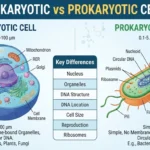
Eukaryotic vs prokaryotic cells differ mainly in how they organize their genetic material.
Eukaryotic cells have a membrane-bound nucleus and other membrane-bound organelles, while prokaryotic cells do not.
Prokaryotes include bacteria and archaea, while eukaryotes include animals, plants, fungi, and protists.
Key Takeaways
- Eukaryotic cells have a nucleus; prokaryotic cells do not.
- Prokaryotic DNA is found in a nucleoid region, while eukaryotic DNA is enclosed in the nucleus.
- Eukaryotic cells usually have more membrane-bound organelles.
- Prokaryotic cells are generally smaller than eukaryotic cells.
- Bacteria and archaea are prokaryotes; humans, plants, animals, and fungi are eukaryotes.
What Is the Difference Between Eukaryotic and Prokaryotic Cells?
The main difference between eukaryotic and prokaryotic cells is the nucleus.
A eukaryotic cell has a nucleus surrounded by a membrane. The nucleus stores most of the cell’s DNA. Eukaryotic cells also contain membrane-bound organelles, such as mitochondria and the endoplasmic reticulum.
A prokaryotic cell does not have a membrane-bound nucleus. Its DNA is located in a region called the nucleoid. Prokaryotic cells also lack the membrane-bound organelles found in eukaryotic cells.
Both types of cells still have basic structures needed for life, including a cell membrane, cytoplasm, DNA, and ribosomes.
Prokaryotic Cells
Prokaryotic cells are found in the domains Bacteria and Archaea. They are usually single-celled organisms.
Their DNA is not enclosed by a nuclear membrane. Instead, the main DNA is located in the nucleoid region. Many prokaryotes also have a cell wall, and some have structures such as capsules, pili, or flagella.
A typical bacterial cell is much smaller than most eukaryotic cells. OpenStax gives a general diameter range of about 0.1 to 5 micrometers for prokaryotic cells.
Eukaryotic Cells
Eukaryotic cells are found in animals, plants, fungi, and protists.
Their DNA is enclosed inside a membrane-bound nucleus. They also contain specialized organelles that perform different jobs inside the cell.
For example, mitochondria help produce ATP for cellular energy, while the endoplasmic reticulum and Golgi apparatus are involved in making, processing, and transporting certain proteins and lipids. Plant cells also contain chloroplasts for photosynthesis.
Eukaryotic vs Prokaryotic: Key Differences
| Feature | Prokaryotic Cells | Eukaryotic Cells |
| Nucleus | No membrane-bound nucleus | Membrane-bound nucleus |
| DNA location | Nucleoid region | Mainly inside nucleus |
| DNA form | Usually circular chromosome | Usually multiple linear chromosomes |
| Membrane-bound organelles | Generally absent | Present |
| Typical size | Generally smaller | Generally larger |
| Ribosomes | Present | Present |
| Cell wall | Common in bacteria and archaea, but composition varies | Present in plants and fungi; absent in animal cells |
| Cell division | Usually binary fission | Mitosis; meiosis involved in sexual reproduction |
| Examples | Bacteria and archaea | Animals, plants, fungi, protists |
These are broad biological patterns. They are useful for learning the main distinction, but individual organisms can have unusual features.
Comparing Eukaryotic and Prokaryotic Cells
Nucleus and DNA
The nucleus is the easiest way to tell the two cell types apart.
Prokaryotic cells: Their DNA is located in a nucleoid region. There is no membrane surrounding the DNA.
Eukaryotic cells: Their DNA is enclosed within a membrane-bound nucleus.
Prokaryotes often have one main circular chromosome, although they can also contain smaller DNA molecules called plasmids. Eukaryotes generally have multiple linear chromosomes.
This difference affects how genetic information is organized and controlled inside the cell.
Organelles
Eukaryotic cells contain many membrane-bound organelles. Each organelle can perform a specialized task.
Examples include:
- Mitochondria: Produce much of the cell’s ATP.
- Endoplasmic reticulum: Helps make and process proteins and lipids.
- Golgi apparatus: Modifies and sorts certain proteins and lipids.
- Lysosomes: Help break down materials in many animal cells.
- Chloroplasts: Carry out photosynthesis in plants and some other eukaryotes.
Prokaryotes do not have these membrane-bound organelles. However, that does not mean they lack organization. Their DNA, ribosomes, membranes, and other structures work together to keep the cell alive.
Cell Size
Prokaryotic cells are generally smaller than eukaryotic cells.
A typical prokaryotic cell may be measured in just a few micrometers or less. Eukaryotic cells are often larger. OpenStax lists approximate ranges of 0.1–5.0 μm for prokaryotes and 10–100 μm for eukaryotic cells.
Size matters because materials must move through a cell. Smaller cells have a high surface-area-to-volume ratio, which can make the movement of nutrients and waste more efficient.
Cell Wall
Cell walls are another important difference, but they should not be treated as a simple “yes or no” rule.
Many bacteria have a cell wall containing peptidoglycan. Archaea can also have cell walls, but their walls do not use bacterial peptidoglycan.
Among eukaryotes, plants have cell walls made mainly of cellulose, while fungi have cell walls containing chitin. Animal cells do not have cell walls.
Ribosomes
Both prokaryotic and eukaryotic cells have ribosomes.
Ribosomes make proteins by translating genetic instructions carried by messenger RNA.
The important difference is that cytoplasmic ribosomes in prokaryotes and eukaryotes have different structures. Prokaryotic ribosomes are generally described as 70S, while cytoplasmic eukaryotic ribosomes are generally 80S.
Mitochondria and chloroplasts have their own ribosomes with bacterial-like characteristics.
Cell Division
Most prokaryotic cells reproduce through binary fission. In this process, the cell copies its DNA and divides into two cells.
Eukaryotic cells use more complex processes. Mitosis produces genetically similar daughter cells for growth and tissue maintenance. Meiosis produces cells involved in sexual reproduction.
The two systems reflect their different cellular structures and methods of organizing DNA.
Number of Cells
Most prokaryotic organisms are unicellular, meaning one cell makes up the organism.
Eukaryotic organisms can be either unicellular or multicellular. Yeast is a familiar unicellular eukaryote, while humans, trees, and mushrooms are multicellular eukaryotes.
This is why “prokaryotic = one cell” is a useful basic rule, but the broader distinction is still based on cellular structure, especially the nucleus.
Examples of Prokaryotic and Eukaryotic Organisms
Examples make the difference easier to understand.
Prokaryotes include:
- Escherichia coli
- Many other bacteria
- Archaea
- Methanogenic archaea
- Some cyanobacteria
Eukaryotes include:
- Humans
- Dogs and other animals
- Oak trees and other plants
- Mushrooms and other fungi
- Amoebas and many other protists
So, if you are looking at a bacterial cell, you are looking at a prokaryotic cell. If you are looking at a human or plant cell, you are looking at a eukaryotic cell.
What Do Prokaryotic and Eukaryotic Cells Have in Common?
Despite their differences, both cell types share several basic features.
Both have:
- DNA to store genetic information
- Ribosomes to make proteins
- Cytoplasm where many cellular reactions occur
- A plasma membrane that separates the cell from its surroundings
These shared features are important because they show that prokaryotic and eukaryotic cells use many of the same basic systems to support life.
Are Prokaryotic Cells Simpler Than Eukaryotic Cells?
In terms of internal compartmentalization, prokaryotic cells are generally simpler. They do not have a membrane-bound nucleus or the large collection of membrane-bound organelles found in eukaryotic cells.
Prokaryotes have sophisticated ways to obtain energy, respond to their environment, exchange genetic material, and survive in many different habitats. Bacteria and archaea are highly diverse groups of organisms.
It is more accurate to say that prokaryotes and eukaryotes use different forms of cellular organization rather than thinking of one as an unfinished version of the other.
How to Remember the Difference
A simple memory trick can make this comparison easier.
Think about the word eukaryotic and remember “E = enclosed nucleus.”
- Eukaryotic → nucleus is enclosed by a membrane.
- Prokaryotic → no membrane-bound nucleus.
Then remember the major examples:
Prokaryotes = Bacteria + Archaea
Eukaryotes = Animals + Plants + Fungi + Protists
For a quick exam question, look for the nucleus first. If the cell has a membrane-bound nucleus, it is eukaryotic. If it does not, it is prokaryotic.
FAQs:
Is bacteria prokaryotic or eukaryotic?
Bacteria are prokaryotic. They do not have a membrane-bound nucleus or membrane-bound organelles such as mitochondria. Their DNA is located in a nucleoid region. Archaea are also prokaryotes, although they are a separate domain from bacteria.
Are humans eukaryotic or prokaryotic?
Humans are eukaryotic. Human cells have membrane-bound nuclei that contain most of their DNA. They also contain organelles such as mitochondria, endoplasmic reticulum, and Golgi apparatus. Human cells are therefore fundamentally different from bacterial and archaeal cells.
Do prokaryotes have a nucleus?
No. Prokaryotes do not have a membrane-bound nucleus. Their DNA is found in a nucleoid region within the cell. This absence of a true nucleus is the central feature that separates prokaryotic cells from eukaryotic cells.
Which cells are larger, prokaryotic or eukaryotic?
Eukaryotic cells are generally larger. Prokaryotic cells commonly range from about 0.1 to 5 micrometers in diameter, while many eukaryotic cells fall within a broader range of about 10 to 100 micrometers. These are general ranges, not strict limits for every cell.
What do both cell types have in common?
Both prokaryotic and eukaryotic cells contain DNA, ribosomes, cytoplasm, and a plasma membrane. These shared structures perform basic functions needed for life. Their biggest structural difference is that eukaryotes have a membrane-bound nucleus, while prokaryotes do not.
Conclusion:
The key to understanding eukaryotic vs prokaryotic cells is the nucleus.
Prokaryotic cells, found in bacteria and archaea, do not have a membrane-bound nucleus. Their DNA is located in a nucleoid region, and they generally lack membrane-bound organelles.
Eukaryotic cells, found in animals, plants, fungi, and protists, have a nucleus and specialized membrane-bound organelles. They are generally larger and have a more compartmentalized internal structure.
Both types still share the basic machinery of life, including DNA, ribosomes, cytoplasm, and a cell membrane. Once you remember “eukaryotic = enclosed nucleus,” the rest of the comparison becomes much easier to understand.

I am Joseph Parker, a devoted Bible content writer dedicated to sharing God’s Word with clarity and purpose.
Through Biblicaltribez.com, I create inspirational and scripture-centered articles that strengthen faith.
My goal is to guide readers into a deeper understanding of biblical teachings and Christian living.