Skip to content
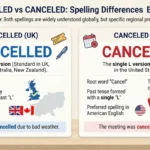
Canceled and cancelled are both correct spellings of the past tense and past participle of cancel. Canceled is the standard spelling in American English, while cancelled is more common in British English.
For U.S. writing, use canceled with one “l.” Both forms have the same meaning and pronunciation.
Key Takeaways
- Canceled is the preferred spelling in American English.
- Cancelled is the standard spelling in British English and other varieties that follow British spelling.
- Both words have the same meaning and pronunciation.
- American English also commonly uses canceling, while British English uses cancelling.
- Cancellation is normally spelled with two “l”s in American English.
Canceled vs Cancelled: What’s the Difference?
The main difference between canceled and cancelled is spelling, not meaning.
Both are forms of the verb cancel. They describe something that was stopped, called off, or no longer going to happen.
For example:
- The flight was canceled because of bad weather.
- The flight was cancelled because of bad weather.
These sentences mean exactly the same thing.
The spelling depends mainly on which variety of English you are using. In the United States, canceled with one “l” is the usual choice. In British English, cancelled with two “l”s is standard.
Oxford’s American English dictionary lists canceled as the past form of cancel and gives cancelled as the Canadian form.
So, if you are writing for an American audience, canceled is the safest and most appropriate spelling.
Is Canceled or Cancelled Correct in American English?
Canceled is the preferred spelling in American English.
This is especially useful to remember if you are writing an American email, school assignment, website, business document, news article, or social media post.
Examples:
- The meeting was canceled.
- My flight was canceled.
- The concert was canceled.
- She canceled her appointment.
- The company canceled the order.
The Associated Press, a major American news organization and style authority, specifically uses canceled with one “l” and cancellation with two.
When to Use Canceled
Use canceled when following American English spelling conventions.
For example:
The school canceled classes because of the storm.
I canceled my appointment for Friday.
The airline canceled our flight.
The company canceled the meeting at the last minute.
This spelling is especially appropriate when your target readers are in the United States.
When to Use Cancelled
Use cancelled when following British English spelling conventions.
For example:
The school cancelled classes because of the storm.
I cancelled my appointment for Friday.
The airline cancelled our flight.
The meaning does not change. Only the spelling changes.
Dictionary.com also confirms that both forms are correct, with canceled typically preferred in American English and cancelled standard in British English.
Why Does American English Use “Canceled”?
The difference comes from broader spelling differences between American and British English.
American English has historically favored some simplified spellings. One example is the treatment of a final l when certain endings are added.
That is why American English commonly has:
- cancel → canceled
- cancel → canceling
British English commonly uses:
- cancel → cancelled
- cancel → cancelling
The pattern is not unique to cancel. Similar differences appear in words such as:
| American English | British English |
| canceled | cancelled |
| canceling | cancelling |
| traveled | travelled |
| traveling | travelling |
The important point is that neither spelling is automatically a mistake. The preferred form depends on the variety of English you are using.
Canceled vs Cancelled Examples
Seeing the two forms side by side makes the difference easier to understand.
| American English | British English |
| The event was canceled. | The event was cancelled. |
| My flight was canceled. | My flight was cancelled. |
| She canceled the order. | She cancelled the order. |
| The meeting was canceled. | The meeting was cancelled. |
| The game was canceled. | The game was cancelled. |
| They canceled their trip. | They cancelled their trip. |
| The appointment was canceled. | The appointment was cancelled. |
Notice that the meaning stays exactly the same.
Example 1: Flight
American:
Our flight was canceled because of heavy snow.
British:
Our flight was cancelled because of heavy snow.
Example 2: Appointment
American:
I canceled my doctor’s appointment.
British:
I cancelled my doctor’s appointment.
Example 3: Event
American:
The outdoor concert was canceled because of rain.
British:
The outdoor concert was cancelled because of rain.
Canceled vs Cancelled: Quick Comparison
| Feature | Canceled | Cancelled |
| Meaning | Called off or stopped | Called off or stopped |
| Spelling | One “l” | Two “l”s |
| American English | Preferred | Less common |
| British English | Less common | Preferred |
| Pronunciation | Same | Same |
| Past tense of | cancel | cancel |
| Past participle of | cancel | cancel |
The simplest rule is:
American English = canceled
British English = cancelled
If you are writing specifically for people in the United States, choose canceled.
What About Canceling vs Cancelling?
The same regional spelling difference appears in the -ing form.
American English usually uses:
canceling
British English usually uses:
cancelling
For example:
- I am canceling my subscription. : American English
- I am cancelling my subscription. : British English
Oxford’s American English dictionary lists canceling as the American English form and cancelling as the Canadian form.
This means you should generally keep the spelling consistent within the same document.
If you start with American English, write:
The customer canceled the order after canceling the subscription.
Avoid switching unnecessarily to British spellings in the same piece of writing.
What About Cancellation?
This is where the spelling can become confusing.
The noun is cancellation, and it is commonly spelled with two “l”s even in American English.
For example:
The cancellation of the flight caused problems for hundreds of passengers.
We received a cancellation notice this morning.
There is a cancellation fee for late changes.
The Associated Press style is particularly clear on this point: it uses canceled and canceling, but cancellation and cancellations with two “l”s.
Oxford also lists cancellation as the standard noun, while noting that cancelation is an American English variant.
So, for ordinary U.S. writing, this is a useful pattern to remember:
- canceled ✓
- canceling ✓
- cancellation ✓
Common Mistakes to Avoid
1. Thinking “cancelled” is always wrong
It is not.
Cancelled is a correct spelling. It is simply more closely associated with British English and other varieties that use British spelling conventions.
2. Thinking “canceled” is wrong outside the United States
Not necessarily.
English has multiple standard varieties, and spelling preferences can differ by region. The important thing is to follow the spelling convention appropriate for your audience.
3. Mixing spelling styles
Consistency makes writing look more polished.
If your article uses American English, prefer:
The event was canceled, and the organizer is canceling the next event.
If you are following British English, use:
The event was cancelled, and the organizer is cancelling the next event.
4. Assuming the pronunciation changes
It does not.
Canceled and cancelled are pronounced the same way. The extra l is a spelling difference.
FAQs:
Is canceled or cancelled correct?
Both canceled and cancelled are correct. The difference is mainly regional. Canceled is preferred in American English, while cancelled is standard in British English. If you are writing for a U.S. audience, choose canceled.
Is cancelled wrong in American English?
No. Cancelled is understandable and is not an incorrect word. However, canceled is the standard preferred spelling in American English. If you are writing for a U.S. publication or audience, using canceled will better match American spelling conventions.
Is canceled American or British English?
Canceled is the preferred American English spelling. British English normally uses cancelled with two “l”s. The two forms have the same meaning and are both accepted English spellings.
Is it canceling or cancelling?
American English generally uses canceling with one “l,” while British English generally uses cancelling with two. For American writing, use canceling to stay consistent with canceled.
Why does cancellation have two Ls?
Cancellation is normally spelled with two “l”s in American English, even though American English uses canceled and canceling with one. The noun has its own established spelling. The AP Stylebook specifically uses cancellation and cancellations with two “l”s.
Conclusion:
When choosing between canceled vs cancelled, the answer depends on the variety of English you are using.
For American English, use canceled with one “l.” For British English, use cancelled with two “l”s. Both forms have the same meaning, and neither changes the pronunciation.
If your readers are primarily in the United States, the easiest rule is:
Use “canceled” for American English.
For related forms, American English generally uses canceling, while cancellation is normally written with two “l”s. Once you know this regional difference, choosing the correct spelling becomes simple.

I am Caleb Anderson, a Christian writer passionate about exploring deep biblical meanings and spiritual truths.
On Biblicaltribez.com, I share faith based insights to help readers grow closer to God through Scripture.
My writing focuses on making the Bible easy to understand, meaningful, and relevant to everyday life.