Skip to content
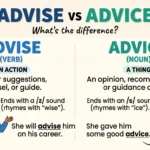
Advice is a noun that means a suggestion, recommendation, or guidance. Advise is a verb that means to give a suggestion or recommendation.
You can give advice to someone, but you advise someone. For example, “She gave me good advice” and “She advised me to wait.”
Key Takeaways
- Advice is a noun: it is the recommendation or guidance itself.
- Advise is a verb: it means to give guidance or recommend something.
- Advice ends with an /s/ sound, while advise ends with a /z/ sound.
- You say “some advice” or “a piece of advice,” not “an advice.”
- A simple rule is: give advice, but advise someone.
What Is the Difference Between Advise and Advice?
The difference between advise vs advice is mainly grammatical.
Advice is a noun. It names the suggestion, recommendation, or guidance that someone gives you.
Advise is a verb. It describes the action of giving that guidance or recommendation.
Compare these two sentences:
- My brother gave me some advice.
- My brother advised me to wait.
In the first sentence, advice is the thing being given. In the second, advised describes what the brother did.
A useful shortcut is:
Advice = recommendation
Advise = recommend
Both words are correct. You simply use them in different parts of a sentence.
Advice: The Noun
Advice means an opinion, suggestion, or recommendation about what someone should do.
For example:
- I need some advice.
- Thank you for your advice.
- Her advice helped me make a decision.
- He gave me good advice about college.
Because advice is a noun, it can follow words such as some, good, useful, helpful, and your.
Advise: The Verb
Advise means to give advice, recommend something, or guide someone.
For example:
- I advise you to leave early.
- My teacher advised me to study more.
- The doctor advised him to rest.
- We advise customers to check the instructions.
Because advise is a verb, it can change with tense:
- advise
- advises
- advised
- advising
Advise vs Advice at a Glance
| Word | Part of speech | Meaning | Example |
| Advice | Noun | A suggestion or recommendation | I need your advice. |
| Advise | Verb | To give a suggestion or recommendation | I advise you to wait. |
The easiest way to remember the difference is to ask: Am I talking about the guidance itself, or the action of giving it?
If it is the guidance itself, use advice.
If it is the action of giving guidance, use advise.
How to Use Advice in a Sentence
Use advice when you are talking about a recommendation or guidance as a thing.
For example:
- She gave me useful advice.
- I asked my parents for advice.
- His advice was easy to follow.
- Thank you for the advice.
- Can I give you some advice?
Notice that these sentences use advice as a noun.
Common Patterns With Advice
Some common expressions are:
- give advice
- get advice
- ask for advice
- receive advice
- take advice
- follow advice
- ignore advice
- some advice
- a piece of advice
For example:
My coach gave me some helpful advice before the game.
I asked my manager for advice about the new project.
She decided to follow her friend’s advice.
Why “An Advice” Is Incorrect
One common mistake is writing “an advice.”
In standard English, advice is an uncountable noun. You normally do not say:
❌ She gave me an advice.
Instead, say:
✅ She gave me some advice.
Or:
✅ She gave me a piece of advice.
You can also say two pieces of advice when you need to count individual recommendations.
How to Use Advise in a Sentence
Use advise when someone is giving guidance or making a recommendation.
A very common structure is:
advise + person + to + verb
Examples:
- I advise you to save your work.
- She advised him to call the office.
- The teacher advised us to arrive early.
- My doctor advised me to get more rest.
This structure is useful because it clearly shows who receives the recommendation and what they are being told to do.
Advise Someone Against Something
You can also use advise when recommending that someone not do something.
The common structure is:
advise + person + against + -ing
Examples:
- The lawyer advised us against signing the contract.
- My parents advised me against driving in bad weather.
- The guide advised tourists against walking alone at night.
Here, against introduces the action that is not recommended.
Advise Someone on a Topic
Advise can also mean to give guidance about a particular subject.
Examples:
- She advises students on career choices.
- The consultant advised us on financial planning.
- He advises clients on business matters.
In these sentences, advise is still a verb.
How Are Advice and Advise Pronounced?
The pronunciation is another useful way to tell these words apart.
Advice ends with an /s/ sound. It sounds roughly like “ad-VICE.”
Advise ends with a /z/ sound. It sounds roughly like “ad-VIZE.”
So:
- advice → /s/ sound
- advise → /z/ sound
For example:
“Thank you for your advice.”
“I advise you to wait.”
The difference can be subtle, but native speakers normally pronounce the final sounds differently.
Common Mistakes With Advice and Advise
These words are often confused because they look almost the same and have closely related meanings.
Mistake 1: “Please advice me”
Incorrect:
❌ Please advice me about this problem.
Correct:
✅ Please advise me about this problem.
Here, you need a verb because you are asking someone to give guidance.
Mistake 2: “Thank you for your advise”
Incorrect:
❌ Thank you for your advise.
Correct:
✅ Thank you for your advice.
Here, you are talking about the guidance you received, so you need the noun advice.
Mistake 3: “She gave me good advise”
Incorrect:
❌ She gave me good advise.
Correct:
✅ She gave me good advice.
After gave, you need the noun referring to the thing that was given.
Mistake 4: “I advice you to wait”
Incorrect:
❌ I advice you to wait.
Correct:
✅ I advise you to wait.
The sentence describes an action, so the verb advise is required.
Easy Ways to Remember the Difference
Here are two simple memory tricks.
Think: Advice = Thing
Advice is the recommendation itself.
I received some advice.
You can think of advice as something you can give, receive, ask for, or follow.
Think: Advise = Action
Advise is the action of giving a recommendation.
I advise you to wait.
Another helpful trick is to remember the final sounds:
advice → ice → /s/
advise → eyes → /z/
The pronunciation clue is useful because the final sound changes even though the words are spelled almost the same.
Advice vs Advise Examples
Seeing both words side by side makes the difference easier to remember.
| Correct Sentence | Why? |
| I need some advice. | Advice is a noun. |
| Please advise me. | Advise is a verb. |
| She gave me good advice. | Advice is the thing given. |
| She advised me to wait. | Advised shows the action. |
| His advice was helpful. | Advice is a noun. |
| I advise you to check again. | Advise is a verb. |
| They asked for our advice. | Advice is the guidance requested. |
| The teacher advised us to practice. | Advised describes the teacher’s action. |
The pattern is consistent: you give advice, and you advise someone.
FAQs:
Is it “please advise” or “please advice”?
The correct phrase is “please advise.” Here, advise is a verb meaning “please give me information or guidance.” For example, “Please advise me about the next step.” Advice is a noun, so “please advice” is incorrect.
Is advice a noun or a verb?
Advice is a noun. It refers to guidance, a suggestion, or a recommendation. For example, “She gave me some useful advice.” You can say some advice or a piece of advice, but standard English does not normally use “advice” as a countable noun.
Is advise a noun or a verb?
Advise is a verb. It means to give guidance, recommend something, or provide information. For example, “I advise you to check the details.” It can also appear in forms such as advised, advises, and advising.
Can you say “an advice”?
Usually, no. Advice is an uncountable noun in standard English. Say “some advice,” “a piece of advice,” or “a useful piece of advice.” For example, “She gave me a piece of advice before my interview.”
What is an easy way to remember advice vs advise?
Remember this simple rule: advice is a noun, and advise is a verb. You give advice, but you advise someone. You can also remember the sounds: advice ends with an /s/ sound, while advise ends with a /z/ sound.
Conclusion:
The difference between advise vs advice is simple once you focus on grammar.
Advice = noun = the recommendation.
Advise = verb = the act of giving the recommendation.
So, you can ask for advice, give advice, and follow advice. But you advise someone, advise someone to do something, or advise someone against doing something.
If you remember just one sentence, remember this:
“She gave me good advice, so I advised her to keep helping others.”

I am Caleb Anderson, a Christian writer passionate about exploring deep biblical meanings and spiritual truths.
On Biblicaltribez.com, I share faith based insights to help readers grow closer to God through Scripture.
My writing focuses on making the Bible easy to understand, meaningful, and relevant to everyday life.