Skip to content
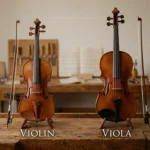
The main difference between a viola and a violin is their size, tuning, pitch, and sound. A viola is larger and tuned lower, with C-G-D-A strings, while a violin uses G-D-A-E.
Violins usually have a brighter, higher sound, while violas produce a warmer, deeper tone and mainly use alto clef.
Key Takeaways
- A viola is larger than a standard full-size violin.
- A violin is tuned G-D-A-E, while a viola is tuned C-G-D-A.
- Violas have a lower, warmer, and darker tone.
- Violin music mainly uses treble clef; viola music mainly uses alto clef.
- Neither instrument is simply “better.” Your choice depends on your sound, goals, body size, and musical interests.
Viola vs Violin: Quick Comparison
At first glance, a viola and violin can look almost identical. Both have four strings, a wooden body, a fingerboard, a bridge, and a bow. Both are held against the shoulder and played with similar basic techniques.
The important differences appear when you look at their size, tuning, range, tone, and musical role.
| Feature | Violin | Viola |
| Size | Smaller | Larger |
| Strings, low to high | G-D-A-E | C-G-D-A |
| Pitch | Higher | Lower |
| Tone | Bright and clear | Warm and darker |
| Main clef | Treble clef | Alto clef |
| Common role | Melody and high lines | Harmony and middle lines |
| Bow | Lighter | Usually somewhat heavier |
| String size | Thinner | Thicker |
The viola is not just a larger violin. Its construction and setup are designed around its lower register and distinct tone.
Size and Physical Differences
The easiest difference to see is size.
A full-size violin has a body length of about 14 inches. Adult violas are generally larger, commonly around 15 to 16.5 inches, although viola sizes vary more than violin sizes.
The extra size gives the viola more room to support its lower strings. It also affects how the instrument feels under the chin and in the left hand.
A viola can feel heavier and wider than a violin. Its strings are also thicker. This means a player may need slightly more finger pressure and bow weight to get a full sound.
Why Is the Viola Bigger?
The viola needs to produce lower notes than the violin. One way to support those lower notes is through a larger body and longer, heavier strings.
There is an important practical limitation, though. An instrument large enough to be acoustically ideal would be uncomfortable or impossible for many players to hold. Modern violas therefore use a compromise between acoustic size and practical playability. Yamaha notes that violas do not follow the same strict sizing standards as violins.
That is why two adult violas can have noticeably different dimensions.
Tuning, Strings, and Pitch
This is one of the biggest differences between the two instruments.
A violin is tuned from lowest to highest:
G-D-A-E
A viola is tuned:
C-G-D-A
The viola is therefore tuned a perfect fifth lower than the violin. It shares the violin’s G, D, and A pitches but replaces the violin’s high E string with a lower C string.
That low C string gives the viola its deeper range.
The thicker strings also contribute to the different playing feel. A beginner who moves from violin to viola may notice that the strings feel less forgiving and that the finger spacing is wider.
This does not mean the viola is automatically harder. It means the physical demands are different.
Sound and Tone
Sound is often the fastest way to tell the instruments apart.
The violin has a higher, brighter, and more projecting sound. Its high E string allows it to reach notes that give it a clear and brilliant character.
The viola has a lower, warmer, and darker tone. Yamaha describes the viola’s timbre as more somber compared with the brighter sound of the violin.
A simple way to picture the difference is to think about voices.
The violin is often compared with a soprano voice. It can rise high above an ensemble and carry a melody clearly.
The viola is closer to an alto voice. It fills the middle of the musical texture and adds warmth and depth.
These are useful comparisons, but they are not absolute rules. A skilled violist can play beautiful melodies, and violinists do not always play the main melody.
Clef and Music Reading
Another major difference is the music each instrument normally reads.
Violinists primarily read treble clef.
Violists primarily read alto clef, also called C clef. In alto clef, middle C is placed on the middle line of the staff.
This can be one of the biggest adjustments for a violinist learning viola.
The basic musical concepts remain the same, but the notes appear differently on the staff. Viola players may also read treble clef when their music reaches a high register.
So, if you already play violin, you do not need to relearn music from scratch to play viola. You mainly need to become comfortable with a different clef and adjust to the instrument’s larger dimensions.
How They Are Played
The basic playing technique is very similar.
Both instruments use:
- A bow
- Four strings
- A fingerboard
- Left-hand fingering
- Bow control
- Shifting
- Vibrato
- Similar posture
However, the larger viola changes the physical experience.
The wider finger spacing can require more reach. The thicker strings can require more pressure and a different bow approach. Viola bows are also generally somewhat heavier than violin bows.
For an experienced violinist, these changes are usually manageable. But they still require practice because good viola playing is not simply violin playing on a bigger instrument.
Role in an Orchestra or Ensemble
The violin and viola also have different typical jobs in an ensemble.
Violins often carry melodies, high musical lines, and prominent solo passages. They have an enormous solo and orchestral repertoire.
Violas often fill the middle of the musical texture. They connect the higher violin parts with lower string instruments such as the cello.
This middle role is extremely important. Removing the viola can make an ensemble sound thinner because the inner harmonies and musical colors are reduced.
In a typical orchestra, there are usually more violinists than violists. Dictionary.com notes that an orchestra may have 20 or more violins compared with around 10 violas, although exact numbers vary by ensemble.
The viola may receive less attention from the audience, but that does not make its musical role less valuable.
Which Is Harder to Play?
There is no simple answer.
The violin can be physically easier to hold because it is smaller and has thinner strings. However, violinists often face demanding high passages, difficult solo repertoire, and intense technical requirements.
The viola has a larger body, wider finger spacing, thicker strings, and the added challenge of learning alto clef.
So, rather than asking which instrument is easier, it is more useful to ask which challenges suit you better.
If you already play violin, the basic technique transfers well to viola. You will mainly need to adjust your left hand, bow technique, sound production, and music reading.
Violin or Viola: Which Should You Choose?
Neither instrument is universally better.
Your choice should depend on the sound you enjoy, your physical comfort, and the kind of music you want to play.
Choose the Violin If…
The violin may be a better fit if you:
- Love bright, high-pitched sounds.
- Want to play many famous solo works.
- Enjoy fast melodic passages.
- Prefer a smaller instrument.
- Want a large selection of beginner materials and repertoire.
- Are especially interested in carrying melodies.
The violin is also a practical starting point for many young players because smaller fractional sizes are widely available.
Choose the Viola If…
The viola may suit you if you:
- Prefer warm, rich, lower sounds.
- Enjoy harmony and inner musical parts.
- Like the idea of playing in orchestras or chamber groups.
- Do not mind learning alto clef.
- Have the body size and reach to play the instrument comfortably.
- Want an instrument with a sound that sits between the violin and cello.
The best choice is not always the instrument with the most famous solo repertoire. The best choice is the one that makes you want to practice.
Can a Violinist Play Viola?
Yes. Many violinists learn to play viola because the instruments share much of the same basic technique.
A violinist already understands bowing, fingering, shifting, vibrato, rhythm, and string playing. The biggest adjustments are usually the larger instrument, wider finger spacing, thicker strings, different bow feel, and alto clef.
The transition works in the opposite direction too. A violist can learn violin, although the smaller finger spacing and higher register will require adjustment.
The key is to treat the second instrument as its own instrument rather than assuming that technique can be copied perfectly.
FAQs:
What is the main difference between a viola and a violin?
The main differences are size, tuning, pitch, tone, and clef. The viola is larger and tuned lower at C-G-D-A. The violin is smaller and tuned G-D-A-E. Violins usually have a brighter sound and use treble clef, while violas have a warmer sound and primarily use alto clef.
Is a viola bigger than a violin?
Yes. A full-size violin has a body length of about 14 inches, while adult violas are commonly around 15 to 16.5 inches. Viola sizing is less standardized, so individual instruments can vary considerably.
Is viola harder to play than violin?
Neither is simply harder. The viola is larger and has thicker strings and wider finger spacing, while its alto clef adds a reading challenge. The violin has its own demanding technical and musical challenges. Difficulty depends on the player and the type of music being performed.
Which is better for a beginner?
Either can be a good choice. A beginner who loves a bright, high sound may prefer violin, while someone who enjoys a deeper, warmer tone may prefer viola. Physical size also matters, especially for children. Trying both instruments with a qualified teacher is one of the best ways to decide.
Do violin and viola use the same strings?
Not exactly. Both have four strings and share G, D, and A pitches, but the violin has a high E string while the viola has a low C string. Viola strings are generally thicker to support its lower tuning.
Why does the viola use alto clef?
The viola’s comfortable playing range is lower than the violin’s. Alto clef places more of the viola’s notes within the staff, reducing the need for excessive ledger lines. Viola parts can switch to treble clef when the music moves into a higher register.
Conclusion:
The viola vs violin choice comes down to more than size.
The violin is smaller, higher-pitched, and brighter. The viola is larger, lower, and warmer. They use similar playing techniques, but their different tuning, strings, physical dimensions, and clefs create distinct musical experiences.
If you want soaring melodies and a bright sound, the violin may be your natural choice. If you prefer rich middle tones and deeper musical color, the viola may be a better match.
If possible, play both before deciding. The instrument that feels comfortable and sounds exciting to you is often the best one to learn.

I am Joseph Parker, a devoted Bible content writer dedicated to sharing God’s Word with clarity and purpose.
Through Biblicaltribez.com, I create inspirational and scripture-centered articles that strengthen faith.
My goal is to guide readers into a deeper understanding of biblical teachings and Christian living.