Skip to content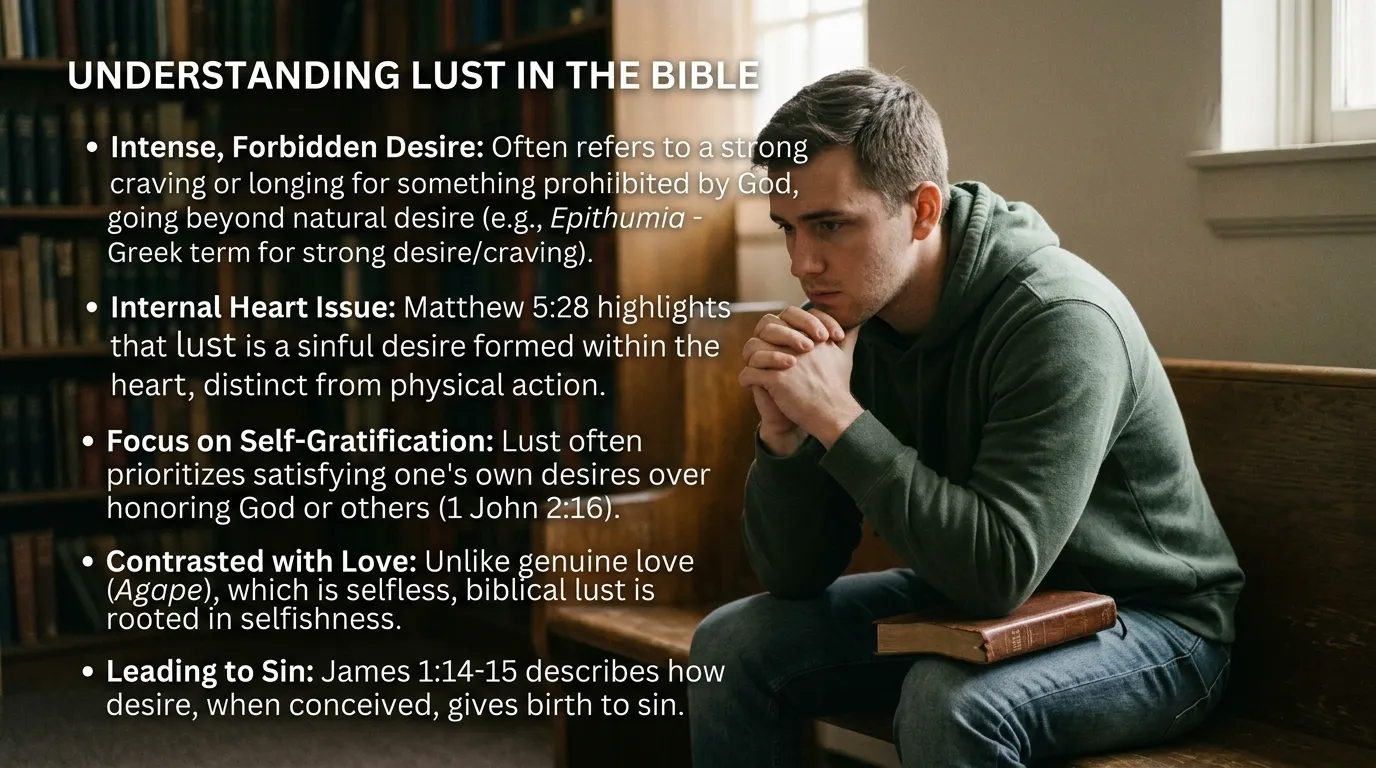
If you have ever asked what is lust in the Bible, you are not alone. The Bible talks about lust as more than a passing feeling or simple attraction.
It points to a desire that moves the heart toward something God does not permit. Jesus gives this issue special attention in Matthew 5:27–28, where He teaches that sin can begin in the heart before it becomes an outward act.
This article explains what lust means in Scripture, how it differs from normal attraction, what Jesus taught about it, and how a Christian can respond when lustful thoughts appear. You will also see key Bible verses, common mistakes, and simple steps that can help you guard your heart.
Quick Answer
What is lust in the Bible? Lust is a strong, sinful desire that pulls a person toward what God forbids. Scripture often connects lust with sexual desire, but the word can also describe an unhealthy craving for things such as money, power, or pleasure.
The Bible does not teach that every feeling of attraction is sinful. The problem comes when desire becomes selfish, impure, or directed toward something God has forbidden.
Definition & Meaning of Lust in the Bible
The Bible presents lust as a matter of the heart, mind, and will. It is not only about what a person does with the body. It can also involve what a person chooses to feed in the mind.
Jesus said:
“Everyone who looks at a woman with lustful intent has already committed adultery with her in his heart.” : Matthew 5:28, ESV
Jesus was speaking about more than noticing someone’s beauty. He addressed a deliberate desire that treats another person as an object for personal sexual satisfaction.
This helps us see an important difference:
- Attraction can happen naturally.
- Temptation can come without your choice.
- Lust involves feeding a sinful desire.
- Action occurs when someone acts on that desire.
The Bible calls believers to deal with sinful desire at its source rather than waiting until it becomes an outward act.
What Does Lust Mean in the Bible?
The meaning of lust can change slightly based on the Bible passage.
In many passages, lust refers to a strong desire that goes against God’s will. Sexual lust is one clear example, but Scripture uses the idea more broadly.
For example, 1 John 2:16 speaks about the “lust of the flesh,” the “lust of the eyes,” and the pride of life. This shows that sinful desire is not limited to sex.
Lust can involve:
- Sexual desire outside God’s design
- Craving what belongs to another person
- Greed for money or possessions
- A strong desire for status or power
- Envy of what others have
- Uncontrolled desire for pleasure
The key issue is not simply how strong the desire feels. The deeper issue is whether the desire turns away from God’s good purpose.
What Did Jesus Say About Lust?
Jesus gives one of the clearest teachings about lust in the Sermon on the Mount.
Matthew 5:27–28 says that while the law forbids adultery, Jesus also addresses the inner desire behind the act. He teaches that a person who looks at another with lustful intent has already committed adultery in the heart.
This teaching shows the depth of biblical holiness.
God cares about:
- What we do
- What we think about
- What we desire
- What we choose to dwell on
- How we treat other people
Jesus was not saying that every unwanted thought makes someone guilty of adultery. His teaching focuses on the heart that willingly entertains sinful sexual desire.
That distinction matters because many people feel shame over thoughts they did not choose.
Is Sexual Attraction the Same as Lust?
No. Sexual attraction and biblical lust are not exactly the same thing.
Attraction can be a normal part of human life. Scripture itself presents marriage, sexual love, and physical desire within God’s design as good gifts.
The problem begins when desire crosses God’s boundaries.
For example, simply noticing that someone is attractive does not mean you have chosen lust. But if you deliberately keep looking, build sexual fantasies, or use another person in your mind for selfish pleasure, you are moving into the kind of desire Jesus warns against.
A helpful question is:
“Am I simply noticing this person, or am I choosing to use this person in my thoughts for sinful desire?”
That question can help bring clarity.
Lust in the Old Testament
The Old Testament also shows how sinful desire can lead people away from God.
One well-known example appears in Exodus 20:17:
“You shall not covet your neighbor’s house; you shall not covet your neighbor’s wife…” : Exodus 20:17, ESV
The command against coveting deals with desire itself.
The issue is not only taking something that belongs to another person. God also warns against cultivating a desire to possess what He has not given us.
Job gives another helpful example. Job 31:1 says:
“I have made a covenant with my eyes…” : Job 31:1, ESV
This principle still has value today.
Lust in the New Testament
The New Testament speaks openly about sinful desire.
James 1:14–15 gives a useful picture of how temptation can develop. A person can be drawn away by desire, and when desire is embraced, it can give birth to sin.
Paul also tells believers to put sinful desires to death.
Colossians 3:5 says:
“Put to death therefore what is earthly in you: sexual immorality, impurity, passion, evil desire…” : Colossians 3:5, ESV
Paul does not tell Christians to simply manage sinful desire forever. He calls them to turn away from it and live under the rule of Christ.
Common Biblical Terms Connected With Lust
| Biblical idea | What it means | Better response |
| Lust | Sinful or uncontrolled desire | Turn your mind toward God |
| Coveting | Wanting what God has not given you | Practice contentment |
| Temptation | An invitation toward sin | Resist rather than feed it |
| Sexual immorality | Sexual behavior outside God’s design | Follow biblical sexual purity |
| Self-control | The ability to govern desires | Depend on God’s Spirit |
How Is Lust Different From Temptation?
This is one of the most important points to understand.
Temptation is not the same as sin.
Jesus Himself was tempted in the wilderness, yet He did not sin. Hebrews 4:15 teaches that Christ was tempted “in every respect as we are, yet without sin.”
A tempting thought may enter your mind without your permission.
The key question is what you do next.
You can:
- Notice the thought.
- Reject it.
- Turn your attention elsewhere.
- Pray for strength.
- Choose a better thought or action.
You do not have to keep thinking about every thought that enters your mind.
What Causes Lustful Thoughts?
Lust can have many triggers. The Bible focuses strongly on the condition of the heart, but daily habits can also shape what we repeatedly think about.
Common triggers may include:
- Sexual images
- Certain social media accounts
- Pornography
- Private fantasies
- Unhealthy relationships
- Flirtation that crosses clear boundaries
- Boredom
- Repeated exposure to sexual content
This does not mean every temptation comes from one source. People differ.
The wise response is to notice your patterns and remove what repeatedly pulls you toward sin.
How Can Christians Overcome Lust?
The Bible does not present victory as a single trick. It points to a changed life that depends on God.
1. Guard Your Eyes
Job’s example shows the value of setting boundaries.
If certain content repeatedly feeds sinful desire, do not keep testing yourself. Remove it.
That may mean unfollowing accounts, avoiding certain websites, or changing what you watch.
2. Control What You Feed Your Mind
Philippians 4:8 tells believers to think about things that are true, honorable, pure, lovely, and worthy of praise.
Your mind needs better food.
Do not only ask, “What should I stop watching?”
Also ask, “What should I start thinking about?”
3. Run From Sexual Sin
Paul gives strong advice in 1 Corinthians 6:18:
“Flee from sexual immorality.”
Notice the word flee.
Sometimes the wise Christian response is not to debate temptation but to leave the situation.
4. Pray Honestly
You do not need impressive words.
Tell God what you are facing. Ask for strength, wisdom, and a clean heart.
Psalm 51:10 gives a simple prayer:
“Create in me a clean heart, O God, and renew a right spirit within me.”
5. Walk by the Spirit
Galatians 5:16 says:
“Walk by the Spirit, and you will not gratify the desires of the flesh.”
Christian growth involves more than saying no. It means learning to live under the direction of God’s Spirit.
6. Seek Wise Help
If lust has become a repeated pattern that you cannot break alone, talk with a mature and trustworthy Christian leader, pastor, or counselor.
Asking for help is not a sign of spiritual failure. Honest support can help you identify patterns, set boundaries, and build healthier habits.
What Are the Most Common Mistakes Christians Make?
Many people respond to lust in ways that make the struggle worse.
| Mistake | Why it can hurt | Better approach |
| Treating every attraction as sin | Creates needless shame | Separate attraction from chosen lust |
| Hiding the struggle | Keeps the pattern private | Seek wise, trusted support |
| Feeding temptation | Makes sinful desire stronger | Remove known triggers |
| Depending only on willpower | Can ignore deeper habits | Pray and build wise boundaries |
| Giving up after failure | Leads to hopelessness | Confess, learn, and begin again |
Does the Bible Say Lust Is Always Sexual?
No.
The Bible uses the concept of sinful desire in a broader way.
Romans 7:7 discusses coveting, while 1 John 2:16 describes several forms of worldly desire. These passages show that lust can describe a craving that turns the heart away from God.
Still, sexual lust receives special attention in Christian teaching because Scripture repeatedly connects sexual desire with purity, marriage, self-control, and the proper treatment of others.
So when people ask about lust in the Bible, sexual lust is often the main concern, but it is not the only form.
What Does the Bible Say About Lustful Thoughts?
The Bible calls believers to control their thoughts rather than surrender to them.
2 Corinthians 10:5 speaks of taking thoughts captive to obey Christ.
This does not mean you can prevent every unwanted thought from appearing. It means you can learn not to welcome and develop sinful thoughts.
A practical pattern is:
Recognize → Reject → Replace → Refocus
For example:
- Recognize: “This thought is pulling me toward sin.”
- Reject: Do not keep building the fantasy.
- Replace: Turn to prayer or a healthy task.
- Refocus: Put your attention on something good.
This simple pattern can help you respond before temptation grows.
What Is the Biblical View of Sexual Desire?
The Bible does not teach that the human body or sexual desire is evil.
Genesis presents marriage and human sexuality within God’s created order. Proverbs 5 also speaks positively about marital love.
The biblical concern is where sexual desire goes and how a person expresses it.
God’s design places sexual intimacy within marriage. Lust, by contrast, takes desire outside its proper boundaries and often reduces another person to an object of personal satisfaction.
That is why biblical teaching calls for both purity and honor.
Quick Reference: Fighting Lust in Daily Life
| Situation | Practical response | Bible principle |
| You see tempting content | Look away and leave it | Job 31:1 |
| A sexual thought appears | Do not feed it | 2 Corinthians 10:5 |
| A trigger keeps returning | Remove the trigger | Romans 13:14 |
| You feel weak | Pray for help | Matthew 26:41 |
| You fall into sin | Confess and turn back | 1 John 1:9 |
| You keep struggling | Seek wise support | Proverbs 11:14 |
Is Lust a Sin If You Do Not Act on It?
Jesus’ teaching in Matthew 5:28 shows that sinful desire matters even before outward action.
However, this does not mean every unwanted thought is a deliberate sin.
There is an important difference between an intrusive or unwanted thought and a thought that you knowingly choose to entertain.
When a thought appears, you can turn away from it. The goal is not to live in fear of your own mind. The goal is to train your heart toward what honors God.
Can God Forgive Lust?
Yes.
The Christian message includes forgiveness and restoration.
1 John 1:9 says that when believers confess their sins, God is faithful and just to forgive and cleanse them.
Failure does not mean you should stop seeking God.
If you fall, do not hide from Him. Confess the sin, learn from what happened, remove the trigger when possible, and return to the path of obedience.
Grace does not make sin unimportant. Grace gives the sinner a way back.
FAQs:
1. What is lust in the Bible according to Jesus?
Jesus describes lust in Matthew 5:28 as a sinful sexual desire that a person deliberately entertains in the heart. His teaching shows that God cares about inner desires, not only outward behavior.
2. Is attraction to someone a sin?
No. Simply finding someone attractive is not the same as choosing lust. The key issue is whether you deliberately turn attraction into sinful desire or fantasy.
3. Is temptation the same as lust?
No. Temptation can happen without your choice. Lust involves embracing and feeding a sinful desire. Hebrews 4:15 shows that Jesus faced temptation without sinning.
4. What Bible verse talks about lust?
Several passages address sinful desire. Matthew 5:28 is one of the clearest, while 1 John 2:16, James 1:14–15, Job 31:1, and Colossians 3:5 also help explain the subject.
5. How do I stop lustful thoughts according to the Bible?
Do not feed the thought. Turn away from known triggers, pray, fill your mind with what is good, and seek support when needed. Scriptures such as Philippians 4:8 and Galatians 5:16 offer useful guidance.
6. Does God forgive sexual lust?
Yes. The Bible teaches that God forgives confessed sin. First John 1:9 gives believers a clear promise of forgiveness and cleansing. Genuine repentance also means turning away from the sinful pattern.
7. Can a Christian struggle with lust and still follow God?
Yes. Christians can face temptation and struggle with sinful habits. The important response is not to accept sin as normal, but to keep turning toward God, practicing self-control, seeking help, and growing in holiness.
Conclusion:
So, what is lust in the Bible? In simple terms, lust is a sinful desire that pulls the heart toward something outside God’s will. Scripture shows that this can include sexual desire, coveting, greed, and other uncontrolled cravings.
Jesus teaches us to look beyond outward actions and examine the heart. At the same time, the Bible does not call every attraction or unwanted thought sinful. What matters is how we respond.
If lust is part of your struggle, do not live in shame or give up. Guard your eyes, change harmful habits, pray honestly, fill your mind with good things, and seek wise help when needed. God’s call is not only to avoid sin but to grow into a life marked by purity, love, self-control, and grace.

I am Samuel Brooks, a Christian author who enjoys breaking down complex Bible concepts into simple truths. At Biblicaltribez.com, I write content that inspires faith, hope, and spiritual growth. I aim to help readers connect Scripture with real life challenges in a meaningful way.