Skip to content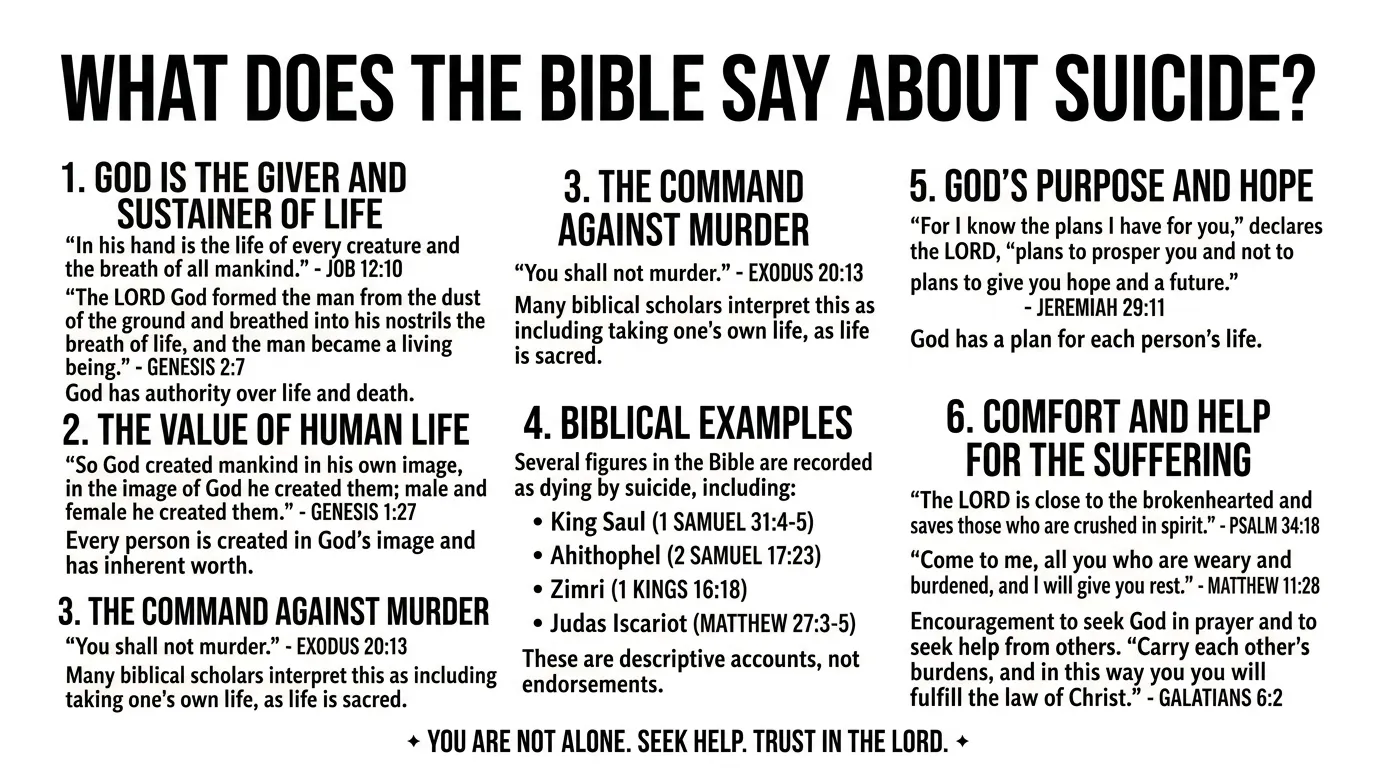
If you are asking what does the Bible say about suicide, you may be dealing with deep pain, grief, fear, or questions about someone you love. This is not a small subject. It needs truth, but it also needs compassion.
The Bible does not give one verse that says, “Suicide is…” and settles every question. Instead, Scripture gives us a wider picture. It teaches that human life has value, that God sees people in their darkest moments, and that despair does not have the final word.
The Bible also records several deaths that involve suicide or self-killing. These stories show pain, fear, pride, shame, defeat, and hopelessness. Yet Scripture does not present suicide as the answer to suffering.
This article explains the biblical teaching in simple terms. It also looks at salvation, forgiveness, suffering, and what Christians can do when someone feels that life is too hard to bear.
If you are thinking about killing yourself right now, please do not face this moment alone. Move away from anything you could use to hurt yourself and get near a trusted person. Contact your local emergency service or go to the nearest emergency department. A pastor, doctor, counselor, or trusted friend can stay with you while the crisis passes.
Quick Answer
So, what does the Bible say about suicide?
The Bible treats human life as valuable and does not teach suicide as a good or proper response to suffering. Scripture records several people who died by suicide, but these accounts do not present their actions as examples for believers to follow. The Bible instead points people toward God, prayer, community, endurance, and hope.
The Bible also does not say that a person who dies by suicide is automatically beyond God’s mercy or automatically condemned. Christians differ on some details of salvation, but Scripture warns us against claiming knowledge of a person’s final spiritual state.
Definition & Meaning
Suicide means intentionally causing one’s own death. The Bible uses different stories rather than giving a modern medical definition of suicide.
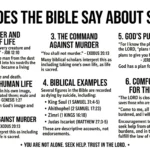
Several biblical figures died in ways that we would describe as suicide today. These include Saul, his armor-bearer, Ahithophel, Zimri, and Judas. Samson’s death is also discussed in this context, although his story has important differences because he died while bringing down the Philistine temple during an act of judgment and sacrifice.
The important point is this: the Bible reports these deaths, but reporting an event does not mean God approves it.
That distinction helps us read Scripture with care.
What Does the Bible Say About Suicide and the Value of Life?
The Bible presents life as a gift from God.
Genesis teaches that human beings are made in the image of God (Genesis 1:26–27). This gives human life special worth.
The commandment, “You shall not murder” (Exodus 20:13), also shows the serious value Scripture places on human life.
The Bible does not treat people as disposable. It calls us to protect life, love our neighbors, care for the weak, and help people who suffer.
This matters when we think about suicide.
A person in severe emotional pain may feel worthless or believe that death is the only way to end the pain. Scripture gives a very different message. Human worth does not depend on success, money, health, relationships, or current feelings.
A person’s value comes from God.
Is Suicide a Sin in the Bible?
Many Christian traditions understand suicide as sinful because it involves intentionally taking a human life, including one’s own.
But we should make an important distinction.
Saying that suicide is morally wrong is not the same as saying that everyone who dies by suicide had the same motives, mental state, understanding, or level of responsibility.
The Bible gives us reason to take sin seriously. It also gives us reason to show mercy.
Only God fully knows the heart, the mind, the circumstances, and the final moments of a person.
So Christians should avoid making confident statements about a person’s eternal destiny based only on the fact that the person died by suicide.
Suicide in the Bible: People Who Died This Way
The Bible contains several difficult stories.
Saul
In 1 Samuel 31:4–5, Saul fell on his sword after he was badly wounded and feared capture by the Philistines. His armor-bearer then died in the same way.
The text describes what happened. It does not praise Saul’s choice.
Saul’s larger story contains fear, disobedience, pride, jealousy, and spiritual decline. His death should not be read as God’s command or as a model for handling suffering.
Ahithophel
Ahithophel was a respected adviser. When his advice was rejected during Absalom’s rebellion, he returned home, put his affairs in order, and died by suicide (2 Samuel 17:23).
His story shows how humiliation and hopelessness can shape a person’s thinking.
It also reminds us that a terrible moment can feel final even when we cannot see what God may do next.
Zimri
Zimri became king of Israel but ruled for only a short time. When he saw that the city had been captured, he burned the royal palace around himself and died (1 Kings 16:18).
Again, Scripture records the event without presenting it as something believers should copy.
Judas
Matthew 27:5 records Judas’s death after he betrayed Jesus.
Judas felt deep remorse after his betrayal, but instead of bringing that guilt to Jesus, his story ended in despair.
His story gives an important warning: guilt needs to move toward God, not toward hopelessness.
What Does God Say About Suicide and Despair?
One of the most helpful parts of the Bible is that it does not hide human despair.
Some faithful people wanted to die.
Elijah, after a period of great stress and fear, became deeply discouraged and asked God to take his life (1 Kings 19:4).
Jonah also became so distressed that he wanted to die (Jonah 4:3, 8).
Job experienced extreme suffering and wished that he had never been born (Job 3:1–26).
These passages matter because they show that the Bible does not pretend that faithful people never experience overwhelming pain.
But notice what happens.
God does not tell Elijah that his life has no value. God cares for him, gives him rest, provides food, and continues to guide him (1 Kings 19:5–18).
That gives us a powerful biblical lesson:
Feeling that you want to die is not the same as God saying that you should die.
Bible Verses About Suicide, Suffering, and Hope
The Bible does not contain a simple verse that answers every question about suicide. But many passages speak directly to the despair behind suicidal thoughts.
Psalm 34:18 says that the Lord is near to the brokenhearted.
This is a strong reminder that pain does not push God away.
Psalm 42:5 shows a person speaking honestly to his own troubled soul while still placing hope in God.
Isaiah 41:10 tells God’s people not to fear because God is with them and strengthens them.
Matthew 11:28 records Jesus inviting the weary to come to Him for rest.
Romans 8:38–39 teaches that nothing in creation can separate believers from the love of God in Christ.
These verses do not replace professional care or emergency help. They give spiritual hope while a hurting person also receives the practical help they need.
Suicide and Salvation: Does Suicide Mean Someone Goes to Hell?
This is one of the hardest questions families ask.
The Bible does not say, “Everyone who dies by suicide goes to hell.”
It also does not give us permission to declare with certainty that a particular person is saved or lost based only on the manner of death.
Christian beliefs about this question vary. Some traditions place strong emphasis on the seriousness of suicide as a grave sin. Others emphasize that salvation rests on God’s grace and a person’s relationship with Christ, not on whether a person had an opportunity to confess every sin before death.
For example, Christians often point to passages such as Ephesians 2:8–9, Romans 8:1, and John 10:27–29 when discussing salvation and God’s grace.
The safest biblical approach is humility.
We should not pretend to know what only God knows.
When a family loses someone to suicide, adding a confident judgment about that person’s eternal destiny can deepen their grief. Christians can instead point grieving people toward God’s justice, mercy, and perfect knowledge.
Does the Bible Say Suicide Is the Unforgivable Sin?
No.
Jesus identifies blasphemy against the Holy Spirit as a uniquely serious sin in passages such as Mark 3:28–29. Scripture does not identify suicide as the unforgivable sin.
This does not make suicide acceptable.
It means we should not tell grieving families that suicide itself proves a person cannot receive God’s mercy. Christian teachers have also argued that suicide should not automatically be treated as the unforgivable sin.
There is still much Christians should leave in God’s hands.
God knows every person’s heart better than we do.
Mistakes vs. a Better Christian Response
| Common Mistake | Better Response |
| Saying suicide automatically means hell | Leave final judgment to God |
| Calling someone weak for struggling | Listen without shame |
| Using Bible verses to silence pain | Use Scripture to offer hope and comfort |
| Telling someone to “just pray” | Pray, listen, and seek practical help |
| Keeping suicidal thoughts secret | Tell a trusted person and seek help |
| Treating mental suffering as simple sin | Take emotional pain seriously and seek proper care |
What Should Christians Do When Someone Feels Suicidal?
A biblical response should be loving, calm, and practical.
First, stay with the person if you believe they may hurt themselves soon. Do not leave them alone simply because you feel unsure about what to say.
Second, listen.
You do not need a perfect speech. You can say, “I am here with you,” or “We will get through this moment together.”
Third, take the danger seriously.
Do not promise to keep a suicidal plan secret. Getting help is not betrayal. It can protect a life.
Fourth, connect the person with qualified help. A doctor, mental-health professional, emergency service, crisis service, pastor, or trusted family member can become part of the support system.
Fifth, use faith as support, not as a weapon.
Prayer, Scripture, church community, and pastoral care can bring comfort. They should work alongside appropriate professional and emergency support when needed.
Quick Reference Checklist
| Situation | What to Do |
| Someone says they want to die | Take the words seriously |
| They may hurt themselves soon | Stay with them and seek emergency help |
| They have access to something dangerous | Help create distance from it |
| They ask you to keep it secret | Explain that safety comes first |
| They feel ashamed | Respond with kindness, not blame |
| They want spiritual support | Pray and share hopeful Scripture |
| The crisis has passed | Encourage ongoing professional and pastoral support |
| Someone died by suicide | Give the family space, compassion, and support |
What Can We Learn From Elijah?
Elijah’s story may be one of the clearest biblical examples of how God responds to a person in deep distress.
After major conflict and intense pressure, Elijah became exhausted and afraid. He wanted to die.
God’s first response was not a lecture.
Elijah received rest and food.
Later, God spoke with him, helped him understand what was happening, and gave him another task.
This does not mean every crisis will end in the same way. But it shows an important truth.
God can meet people in places of extreme weakness.
Sometimes help begins with very simple things: rest, food, safety, another person nearby, honest conversation, prayer, and professional care.
What Does the Bible Say About Helping the Brokenhearted?
Scripture repeatedly calls God’s people to care for others.
Galatians 6:2 says believers should “bear one another’s burdens.”
Romans 12:15 tells Christians to weep with those who weep.
1 Thessalonians 5:14 calls believers to encourage the discouraged and help the weak.
These teachings matter when someone struggles with suicidal thoughts.
A Christian does not need to solve another person’s entire life.
Sometimes the most faithful action is to stay close, listen, pray, and help the person reach someone who can provide the right care.
How Should Families Respond After a Suicide?
Families often experience grief mixed with guilt, anger, confusion, and unanswered questions.
They may ask:
“Could I have stopped it?”
“Did I miss a warning?”
“Is my loved one with God?”
“Why did this happen?”
There may not be quick answers.
Christians should resist the urge to give simple explanations for a complex death. Instead, offer presence and compassion.
Let grieving people cry. Let them ask hard questions. Pray with them if they want prayer. Help with meals, daily tasks, and practical needs.
Most of all, do not turn grief into blame.
God sees what human beings cannot see.
Why Hope Matters in the Christian View of Suicide
Christian hope does not mean pretending that pain is small.
The Bible openly talks about suffering, tears, fear, loneliness, and death.
But it also points beyond them.
Psalm 23 speaks of God’s presence in the darkest valley.
Jesus promises rest to those who are weary.
Romans 8 points believers toward God’s love.
Revelation 21:4 gives the Christian hope of a future where death, mourning, crying, and pain will no longer have the final word.
That hope does not erase today’s pain.
It tells us that today’s pain is not the whole story.
FAQs:
1. Is suicide a sin according to the Bible?
Most Christian traditions consider suicide morally wrong because human life belongs to God and should be protected. At the same time, Christians should avoid reducing a person’s entire spiritual story to the act of suicide. God alone fully knows the person’s heart and circumstances.
2. Does suicide automatically send a person to hell?
The Bible does not say that suicide automatically sends someone to hell. Scripture teaches that salvation involves God’s grace and faith, while final judgment belongs to God. Christians should be careful not to make claims about an individual’s eternal destiny that Scripture does not clearly make.
3. What does the Bible say about someone who wants to die?
The Bible contains several people who expressed a desire to die, including Elijah and Jonah. Their stories show that deep despair can happen to people who know God. Scripture responds by pointing people back toward God’s presence, care, and hope.
4. Is suicide the unforgivable sin?
No. The Bible does not identify suicide as the unforgivable sin. Jesus’ warning about the unforgivable sin appears in passages such as Mark 3:28–29.
5. Are there people in the Bible who died by suicide?
Yes. Scripture records deaths involving Saul, Saul’s armor-bearer, Ahithophel, Zimri, and Judas. Samson’s death is also sometimes included in discussions of suicide, although his situation is distinct because of the circumstances of his final act.
6. What should I do if I have suicidal thoughts?
Tell someone you trust today. Stay around other people, move away from anything you could use to hurt yourself, and seek urgent professional or emergency help if you may act soon.
7. How can Christians help someone with suicidal thoughts?
Listen without shame, stay with the person when danger is high, take their words seriously, and help them reach qualified care. Pray with them if they welcome it. Share hope, but do not use Scripture to dismiss their pain or tell them that faith means they should simply “get over it.”
Conclusion:
So, what does the Bible say about suicide? Scripture shows that human life has great value and does not present suicide as God’s answer to suffering.
The Bible records several tragic deaths and also gives us stories of people who felt deep despair. These stories remind us that pain can become overwhelming, but God does not abandon people in their darkest moments.
The Bible also does not teach that suicide automatically determines a person’s eternal destiny. Final judgment belongs to God.
If you or someone you know is struggling with suicidal thoughts, seek help now. Stay close to safe people, pray, reach out, and involve qualified care. Your pain deserves attention, and your life is worth protecting.

I am Joseph Parker, a devoted Bible content writer dedicated to sharing God’s Word with clarity and purpose.
Through Biblicaltribez.com, I create inspirational and scripture-centered articles that strengthen faith.
My goal is to guide readers into a deeper understanding of biblical teachings and Christian living.