Skip to content
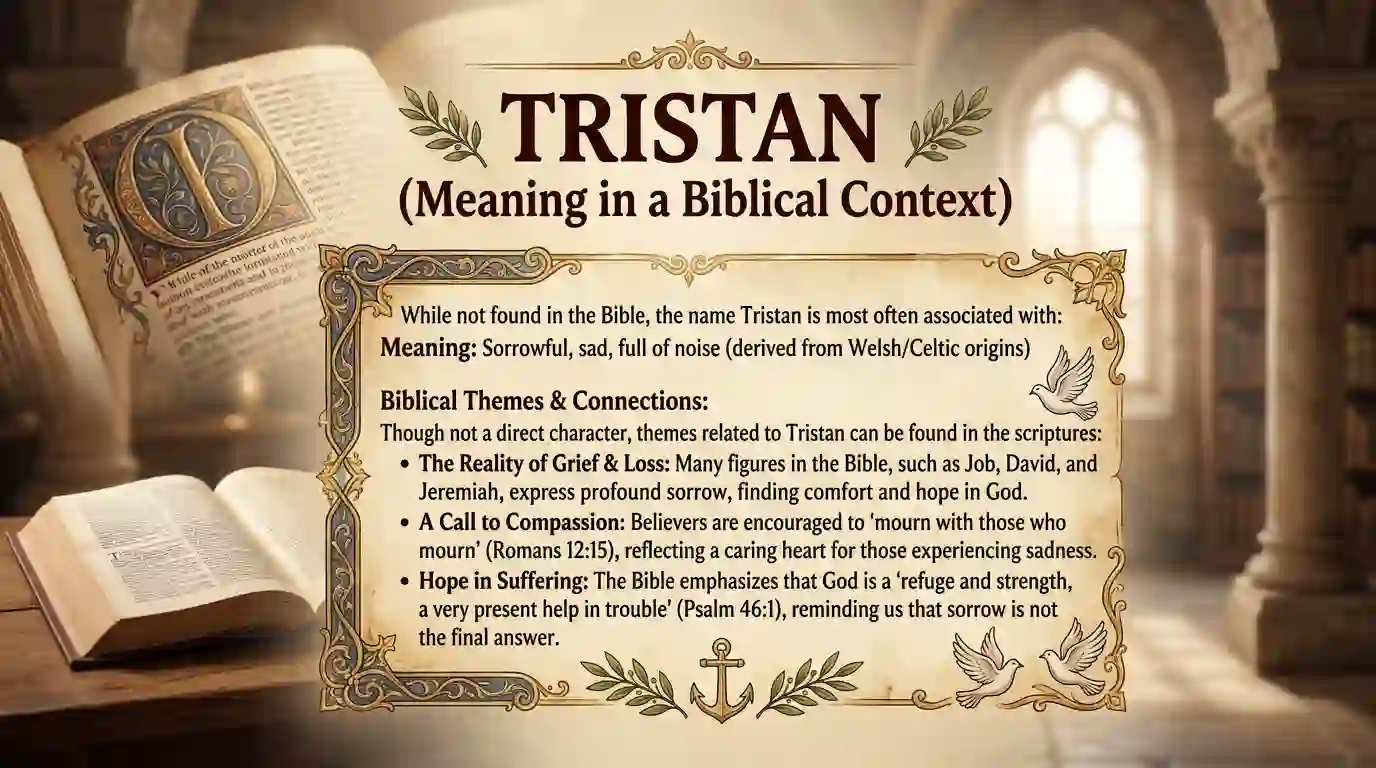
The name Tristan does not appear in the Bible and has no established biblical meaning. It is generally traced to the old Pictish name Drustan, with later influence from the Old French word triste, meaning “sad.” Although Tristan is not a biblical name, Christian parents may connect it symbolically with biblical themes of comfort, perseverance, and hope.
Key Takeaways
- Biblical status: Tristan is not a name recorded in the Bible.
- Origin: Its history is probably connected with Pictish and other Celtic naming traditions.
- Meaning: The name is commonly associated with sadness, although its deeper etymology remains uncertain.
- Spiritual significance: Christians may associate Tristan with comfort and hope, but these are interpretations rather than biblical definitions.
- Christian use: A family can choose Tristan as a Christian name without claiming that it comes from Scripture.
Does the Name Tristan Appear in the Bible?
No, Tristan does not appear as a personal name in the Old Testament or New Testament. The Bible does not identify a prophet, king, apostle, or other biblical figure named Tristan.
This distinction matters when researching the Tristan name meaning Bible connection. Some names have documented Hebrew, Greek, or other ancient biblical origins. Tristan belongs to a different naming tradition, with historical roots in medieval Europe.
However, a name does not have to appear in Scripture to be meaningful to a Christian family. Parents may choose names because of their sound, cultural history, family connections, or the values they hope to encourage in their children.
The important point is to distinguish between what the Bible actually says and what someone personally associates with a name.
What Does the Name Tristan Mean?
Tristan is a masculine given name best known for its association with sadness and the medieval romance of Tristan and Isolde. However, its precise historical origin is not completely certain.
The name is commonly linked to the old Pictish name Drustan, a diminutive of Drust. Its later form was probably influenced by the Old French word triste, meaning “sad.”
These explanations describe different parts of the name’s history. They should not be combined into a claim that Tristan has one universally accepted translation.
The Possible Celtic and Pictish Origin
Name reference sources generally trace Tristan to Drustan, associated with the Picts, an ancient people of what is now Scotland. Related forms include the Welsh names Trystan and Drystan.
The deeper meaning of Drust is uncertain. Some explanations connect it with ideas such as noise or tumult, but this interpretation should not be treated as settled fact.
For parents researching baby names, the distinction is useful: Tristan has a European historical background, not a documented biblical or Hebrew origin.
Why Tristan Is Associated With Sadness
The association with sadness comes partly from the similarity between Tristan and the Old French word triste. This connection became especially memorable through the medieval story of Tristan and Isolde.
In this tragic romance, Tristan and Isolde fall in love under circumstances that lead to conflict and heartbreak. Versions of the story developed across medieval European literature, and the name became strongly associated with tragic love.
The literary association helps explain why baby-name websites often describe Tristan as meaning “sad” or “sorrowful.” Still, a literary association is not the same as a proven original meaning.
A careful summary is that Tristan has a probable Pictish connection and a well-established historical association with sorrow.
What Is the Spiritual Meaning of Tristan?
There is no official spiritual meaning of Tristan given in the Bible. Nevertheless, Christian families may use the name as an opportunity to reflect on themes such as compassion, courage, perseverance, and hope.
If you associate Tristan with sorrow, you can connect that association with biblical teachings about God’s care for people who suffer. These connections are personal interpretations, not claims about the name’s original linguistic meaning.
Psalm 34:18 and Comfort in Sorrow
Psalm 34:18 teaches that the Lord is near to the brokenhearted and saves those who are crushed in spirit.
This verse offers a meaningful Christian reflection for anyone who associates Tristan with sadness. It reminds readers that grief does not make a person forgotten or abandoned by God.
Parents who appreciate this message might see the name as a reminder to show compassion toward people experiencing pain. However, Psalm 34:18 does not mention Tristan or assign the name a special biblical definition.
Matthew 5:4 and the Promise of Comfort
Matthew 5:4 records Jesus’ teaching: “Blessed are those who mourn, for they will be comforted” (NIV).
The verse appears in the Beatitudes and speaks about those who mourn. It emphasizes comfort rather than treating sadness as a person’s permanent identity.
For a Christian family, this message may provide a hopeful way to interpret a name associated with sorrow. Tristan can serve as a personal reminder that difficult experiences do not have to define someone’s entire life.
This is a spiritual application of the verse, not evidence that Tristan originated in the Bible.
Romans 5:3–4 and Perseverance
Romans 5:3–4 describes how suffering can produce perseverance, character, and hope.
This passage offers another useful reflection for parents who want their child’s name to inspire positive values. Rather than focusing only on sadness, they might emphasize resilience, patience, and the ability to keep going through difficult circumstances.
These qualities are compatible with Christian teaching, but they are not literal translations of Tristan.
Is Tristan a Christian or Biblical Name?
Tristan is not a biblical name in the historical sense because it is not recorded in Scripture. However, Christian parents can choose it for their children.
It helps to distinguish between three categories:
| Category | Meaning | Where Tristan fits |
|---|---|---|
| Biblical name | A name recorded in Scripture | No |
| Christian name | A name used by Christians, whether biblical or not | Yes, it can be |
| Spiritually meaningful name | A name connected personally with faith or values | Yes, through personal interpretation |
If you like Tristan but prefer a biblical name, you could pair it with a middle name such as James, Daniel, or Micah. These are biblical names, while Tristan would retain its own European history.
For example, Tristan James or Tristan Daniel combines a nonbiblical first name with a name found in Scripture. Such combinations are a matter of personal and family preference, not a religious requirement.
Tristan Name Facts at a Glance
| Name detail | Information |
|---|---|
| Name | Tristan |
| Common use | Masculine given name |
| Pronunciation | TRIS-tən |
| Historical origin | Probably Pictish, with related Celtic forms |
| Common association | Sadness or sorrow |
| Biblical status | Not found in Scripture |
| Hebrew meaning | No established biblical Hebrew meaning |
| Related forms | Trystan, Drystan, Tristram |
| Famous historical association | Tristan and Isolde |
| Christian interpretation | May symbolize comfort, perseverance, or hope |
The pronunciation is usually two syllables: “TRIS-tən.” Spellings such as Trystan and Tristen are related forms, although spelling preferences vary by region and family.
Frequently Asked Questions
What does the name Tristan mean in the Bible?
Tristan has no direct biblical meaning because it does not appear in Scripture. Historically, it is probably connected with the Pictish name Drustan, while its association with sadness developed through medieval European usage. Christians may connect the name with biblical themes of comfort and hope, but those connections are symbolic.
Is Tristan mentioned in the Old or New Testament?
No. Tristan is not recorded as a personal name in either testament. Its history is associated with European naming traditions and medieval literature rather than the people and places described in the Bible.
What is the Hebrew meaning of Tristan?
Tristan has no established biblical Hebrew meaning. Its known naming history points toward European traditions, particularly the Pictish name Drustan and related Celtic forms. A Hebrew spelling used to represent the name phonetically would not establish a Hebrew origin or meaning.
Does Tristan mean sad or sorrowful?
Tristan is commonly associated with sadness because of its connection to the Old French word triste and the tragic romance of Tristan and Isolde. However, the name’s deeper origin is uncertain, so “sad” should not be presented as a proven, universal original meaning.
Can Christians name their baby Tristan?
Yes. Christians can choose Tristan even though it is not found in the Bible. Families may value its sound, history, or personal significance. Those who want a direct scriptural connection can also consider a biblical middle name, such as James, Daniel, or Micah.
What Bible verses are associated with Tristan?
Psalm 34:18, Matthew 5:4, and Romans 5:3–4 offer themes of comfort, compassion, perseverance, and hope. These passages can provide a Christian perspective on the name’s association with sorrow, but none of them mentions Tristan or defines its meaning.
Final Thoughts on the Tristan Name Meaning Bible
The most accurate answer to the Tristan name meaning Bible question is that Tristan does not appear in Scripture and has no established biblical definition. Its history is probably connected with the Pictish name Drustan, while its association with sadness was shaped by medieval European language and literature.
For Christian parents, that does not make Tristan an unsuitable choice. The name can carry personal meaning when connected with compassion, perseverance, and hope. Psalm 34:18 and Matthew 5:4 offer helpful reflections on comfort during difficult times.
Ultimately, understanding the difference between a name’s historical origin and its spiritual interpretation allows families to choose a name with confidence, without relying on unsupported biblical claims.

I am Caleb Anderson, a Christian writer passionate about exploring deep biblical meanings and spiritual truths.
On Biblicaltribez.com, I share faith based insights to help readers grow closer to God through Scripture.
My writing focuses on making the Bible easy to understand, meaningful, and relevant to everyday life.