Skip to content
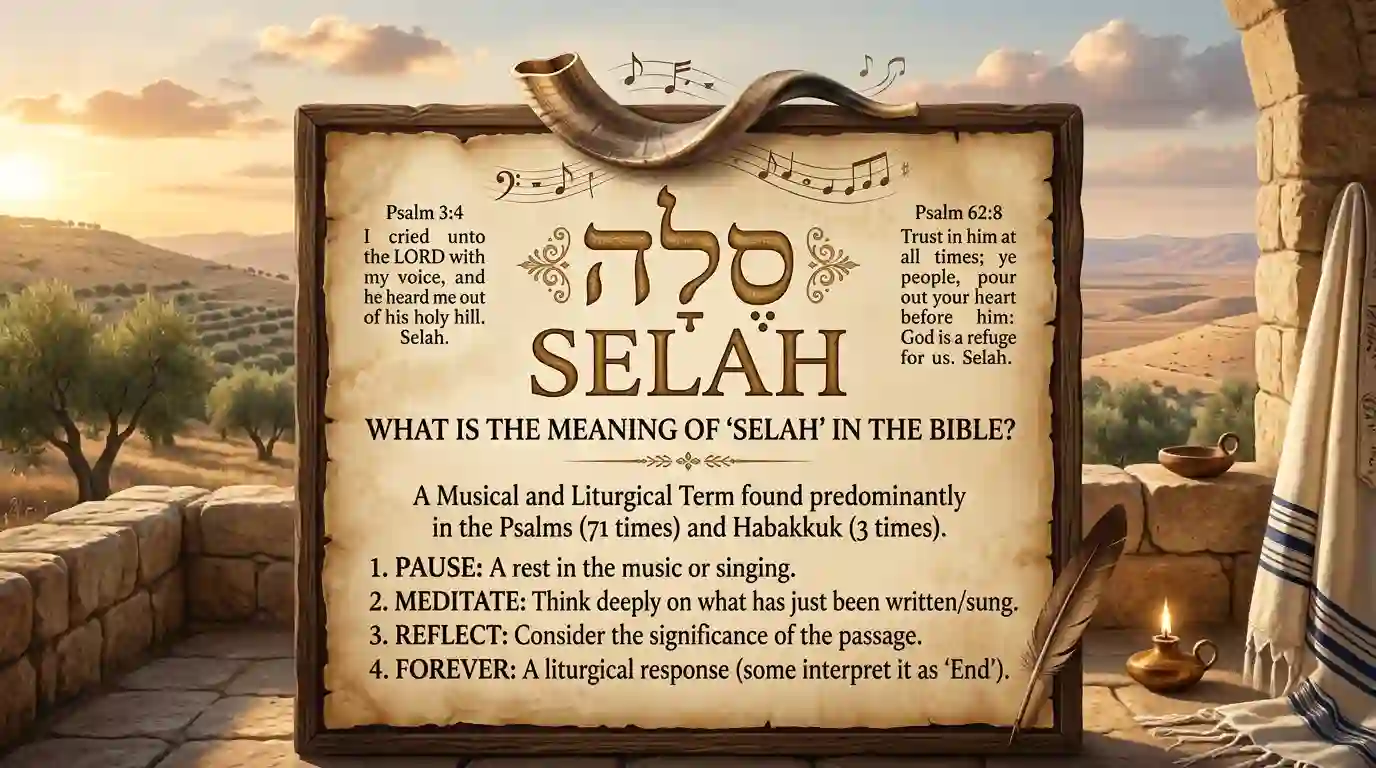
The Selah meaning in the Bible is uncertain, but many scholars believe it was a musical or worship-related instruction used in biblical poetry. It may have signaled a pause, a musical interlude, or a change in performance. Although Christians often understand Selah as an invitation to stop and reflect on God’s Word, the Bible does not provide an exact definition.
Key Takeaways
- Selah appears 71 times in Psalms and three times in Habakkuk 3 in the Hebrew biblical text.
- Its exact Hebrew meaning remains uncertain.
- Many scholars associate Selah with music, worship, or a change in how a passage was performed.
- “Pause and reflect” is a helpful devotional interpretation, not a confirmed literal translation.
- Christians can use the word as a reminder to read Scripture thoughtfully without claiming that its original meaning is settled.
What Does Selah Mean in the Bible?
Selah is a Hebrew term found mainly in the Book of Psalms, with three additional occurrences in Habakkuk 3. Its precise meaning is unknown, but scholars have proposed that it served as a musical direction or a marker in worship.
Many modern readers understand Selah as “pause and reflect.” This interpretation encourages people to consider the words that come before it, especially when a passage describes God’s protection, a person’s suffering, or the greatness of God.
However, it is important to distinguish a spiritual application from a proven definition. The biblical text does not explicitly translate Selah as “pause,” “think about it,” or “stop and listen.”
The safest explanation is that Selah was probably a musical or liturgical marker whose exact function has been lost or remains uncertain.
What Does Selah Mean in Hebrew?
Selah is written in Hebrew as סֶלָה and is commonly transliterated into English as Selah. The word appears in biblical poetry rather than ordinary narrative.
Its precise etymology, or linguistic origin, is disputed. Some explanations connect it with ideas such as lifting up, pausing, or marking a musical passage. However, scholars have not established a universally accepted explanation.
This uncertainty explains why many English Bible translations retain the word Selah instead of replacing it with an English expression.
The ancient Greek translation of the Old Testament, known as the Septuagint, sometimes renders Selah with the term diapsalma, traditionally associated with a musical interlude or division. This provides historical evidence of a musical or liturgical interpretation, although it does not settle the word’s exact meaning.
Does Selah Literally Mean “Pause and Reflect”?
Not necessarily. “Pause and reflect” is a popular Christian interpretation that captures one possible way to respond to the word while reading Scripture.
It can be a meaningful devotional practice, but readers should not confuse it with a proven word-for-word Hebrew translation. A careful explanation acknowledges both the value of reflection and the limits of what scholars know.
Where Does Selah Appear in the Bible?
Selah occurs 74 times in the Hebrew biblical text: 71 times across 39 psalms and three times in Habakkuk 3. Its placement in these passages helps explain why scholars connect it with worship and biblical poetry.
Selah in the Book of Psalms
The Psalms contain songs, prayers, praise, laments, and expressions of trust in God. Many were associated with Israel’s worship, making a musical function for Selah plausible.
Consider Psalm 3. The psalm describes the pressure David faces from his enemies and the claim that God will not deliver him. Selah appears after this troubling statement in Psalm 3:2.
Later, David declares his confidence in God as his protector in Psalm 3:3. The placement creates a striking contrast between human opposition and trust in God.
Psalm 3:4 also ends with Selah after David describes calling to the Lord and receiving an answer. Readers may find it helpful to reflect on this change from distress to confidence, even though the word’s original function is uncertain.
Another example is Psalm 46, which describes God as a refuge and source of strength during trouble. Selah appears within the psalm at important points in its poetic structure.
These examples show that Selah occurs in passages worth examining carefully. They do not prove that the word always instructs readers to stop and meditate.
Selah in Habakkuk 3
Selah is not limited to the Psalms. It also appears three times in Habakkuk 3, a poetic prayer that recalls God’s power and mighty acts.
Habakkuk 3:3 describes God coming from Teman and the Holy One from Mount Paran. Selah follows this description in many English translations.
Habakkuk 3:9 and 3:13 contain the other occurrences. The chapter uses vivid imagery to describe God’s power, judgment, and deliverance.
These passages strengthen the connection between Selah and poetic or worship-related material. They also show why its meaning should be studied within its literary context rather than reduced to a single inspirational phrase.
Is Selah a Musical Term or a Call to Pause?
The leading explanations generally fall into a few categories. None has been conclusively established.
| Interpretation | What it may suggest | Level of certainty |
|---|---|---|
| Musical interlude | Instruments play between vocal sections | Plausible theory |
| Pause in singing | Singers briefly stop while music continues | Plausible theory |
| Change in musical intensity | A shift in volume or performance | Possible, but uncertain |
| Literary or liturgical marker | A division or cue within a worship passage | Possible interpretation |
| Pause for reflection | Readers consider the preceding words | Popular devotional application |
The musical explanations receive considerable attention because Selah appears in poetry associated with worship. Yet the ancient musical notation system is not fully understood, so scholars cannot confidently reconstruct the exact action it instructed performers to take.
The reflective interpretation remains useful for personal Bible study. It simply should not be presented as the only historically correct meaning.
Examples of Selah in Scripture
The following passages illustrate how readers can examine Selah in context.
1. Psalm 3:2: Trouble and opposition
David describes people who believe God will not deliver him. Selah follows this statement. A reader can consider the weight of those accusations before moving to David’s declaration of trust in the next verse.
2. Psalm 3:4: Prayer and God’s response
David describes crying out to the Lord and receiving an answer. Selah follows the verse. The surrounding passage moves from fear toward confidence, offering a meaningful subject for reflection.
3. Psalm 46:7: God as refuge
Psalm 46:7 declares that the Lord of hosts is with his people and that the God of Jacob is their refuge. Selah appears after this statement in translations that retain the term. Its placement highlights a powerful declaration of divine protection.
4. Habakkuk 3:3: God’s majesty
Habakkuk describes God’s coming in language filled with grandeur and holiness. Selah marks the passage in which this description appears. The surrounding chapter encourages readers to consider God’s power and the prophet’s response to difficult circumstances.
These examples are not proof that Selah has a different definition in each passage. They demonstrate how context can deepen understanding even when a word’s exact meaning remains unknown.
What Is the Spiritual Meaning of Selah for Christians?
For many Christians, Selah has become a reminder to slow down, listen carefully, and reflect on Scripture. This spiritual application fits naturally with the themes of many psalms, which encourage prayer, trust, worship, and honest conversation with God.
For example, when reading Psalm 3, a person facing uncertainty might consider the contrast between the accusations David hears and the confidence he expresses in God. The reader can then think about how faith shapes a response to fear.
Similarly, Psalm 46 can encourage believers to consider what it means to trust God during difficult circumstances.
However, Selah should not be treated as a magical word or a guaranteed promise that a particular prayer will receive a specific answer. Its spiritual value comes from thoughtful engagement with the passage, not from assigning it powers that the biblical text does not describe.
The distinction matters: the word’s historical meaning remains uncertain, while the practice of reflecting on Scripture is independently supported by biblical teaching.
How to Apply the Meaning of Selah Today
You can use Selah as a personal reminder to read the Bible with attention rather than rushing through a passage.
- Read the complete passage. Start with the verses before and after Selah so you understand the writer’s message.
- Notice the main theme. Ask whether the passage discusses fear, worship, suffering, hope, or God’s character.
- Reflect on the words. Consider what the passage teaches without assuming Selah has a confirmed literal translation.
- Respond through prayer. Thank God, express your concerns, or ask for wisdom in light of what you have read.
- Apply the message. Identify one practical way the passage can shape your choices, attitude, or treatment of others.
For example, after reading Psalm 46, you might take a quiet moment to consider what trusting God looks like in a stressful situation. This practice can be helpful regardless of whether Selah originally instructed singers to pause or musicians to play an interlude.
Frequently Asked Questions
What does Selah mean in the Bible?
Selah is a Hebrew term of uncertain meaning found mainly in Psalms and also in Habakkuk 3. Many scholars believe it was a musical or liturgical instruction. Christians often interpret it as a reminder to pause and reflect, although that is not a confirmed literal translation.
What does Selah mean in Hebrew?
Selah is written סֶלָה in Hebrew. Its precise etymology and original function remain uncertain. Proposed explanations include a musical interlude, a pause in singing, or another performance marker. No single interpretation has gained universal acceptance.
How many times does Selah appear in the Bible?
Selah appears 74 times in the Hebrew biblical text: 71 times in the Book of Psalms and three times in Habakkuk 3. English translations may differ in how they display the term, but these are the commonly cited Hebrew-text totals.
Does Selah mean “pause and reflect”?
That is a popular devotional interpretation, not an established literal definition. The word may have marked a pause or musical transition in ancient worship. Readers can still use it as a reminder to reflect on Scripture while recognizing the uncertainty about its original meaning.
Is Selah a name in the Bible?
In biblical word studies, Selah usually refers to the poetic or musical term found in Psalms and Habakkuk, not a personal name in those passages. Selah is also used as a modern given name, but its popularity as a name does not establish the word’s original biblical meaning.
Why does Selah appear in Psalms?
Psalms contains poetry, prayers, and songs associated with Israel’s worship. Selah may have helped performers mark musical changes, pauses, or divisions. Its repeated appearance in this setting supports a possible musical or liturgical function, although the precise instruction remains unknown.
Conclusion
The Selah meaning in the Bible cannot be established with complete certainty. Its use in Psalms and Habakkuk suggests a connection with biblical poetry and possibly with music or worship. The familiar interpretation “pause and reflect” offers a helpful devotional practice, but it should not be confused with a proven Hebrew definition.
When you encounter Selah in Scripture, read the surrounding verses and consider the message they communicate. Whether the word originally directed musicians, marked a poetic division, or served another liturgical purpose, it can prompt a thoughtful engagement with the biblical passage today.

I am Samuel Brooks, a Christian author who enjoys breaking down complex Bible concepts into simple truths. At Biblicaltribez.com, I write content that inspires faith, hope, and spiritual growth. I aim to help readers connect Scripture with real life challenges in a meaningful way.