Skip to content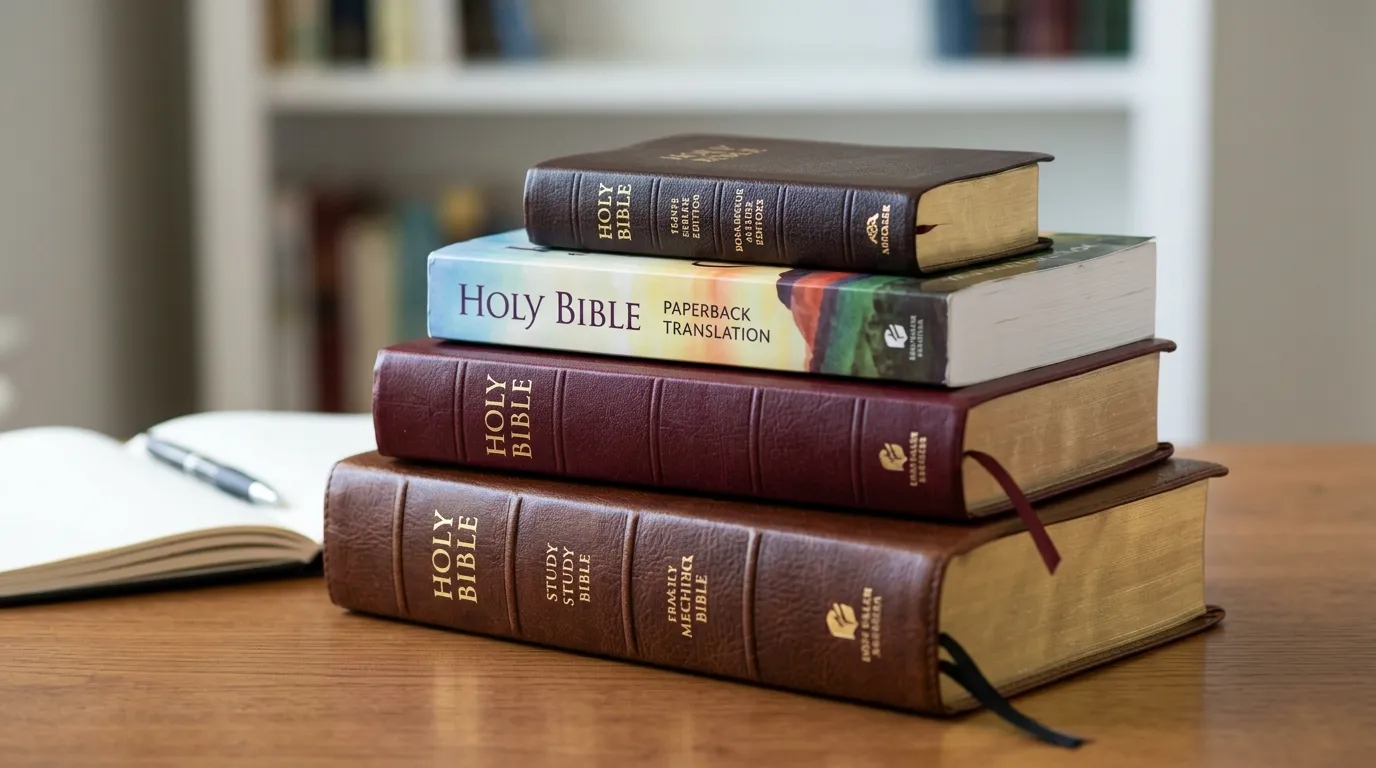
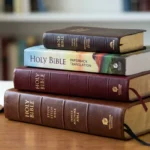
If you are holding a Bible for the first time, you may wonder, how many pages are in the Bible? The simple answer is that there is no single page count for every Bible. The number of pages depends on the translation, font size, paper, page size, study notes, maps, and even the type of Bible you choose.
A regular Bible often has around 1,000 to 1,500 pages, while some study Bibles can have far more because they include explanations, notes, maps, charts, and other helpful material. For example, a recent full-text King James Version edition published by Collins has 1,152 pages.
The Bible is also more than one book. It is a collection of sacred writings that Christians read to learn about God, creation, sin, faith, salvation, Jesus Christ, and Christian living. The Catholic Church describes the Bible as a library of 73 books, while most Protestant Bibles contain 66 books.
So, let us look at the Bible’s page count, books, chapters, and why different Bibles have different numbers of pages.
Quick Answer: How Many Pages Are in the Bible?
Most complete printed Bibles have about 1,000–1,500 pages, but there is no fixed number.
A Bible may have fewer or more pages depending on its:
- Translation
- Font size
- Page size
- Paper thickness
- Layout
- Study notes
- Maps and charts
- Introductions and commentary
- Number of biblical books included
A compact Bible may fit the same biblical text into fewer pages by using very small print. A large-print Bible may need many more pages.
A study Bible can be much longer because it contains material beyond the biblical text.
Why Does the Bible Have Different Page Counts?
The Bible does not have one fixed physical format.
Think about two school books. One may use small letters and thin paper. Another may use large letters, wide spaces, and pictures. Both can contain the same lesson, but their page counts will be different.
The same thing happens with Bibles.
Bible Translation
Different translations can have different word counts and layouts.
For example, the King James Version (KJV), New International Version (NIV), English Standard Version (ESV), New King James Version (NKJV), and Christian Standard Bible (CSB) do not always use exactly the same wording.
That can affect the number of pages.
Font Size
Font size has a major effect.
A Bible with tiny print can contain more words on one page. A large-print Bible spreads the same material across more pages.
This is why an older reader may prefer a large-print Bible even though it is physically bigger.
Page Size
A pocket Bible and a large family Bible may contain the same biblical text but have very different dimensions.
A wider page can fit more words per line. A smaller page may require more lines and therefore more pages.
Study Notes and Extra Material
A study Bible can be much longer than a simple text Bible.
It may contain:
- Verse explanations
- Historical notes
- Maps
- Charts
- Character studies
- Word studies
- Book introductions
- Cross-references
- Articles
- Reading plans
These materials are useful, but they are not part of the original biblical text.
How Many Books Are in the Bible?
The answer depends on the Christian tradition.
Most Protestant Bibles contain 66 books:
- 39 books in the Old Testament
- 27 books in the New Testament
Catholic Bibles contain 73 books:
- 46 books in the Old Testament
- 27 books in the New Testament
The United States Conference of Catholic Bishops confirms that Catholic and Protestant Bibles both contain 27 New Testament books, while Catholic Bibles include 46 Old Testament books and Protestant Bibles generally include 39.
The difference is mainly in the Old Testament canon.
Catholic Bibles include books such as:
- Tobit
- Judith
- 1 Maccabees
- 2 Maccabees
- Wisdom
- Sirach
- Baruch
Catholic editions also include certain sections of Esther and Daniel that are not found in most Protestant editions.
So when someone asks, “How many pages are in the Bible?”, it is important to know which Bible they mean.
How Many Pages Are in the Old Testament?
There is no universal page count for the Old Testament.
In a standard Bible, the Old Testament takes up much more space than the New Testament because it contains many more books and much more text.
The Old Testament begins with Genesis and ends with Malachi in most Protestant Christian Bibles.
It includes different kinds of writing, such as:
- History
- Law
- Poetry
- Wisdom
- Prophecy
The Old Testament tells the story of God’s relationship with His people and prepares the reader for the coming of Christ.
For Christians, it is not simply an old collection of stories. It helps explain God’s character, His promises, human sin, faith, judgment, mercy, and redemption.
How Many Pages Are in the New Testament?
The New Testament is much shorter than the Old Testament.
It contains 27 books and begins with Matthew. It ends with Revelation.
The New Testament includes:
- Four Gospels
- Acts
- Paul’s letters
- General letters
- Revelation
The Gospels tell us about the life, teachings, death, and resurrection of Jesus Christ.
The New Testament then explains how the early church grew and teaches Christians how to live by faith.
The USCCB notes that the New Testament has 27 books and includes the four Gospels, Acts, letters, and Revelation.
How Many Chapters Are in the Bible?
A standard Protestant Bible has 1,189 chapters.
There are:
- 929 chapters in the Old Testament
- 260 chapters in the New Testament
These chapter divisions were added to help readers find passages more easily.
The Bible’s original manuscripts did not look exactly like modern Bibles with our chapter and verse numbers.
This is helpful to remember when studying Scripture. Chapter numbers are useful tools, but the meaning of a passage should always be understood in its larger context.
How Many Verses Are in the Bible?
The exact verse count can vary slightly between Bible traditions and editions because the chapter and verse systems are not identical in every tradition.
A commonly cited count for the Protestant Bible is 31,102 verses.
This number comes from counting the traditional chapter and verse divisions in a standard 66-book Bible.
However, you should not treat the verse number as the most important fact.
The Bible was written as meaningful books and writings. A single verse should be understood in its surrounding passage and in light of the whole message of Scripture.
What Is the Longest Book in the Bible?
Psalms is the longest book of the Bible by number of chapters.
It has 150 chapters.
Psalm 119 is the longest chapter in the Bible.
It contains 176 verses and focuses strongly on God’s Word, His commands, and faithful living.
Psalm 119:105 says:
“Thy word is a lamp unto my feet, and a light unto my path.” : Psalm 119:105, KJV
This verse gives a beautiful picture of Scripture.
God’s Word is compared to a lamp. It helps believers see where they are going and guides them when life feels dark or uncertain.
What Is the Shortest Book in the Bible?
The answer can depend on If you measure by words, verses, or chapters.
3 John is one of the shortest books in the Bible and contains only one chapter.
Other very short books include:
- 2 John
- Philemon
- Jude
- Obadiah
A short book does not mean an unimportant book.
Every part of Scripture has a purpose. Second Timothy 3:16 teaches that Scripture is inspired by God and useful for teaching, correction, and training in righteousness.
Does the Bible Have a Fixed Number of Pages?
No, the Bible does not have a fixed number of pages.
This is one of the most important answers to remember.
The biblical message does not change because a publisher uses different paper or font sizes.
One Bible might have 1,100 pages. Another may have 1,400. A study Bible might have more than 2,000 pages because it includes extensive study material.
The number printed on the final page does not tell you how valuable the Bible is.
What matters is the message of Scripture.
Why Is the Bible Called a Library?
The Bible contains many books written in different styles.
The books include:
- History
- Poetry
- Wisdom literature
- Prophecy
- Gospels
- Letters
- Apocalyptic writing
This is why it can be helpful to think of the Bible as a library of books rather than a single modern-style book.
The USCCB describes the Bible as a collection of 73 books in the Catholic tradition and points out that its books include different forms of writing, from history and prophecy to poetry and letters.
This also helps new readers.
You would not read a poem in exactly the same way you read a history book. In the same way, Proverbs, Psalms, Romans, and Revelation require different reading approaches.
What Bible Should a Beginner Read?
If you are new to the Bible, do not worry about finishing it quickly.
Start with a translation you can understand.
Many beginners find modern English translations easier to read than older English. If you enjoy traditional language, the KJV or NKJV may be meaningful to you.
You may also begin with one of the Gospels.
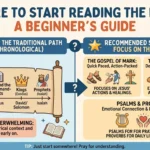
A Simple Reading Order
A beginner could start with:
- John : Learn about Jesus.
- Mark : Read a short, fast-moving Gospel.
- Acts : Learn how the early church grew.
- Genesis : Learn about creation and the beginning of God’s story.
- Psalms : Learn how people prayed and worshiped God.
- Proverbs : Learn practical wisdom for daily life.
You do not need to read 50 pages a day.
Even one chapter can be meaningful when you read it carefully and pray about what you learn.
What Does the Bible Say About Reading God’s Word?
The Bible encourages believers to know and live by God’s Word.
Psalm 119:105 says:
“Thy word is a lamp unto my feet, and a light unto my path.” : Psalm 119:105, KJV
The picture is simple.
A lamp does not always show you the entire road at once. It gives enough light for the next step.
Scripture can work in the same way. It teaches us God’s truth and helps guide our choices.
Jesus also emphasized the importance of God’s Word. In Matthew 4:4, Jesus says:
“Man shall not live by bread alone, but by every word that proceedeth out of the mouth of God.”
The lesson is clear: physical food keeps our bodies alive, but we also need spiritual truth.
How Long Does It Take to Read the Bible?
There is no single answer because reading speed differs from person to person.
If you read a few chapters each day, you can complete the Bible within a year.
For example, reading about 3–4 chapters each day is a common way to work through a standard 66-book Bible over roughly a year.
But do not turn Bible reading into a race.
The goal is not simply to say, “I finished the Bible.”
The goal is to know God better, understand His Word, grow in faith, and allow Scripture to shape your life.
How Can Christians Apply the Bible to Daily Life?
Knowing how many pages are in the Bible is useful, but living by God’s Word is far more important.
For Personal Faith
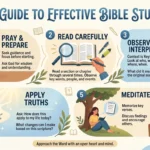
Read Scripture regularly and pray about what you learn.
Ask:
- What does this passage teach about God?
- What does it teach about people?
- Is there a sin I need to avoid?
- Is there a promise I need to trust?
- Is there something I should do?
For Prayer
Use the Psalms to help shape your prayers.
The Psalms contain praise, sadness, confession, hope, fear, and thanksgiving. They remind us that we can speak honestly with God.
For Families
Parents can read Bible stories with their children.
Younger children can learn simple stories such as creation, Noah, David, Daniel, and the birth of Jesus.
Teenagers can explore questions about faith, identity, temptation, relationships, and purpose through Scripture.
For Marriage
The Bible teaches partnersto love, honor, forgive, serve, and care for one another.
Ephesians 5:25 tells husbands to love their wives as Christ loved the church.
The biblical model of marriage is not selfishness. It calls for sacrificial love and faithful commitment.
For the Church
Christians are called to gather, encourage one another, worship, learn, and serve.
Hebrews 10:24–25 encourages believers to consider how they can encourage one another and not give up meeting together.
Does a Bigger Bible Mean a Better Bible?
No.
A Bible with 2,000 pages is not automatically better than one with 1,200 pages.
The extra pages may contain study notes, maps, articles, references, or commentary. Those tools can be very helpful, but they are different from the biblical text itself.
Choose a Bible that helps you read and understand Scripture faithfully.
The best Bible is one you will actually open, read, understand, and apply.
FAQs:
1. How many pages are in the Bible?
There is no fixed page count. A typical complete Bible often has around 1,000–1,500 pages, but the exact number depends on the translation, font, page size, paper, and extra study material.
2. How many books are in the Bible?
Most Protestant Bibles have 66 books: 39 in the Old Testament and 27 in the New Testament. Catholic Bibles have 73 books, including seven additional Old Testament books and additional sections of Esther and Daniel.
3. How many chapters are in the Bible?
A standard Protestant Bible has 1,189 chapters. There are 929 in the Old Testament and 260 in the New Testament.
4. How many pages are in a King James Bible?
It depends on the edition. For example, a Collins full-text KJV edition published in 2026 lists 1,152 pages. Other KJV editions may have different page counts because of differences in size, font, paper, and added material.
5. Can I read the whole Bible in one year?
Yes. Many Christians read about three to four chapters each day to complete a standard 66-book Bible in about a year. The exact schedule can change based on your reading speed and the plan you follow.
Conclusion:
So, how many pages are in the Bible? There is no single answer because Bibles come in many translations, sizes, formats, and editions.
A typical complete Bible often contains around 1,000–1,500 pages, while study Bibles can be much larger.
More important than the page count is the message inside those pages. The Bible tells the story of God’s work, humanity’s need for Him, and God’s plan of salvation. For Christians, the Bible ultimately points us to Jesus Christ.
If you are a child, teenager, parent, or longtime believer, you do not need to read the Bible quickly.
Start with a manageable section, pray, read carefully, and ask what God is teaching you.
The goal is not simply to finish all the pages. The goal is to know God’s Word and let it shape your life.
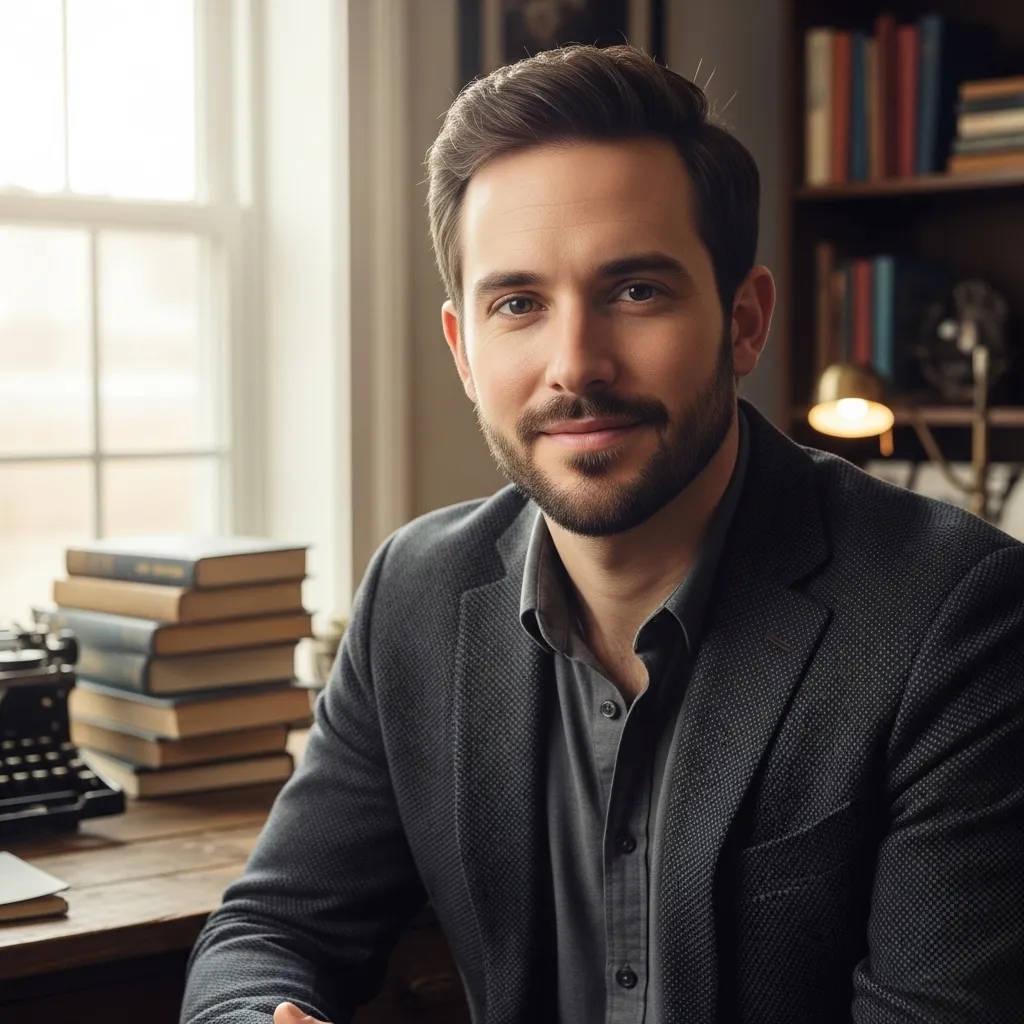
I am Caleb Anderson, a Christian writer passionate about exploring deep biblical meanings and spiritual truths.
On Biblicaltribez.com, I share faith based insights to help readers grow closer to God through Scripture.
My writing focuses on making the Bible easy to understand, meaningful, and relevant to everyday life.