Skip to content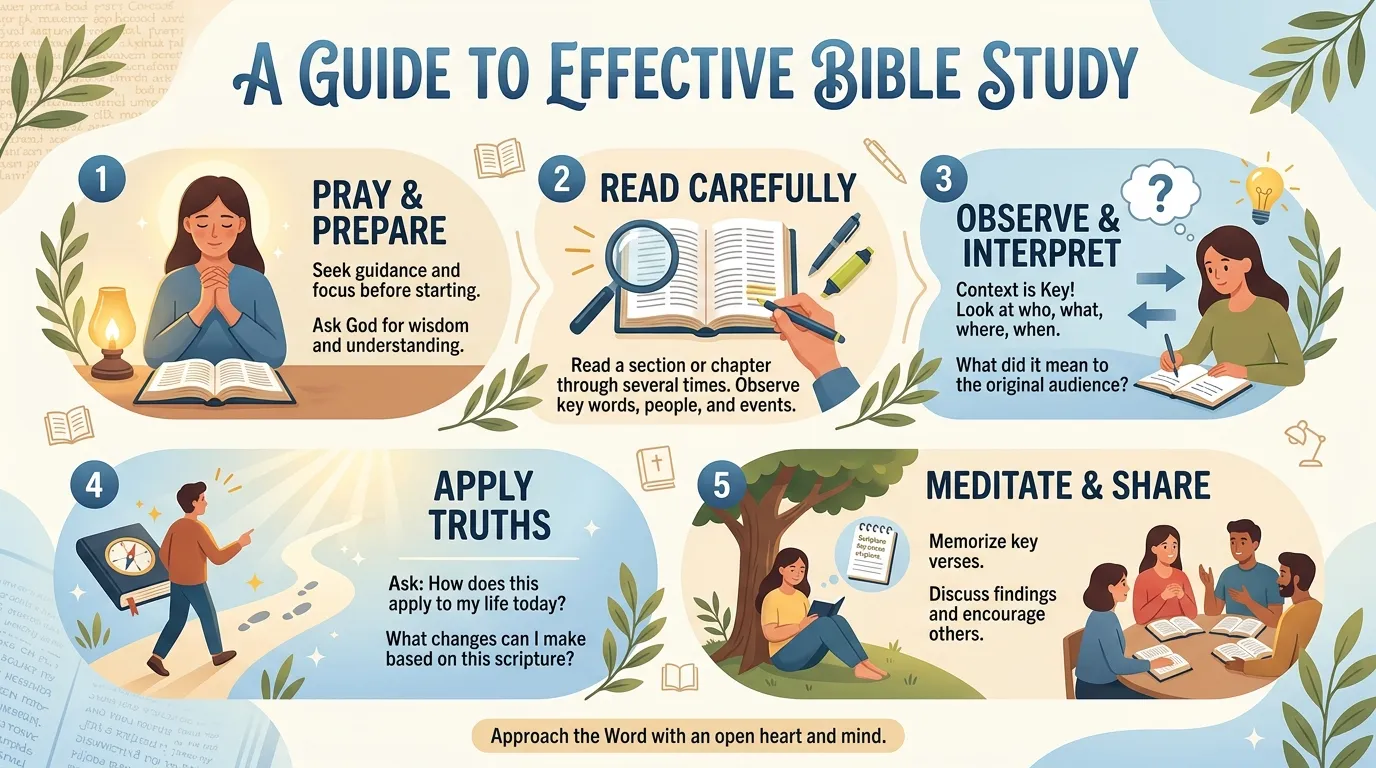
Have you ever opened the Bible and thought, “Where do I even start?” You are not alone. The Bible has many books, people, places, stories, laws, poems, and letters. At first, it can feel hard to know what to read or how to understand it.
Learning how to study the Bible does not require a seminary degree or a large library. You need a Bible, a quiet place, an open heart, and a simple plan.
Good Bible study helps you do more than read words on a page. It helps you see what a passage says, understand what it means, and think about how it should shape your life.
This guide will show you a simple way to study Scripture. You will learn where to start, which Bible study methods can help, how to ask good questions, how to avoid common mistakes, and how to build a Bible study plan you can keep.
Quick Answer
The best way to study the Bible is to read a small passage, understand its context, observe what it says, ask what it means, compare it with other Scripture, and apply its truth to your life.
Start with one book of the Bible instead of jumping from verse to verse. Pray before you read, take notes, look at the verses around the passage, and focus on what the text actually says.
You do not need to understand everything in one sitting. Bible study is a lifelong process. Take your time and let Scripture shape your thinking and actions.
Definition & Meaning
Bible study means giving careful attention to Scripture so you can understand its message and live it out.
Reading and studying are related, but they are not exactly the same.
When you read the Bible, you move through the text and learn what it says. When you study it, you slow down and look closer at the words, setting, people, themes, and message.
For example, you may read Psalm 23 in a few minutes. During a deeper study, you may ask:
- Who wrote the psalm?
- What picture of God does it give?
- What does “The LORD is my shepherd” tell us?
- What was the writer facing?
- What does the passage teach about God’s care?
- How can I live out this truth?
This deeper process can turn a short reading into a meaningful study.
Why Should You Study the Bible?
The Bible itself gives strong reasons to know God’s Word.
Second Timothy 3:16 says that Scripture is “God-breathed” and useful for teaching, correction, and training in righteousness.
Psalm 119:105 says:
“Your word is a lamp for my feet, a light on my path.”
These verses show that Scripture is not only a book to collect knowledge from. It can guide our choices, correct our thinking, and help us grow in faith.
Bible study also helps you test ideas. You may hear many opinions about God, faith, morality, or Christian living. Knowing Scripture helps you compare those ideas with what the Bible actually teaches.
How to Study the Bible Step by Step
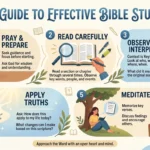
1. Choose One Book or Passage
Do not try to study the whole Bible at once.
Pick one book and stay with it for a while. Beginners may find a Gospel such as John or Mark easier to follow because these books focus on the life and ministry of Jesus.
You can also start with Psalms, Proverbs, James, or another book that fits your current needs.
The key is consistency. Study a small section well instead of rushing through many chapters.
2. Pray Before You Study
Take a moment to pray before opening the text.
Ask God to help you understand His Word and respond with humility.
A simple prayer can be enough:
“God, help me understand what I read today. Show me what is true and help me live it out.”
Prayer does not replace careful study. It works alongside it.
3. Read the Passage More Than Once
Read the same passage two or three times.
The first reading gives you the big picture. The next readings help you notice details.
Look for repeated words, commands, questions, promises, warnings, names, places, and changes in the story.
Do not rush.
Sometimes a detail that seems small at first becomes important when you read the passage again.
4. Read the Context
Context is one of the most important parts of Bible study.
Never build a major idea from one verse without checking the verses around it.
Read the paragraph, chapter, and, when useful, the whole book.
Ask:
- What comes before this passage?
- What comes after it?
- Who is speaking?
- Who is listening?
- What problem or situation is being addressed?
- Why was this written?
Context helps protect you from giving a verse a meaning that the original passage does not support.
5. Observe What the Text Says
Before asking what a passage means, ask what it says.
This is a key part of inductive Bible study.
Write down what you notice.
Look for:
- People
- Places
- Actions
- Commands
- Promises
- Warnings
- Reasons
- Repeated words
- Contrasts
- Questions
- Results
For example, if you study Ephesians 6:10–18, you may notice repeated ideas about strength, standing, spiritual warfare, and the armor of God.
Observation comes before interpretation.
6. Ask What the Passage Means
After careful observation, move to interpretation.
Now ask what the writer intended to communicate.
Consider the historical and literary setting.
A poem should not be read in exactly the same way as a letter. A proverb may express general wisdom rather than a promise that applies in every situation.
Ask:
What did this passage mean to its first readers?
That question can keep you from forcing modern ideas into an ancient text.
7. Compare Scripture With Scripture
The Bible contains many connected themes.
When a passage raises a question, look for other passages that address the same topic.
For example, if you study forgiveness, you can examine passages in the Gospels, Paul’s letters, and other parts of Scripture.
But avoid using many unrelated verses just to prove your point.
The goal is not to collect verses. The goal is to understand God’s message in its full context.
8. Write Down Questions
Good questions can make Bible study much deeper.
Keep a notebook or digital document for questions that come to mind.
You might write:
- Why did this person respond this way?
- What does this word mean?
- Why is this event included?
- What does this passage teach about God?
- What does it teach about people?
- Is this a command, promise, warning, or description?
- How does this passage connect to the rest of the book?
You may not answer every question right away.
That is okay.
Keep studying and return to difficult questions later.
9. Use Helpful Study Tools
You can use tools to improve your study, but use them wisely.
Helpful resources include:
- A few trusted Bible translations
- Bible dictionaries
- Concordances
- Cross-reference tools
- Bible commentaries
- Study Bibles
- Maps
- Historical background resources
- Original-language tools
Do not let a commentary replace your own reading.
Read the passage first. Think about it. Then use outside resources to check and deepen your understanding.
This order helps you engage with Scripture instead of simply accepting someone else’s explanation.
10. Apply What You Learn
Bible study should lead to action.
James 1:22 warns believers not to hear the word only, but to do what it says.
After studying a passage, ask:
What should change because of what I learned?
Your answer may involve:
- A habit to change
- A sin to confess
- A person to forgive
- A truth to believe
- A command to follow
- A promise to trust
- A person to encourage
- A prayer to make
Application should come from the passage. Do not force a personal lesson that the text does not support.
Best Bible Study Methods
There is no single method that every Christian must use. Different methods can help you study Scripture from different angles.
Here are several useful Bible study methods.
The SOAP Method
SOAP stands for:
S : Scripture
Write down the passage.
O : Observation
Write what you notice.
A : Application
Think about how the truth applies to your life.
P : Prayer
Respond to God in prayer.
This method works well for beginners because it is simple and easy to repeat.
The Inductive Method
The inductive method follows three main steps:
- Observation
- Interpretation
- Application
It encourages you to begin with the text itself.
This method works well when you want to understand a passage in greater depth.
The Topical Method
A topical study focuses on one subject.
You might study:
- Faith
- Prayer
- Forgiveness
- Wisdom
- Love
- Fear
- Hope
- Marriage
- Temptation
- Service
Find several relevant passages and compare what Scripture teaches about the topic.
Be careful not to choose only verses that support what you already believe.
The Book Study Method
This method focuses on one entire book.
Start by learning about its structure and purpose. Then move through it section by section.
This method is especially useful because it keeps each passage connected to the larger message of the book.
How to Study the Bible for Beginners
If you are new to Bible study, keep it simple.
You do not need to study for an hour every day. You can begin with 15–20 focused minutes.
Try this basic routine:
Read: 5 minutes
Observe: 5 minutes
Understand: 5 minutes
Apply and pray: 5 minutes
Pick a regular time.
Morning works well for some people. Others prefer lunch, evening, or before bed.
The best time is one you can keep.
Do not measure success only by how many chapters you finish. A slow and thoughtful study can be more useful than a fast reading with little reflection.
How to Read the Bible Without Getting Overwhelmed
The Bible is a large collection of books, so feeling overwhelmed is normal.
Start small.
Instead of asking, “How can I read the whole Bible?” ask, “What passage will I study today?”
You can also create a simple Bible study plan.
For example:
Week 1: Read and study John 1
Week 2: Read and study John 2
Week 3: Read and study John 3
Week 4: Read and study John 4
Adjust the pace as needed.
You do not have to finish a chapter in one sitting. If a chapter contains several important ideas, divide it into smaller sections.
Common Bible Study Mistakes
Even sincere readers can make mistakes.
One common mistake is reading a verse without its context.
Another is treating every part of the Bible as if it were the same kind of writing. Scripture contains history, poetry, wisdom literature, prophecy, Gospels, and letters. Genre matters.
Another mistake is studying only when you need an answer.
Bible study is not just a tool for solving problems. It is a way to know God’s Word over time.
Before vs. After: A Better Study Approach
| Common Approach | Better Approach |
| Read random verses | Study connected passages |
| Rush through chapters | Slow down and observe |
| Ignore context | Read the surrounding text |
| Trust every online claim | Check claims against Scripture |
| Search for only favorite verses | Study the full message |
| Read without reflection | Ask questions and take notes |
| Learn but never act | Turn truth into wise action |
Bible Study Tips That Make a Difference
Small habits can make your study stronger.
Keep a study notebook. Write down insights, questions, and applications.
Mark repeated words. Repetition often helps reveal the writer’s focus.
Read different translations when needed. Comparing translations can help you see how a verse is worded.
Study the whole thought. A single sentence may depend on the verses around it.
Be patient with hard passages. Some texts need more time and research.
Check your assumptions. Ask whether the text really says what you think it says.
Study with other believers. A good Bible study group can help you notice things you missed.
Return to important passages. You may see something new after more life experience or further study.
A Simple 30-Minute Bible Study Routine
If you want a practical routine, try this:
- Minutes 1–3: Pray
- Ask for wisdom and an open heart.
- Minutes 4–10: Read
- Read the passage slowly two or three times.
- Minutes 11–17: Observe
- Write down key words, people, actions, commands, and questions.
- Minutes 18–23: Understand
- Check the context and use trusted study tools when needed.
- Minutes 24–27: Apply
- Write one clear action you can take.
- Minutes 28–30: Pray
- Thank God for what you learned and ask for help to live it.
This simple routine is enough to build a strong habit.
Quick Bible Study Checklist
| Step | What to Do | Quick Question |
| 1 | Choose a passage | What will I study? |
| 2 | Pray | Am I ready to listen? |
| 3 | Read | What does the passage say? |
| 4 | Observe | What stands out? |
| 5 | Check context | What comes before and after? |
| 6 | Interpret | What did it mean? |
| 7 | Compare | What does the rest of Scripture teach? |
| 8 | Apply | What should I do? |
| 9 | Pray | How should I respond? |
What If You Do Not Understand a Passage?
Do not panic when a passage seems confusing.
First, read it again.
Then read the surrounding verses. Look at the chapter and the larger book.
Next, check a trusted Bible resource. A good commentary can explain history, language, culture, and different interpretations.
Some passages have genuine differences in interpretation among Christians. When that happens, be honest about it.
You do not need to pretend that every difficult question has one simple answer.
A humble approach is better than a confident but weak claim.
How Long Should You Study the Bible Each Day?
There is no universal time limit.
Some people may study for 15 minutes. Others may spend an hour or more.
The quality of your attention matters more than the clock.
If you are new, start with a short session that you can repeat. A steady habit is easier to maintain than a long plan that you abandon after a few days.
You can always increase your study time later.
Should You Read the Bible in Order?
You can, but you do not have to.
Reading from Genesis to Revelation can help you see the Bible’s broad story. But beginners may prefer to start with a book that is easier to follow.
A Gospel is a helpful starting point for many readers because it centers on Jesus’ life and teaching.
The important thing is to have a clear plan instead of opening the Bible at random each day.
How Can You Make Bible Study a Habit?
Make the habit easy to start.
Keep your Bible and notebook in one place. Choose a regular time. Set a small daily goal.
You can also study with a friend or group.
If you miss a day, do not quit.
Simply start again the next day.
A missed day does not destroy your progress.
The goal is not perfection. The goal is to keep returning to God’s Word.
FAQs:
1. What is the best way to start studying the Bible?
Start with one manageable book or passage. Read it more than once, check its context, write down what you notice, think about its meaning, and choose one clear way to apply what you learn.
2. What book of the Bible should a beginner study first?
Many beginners find one of the Gospels helpful because the Gospels focus on Jesus. John is a common starting point, but Mark, Luke, and Matthew can also provide a clear introduction to Jesus’ life and ministry.
3. How long should a Bible study last?
There is no fixed rule. A focused 15–30 minute session can be a good starting point. As you grow more comfortable, you can spend more time when needed.
4. What is the easiest Bible study method for beginners?
The SOAP method is simple for beginners. It asks you to focus on Scripture, Observation, Application, and Prayer. The inductive method is also useful when you want to study a passage in greater depth.
5. Should I read the Bible every day?
Daily reading can help you build a steady habit, but do not turn it into a race. If you miss a day, simply begin again. Consistency matters more than trying to maintain a perfect streak.
6. How do I understand difficult Bible verses?
Start with the surrounding verses and the larger context. Check the type of writing and use trusted study resources. If Christians hold different views, compare the arguments carefully and avoid claiming certainty where the text does not give it.
7. How can I remember what I learn from Bible study?
Write down key lessons and review them. You can also memorize important verses, explain the passage to someone else, pray about it, and put its teaching into practice. Applying truth often helps it stay with you.
Conclusion:
Learning how to study the Bible does not have to feel hard. Start small, choose one passage, pray, read it closely, and pay attention to its context. Then ask what it means and how you should respond.
Use simple Bible study methods such as SOAP, inductive study, topical study, or book study. Keep notes, ask honest questions, and use trusted resources when you need help.
Most of all, do not study Scripture only to gain information. Let what you learn shape your thoughts, choices, faith, and daily life.
Start with a few verses today. Read them slowly. Think about them. Pray over them. Then take one faithful step based on what you learned.

I am Caleb Anderson, a Christian writer passionate about exploring deep biblical meanings and spiritual truths.
On Biblicaltribez.com, I share faith based insights to help readers grow closer to God through Scripture.
My writing focuses on making the Bible easy to understand, meaningful, and relevant to everyday life.