Skip to content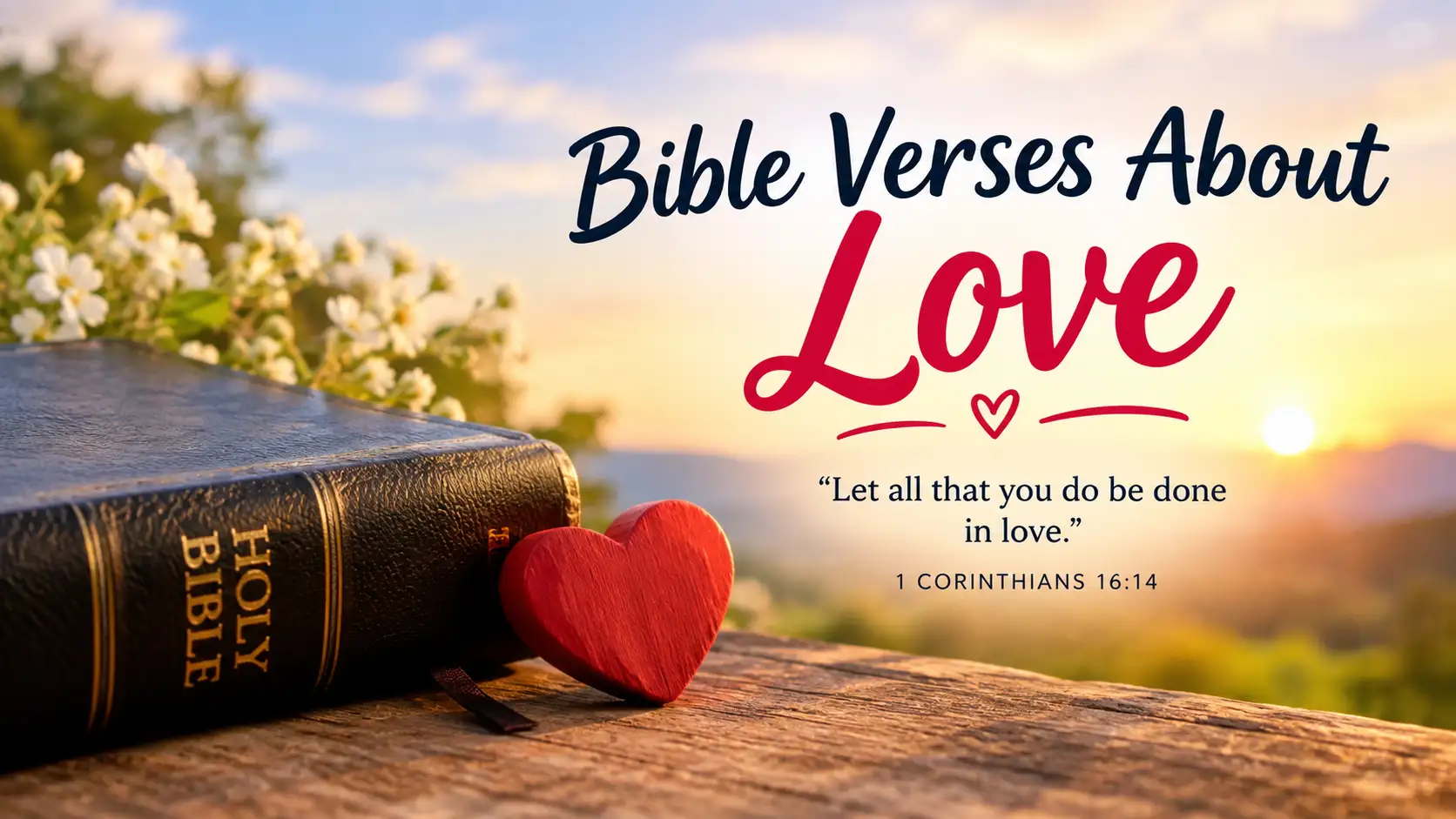
Love is one of the most repeated themes in all of Scripture, running from the opening chapters of Genesis to the final promises of Revelation.
Most lists of “Bible verses about love” online are just lists, dropped one after another with little structure or explanation.
This guide takes a different approach. Instead of a random collection, the verses below are organized by category of God’s love for us, our love for God, love for others, romantic and marital love, and love for enemies with context on what each passage actually means and how it applies to daily life.
God’s Love for Humanity
The starting point of biblical love is not human affection but God’s initiative. Scripture consistently presents love as something that begins with God and flows outward to people.
John 3:16 is the most quoted verse on this theme: “For God so loved the world, that he gave his only begotten Son, that whosoever believeth in him should not perish, but have everlasting life.” This single verse summarizes the entire gospel message that God’s love is demonstrated through sacrifice, not just sentiment.
Romans 5:8 builds on this idea: “But God commendeth his love toward us, in that, while we were yet sinners, Christ died for us.” The point here is timing God’s love was not a reward for good behavior, but was extended before anyone had earned it.
1 John 4:9-10 describes love as being revealed, not just declared, through the sending of Jesus so that people “might live through him.” The passage goes on to define love itself: not that we loved God, but that He loved us first and sent His Son as a sacrifice for sin.
Jeremiah 31:3 captures the permanence of this love with God’s words to Israel: “I have loved thee with an everlasting love: therefore with lovingkindness have I drawn thee.” This verse is often cited as evidence that biblical love is not fickle or temporary but described as eternal.
Our Love for God
The Bible frames love as a two-way relationship not only does God love people, but people are called to love God in return, with their whole being.
Deuteronomy 6:5, part of what is known as the Shema, one of the central declarations of Jewish faith, commands: “And thou shalt love the LORD thy God with all thine heart, and with all thy soul, and with all thy might.”
Matthew 22:37-38 shows Jesus quoting this same command directly and calling it “the first and great commandment,” establishing continuity between the Old and New Testaments on this point.
1 John 4:19 offers the reasoning behind this command in a single short sentence: “We love him, because he first loved us.” According to this verse, human love for God is a response to not the origin of divine love.
Love for Others (Neighbor, Friend, and Family)
A large portion of biblical teaching on love concerns how people are meant to treat one another, both within the church and in daily human relationships.
Leviticus 19:18, an Old Testament command later repeated by Jesus, states: “Thou shalt not avenge, nor bear any grudge against the children of thy people, but thou shalt love thy neighbour as thyself.”
John 13:34-35 records Jesus giving what he calls a “new commandment” to his disciples: to love one another as he had loved them, adding that this mutual love would be the identifying mark of his followers to the outside world.
1 Peter 4:8 emphasizes the covering, restorative power of this kind of love: “And above all things have fervent charity among yourselves: for charity shall cover the multitude of sins.”
Proverbs 17:17 speaks to loyalty within relationships: “A friend loveth at all times, and a brother is born for adversity” a reminder that biblical love is tested and proven especially during hardship, not just in comfortable seasons.
1 John 4:20-21 contains one of Scripture’s more direct challenges: it says a person cannot claim to love God while hating a fellow believer, because loving God and loving people are treated as inseparable commands.
The Definition of Love: 1 Corinthians 13
No discussion of biblical love is complete without 1 Corinthians 13, sometimes called “the love chapter.” Paul writes this passage to a divided church, using it to correct behavior rather than as a poetic aside for weddings, though it has become a popular wedding reading.
Verses 4-7 describe love primarily through actions and restraint rather than feeling: love suffers long, is kind, does not envy, is not puffed up, does not behave rudely, is not easily provoked, thinks no evil, and bears, believes, hopes, and endures all things. Verse 8 declares that “charity never faileth,” contrasting love’s permanence with spiritual gifts that Paul says will eventually cease. Verse 13 closes the passage by ranking faith, hope, and love together as things that remain, adding, “but the greatest of these is charity” using the older English word for self-giving love.
Love in Marriage and Romantic Relationships
While much of the Bible’s teaching on love is about God and community, Scripture also directly addresses romantic love, particularly within marriage.
Song of Solomon 8:6-7 is the Bible’s most extended poetic treatment of romantic love, comparing love’s intensity to a seal set upon the heart and stating that love is “strong as death” and that “many waters cannot quench love.”
Ephesians 5:25 instructs husbands specifically: “Husbands, love your wives, even as Christ also loved the church, and gave himself for it,” setting sacrificial, others-focused love as the model for marriage rather than simple affection or attraction.
1 Corinthians 13:4-7, already discussed above, is also frequently used in wedding ceremonies as a practical checklist for what committed love should look like day to day.
Love for Enemies
One of the more countercultural teachings in the Bible is the command to extend love even to those who are hostile.
Matthew 5:44 records Jesus instructing his followers: “But I say unto you, Love your enemies, bless them that curse you, do good to them that hate you, and pray for them which despitefully use you, and persecute you.”
Luke 6:27-28 repeats this same teaching in Luke’s Gospel, expanding it to include doing good to those who hate you and praying specifically for those who mistreat you, a command that goes well beyond simply tolerating an enemy.
Romans 12:20-21, drawing on Old Testament wisdom literature, instructs believers to feed a hungry enemy and give a thirsty enemy something to drink, summarizing the principle as overcoming evil with good rather than repaying evil for evil.
What These Verses Mean Together
Read individually, these verses are often used as short devotional quotes or wedding readings. Read together, they form a consistent pattern: biblical love is not primarily an emotion but a decision expressed through action patience, sacrifice, forgiveness, and service. It begins with God’s love toward humanity, is meant to be returned to God directly, and is then extended outward to family, friends, spouses, strangers, and even enemies.
This is also why many of these passages pair “love” with specific verbs give, cover, endure, bear, do good rather than only feelings like affection or desire. In this framework, love is measurable by what a person does, not only by what they feel.
Practical Ways to Apply These Verses
- For daily encouragement: Keep a short list of verses like John 3:16, Romans 5:8, and 1 John 4:19 as reminders of God’s love before turning attention to loving others.
- For relationship struggles: Read 1 Corinthians 13:4-7 slowly, replacing the word “love” with your own name, as a way of measuring personal conduct rather than simply admiring the poetry.
- For marriage preparation or anniversaries: Ephesians 5:25 and Song of Solomon 8:6-7 are often used together to reflect both the sacrificial and passionate sides of married love.
- For conflict with a difficult person: Matthew 5:44 and Romans 12:20-21 offer direct, practical instruction rather than vague encouragement to “be nice.”
FAQs
Bible verses about love and relationships
Bible verses about love and relationships teach that true love should be patient, kind, faithful, and centered on God.
Bible verses about love and strength
Bible verses about love and strength remind us that God’s love can give us courage, peace, and strength during difficult moments.
Bible verses about love in hard times
Bible verses about love in hard times offer comfort and remind us to stay faithful, hopeful, and loving through life’s struggles.
Bible verses about relationships
Bible verses about relationships provide guidance on love, trust, forgiveness, kindness, and building healthy relationships with others.
Bible verses about love, for a woman
Bible verses about love, for a woman can offer beautiful words about God’s love, dignity, faith, and the value of loving relationships.
Bible verses about love and hope
Bible verses about love and hope remind us that God’s love remains strong and gives us hope even when life feels uncertain.
Bible verses about love for him
Bible verses about love for him can express care, devotion, encouragement, and a desire for a relationship guided by God.
Short Bible verses about love
Short Bible verses about love offer simple and meaningful reminders of God’s love, kindness, faithfulness, and care.
Conclusion
The Bible does not treat love as a single idea but as a thread that runs through nearly every book, connecting God’s character, human relationships, marriage, and even how people are meant to treat their enemies.
The goal is personal encouragement, guidance for a relationship, or simply a deeper understanding of what Scripture teaches, these categorized verses offer a fuller picture than a simple list ever could showing not just that the Bible talks about love, but exactly what kind of love it is asking for.

I am Samuel Brooks, a Christian author who enjoys breaking down complex Bible concepts into simple truths. At Biblicaltribez.com, I write content that inspires faith, hope, and spiritual growth. I aim to help readers connect Scripture with real life challenges in a meaningful way.