Skip to content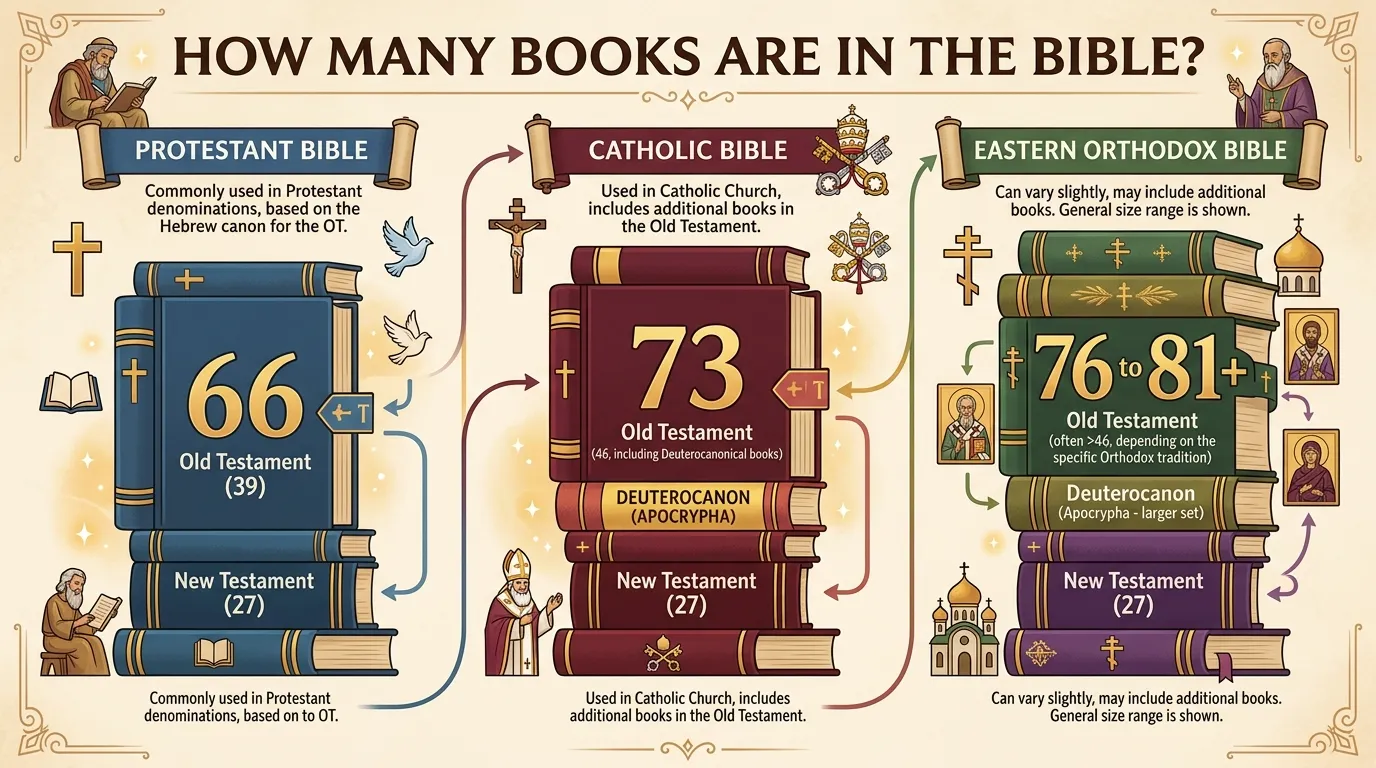
Have you ever opened a Bible and wondered, “How many books are in the Bible?” You are not alone. The Bible can look like one large book, but it is actually a collection of many smaller books written over many years.
The Bible has 66 books in the Protestant Bible. These books are divided into two main parts: the Old Testament, with 39 books, and the New Testament, with 27 books.
Different Christian traditions use different numbers of books. For example, Catholic Bibles contain 73 books, while Eastern Orthodox traditions may include even more. The difference comes mainly from which Old Testament books each tradition includes.
Understanding the number and order of the books can make Bible reading much easier. Whether you are a child learning Bible basics, a teenager studying Scripture, or an adult growing in faith, knowing the Bible’s structure helps you see the larger story of God’s work.
How Many Books Are in the Bible?
The Protestant Bible has 66 books:
- 39 books in the Old Testament
- 27 books in the New Testament
- 66 books in total
These books were written by different human authors and in different settings. Yet Christians believe they form one united story centered on God, His relationship with humanity, sin, redemption, and salvation through Jesus Christ.
The Bible is also called Scripture, the Word of God, and the Holy Bible.
How many books are in the bible catholic
The Catholic Bible has 73 books. It contains 46 books in the Old Testament and 27 books in the New Testament. The main difference between the Catholic Bible and most Protestant Bibles is that the Catholic Old Testament includes seven additional books called the Deuterocanonical books.
These books are Tobit, Judith, Wisdom, Sirach, Baruch, 1 Maccabees, and 2 Maccabees. Catholic Bibles also include additional sections in Esther and Daniel.
The New Testament has the same 27 books in both Catholic and Protestant Bibles. The Catholic Church recognizes these 73 books as the biblical canon.
The Bible itself shows that God’s Word is valuable for teaching and guiding God’s people:
“All scripture is given by inspiration of God, and is profitable for doctrine, for reproof, for correction, for instruction in righteousness.” : 2 Timothy 3:16
It is important to remember that the number of books depends on the Christian tradition and canon being used. So, when someone asks how many books are in the Catholic Bible, the answer is 73.
How many books in the new testament
There are 27 books in the New Testament. These books tell the story of Jesus Christ, His ministry, death, resurrection, and the growth of the early Christian church.
The 27 books include the four Gospels, Acts, 21 letters, and Revelation.
The 27 New Testament books are:
- Matthew
- Mark
- Luke
- John
- Acts
- Romans
- 1 Corinthians
- 2 Corinthians
- Galatians
- Ephesians
- Philippians
- Colossians
- 1 Thessalonians
- 2 Thessalonians
- 1 Timothy
- 2 Timothy
- Titus
- Philemon
- Hebrews
- James
- 1 Peter
- 2 Peter
- 1 John
- 2 John
- 3 John
- Jude
- Revelation
The New Testament focuses on the new covenant through Jesus Christ. Jesus spoke about this new covenant at the Last Supper:
“This cup is the new testament in my blood, which is shed for you.” : Luke 22:20
The 27 books work together to explain the gospel, Christian faith, salvation, discipleship, and hope in Christ.
How many books are in the bible old and new testament
The answer depends on which biblical tradition you mean.
Most Protestant Bibles have 66 books: 39 in the Old Testament and 27 in the New Testament.
The Catholic Bible has 73 books: 46 in the Old Testament and 27 in the New Testament.
Protestant Bible
- Old Testament: 39 books
- New Testament: 27 books
- Total: 66 books
Catholic Bible
- Old Testament: 46 books
- New Testament: 27 books
- Total: 73 books
The New Testament is the same number in both traditions. The difference comes mainly from the Old Testament canon.
The Bible presents God’s revelation as something that points people toward Him. Jesus said:
“Search the scriptures; for in them ye think ye have eternal life: and they are they which testify of me.” : John 5:39
So, if you are using a standard Protestant Bible such as the KJV or NIV, there are 66 books. If you are using a Catholic Bible, there are 73 books.
How many books in the old testament
The number of Old Testament books depends on the Christian tradition.
In most Protestant Bibles, there are 39 Old Testament books. In the Catholic Bible, there are 46 Old Testament books.
The seven additional Catholic books are:
- Tobit
- Judith
- Wisdom
- Sirach
- Baruch
- 1 Maccabees
- 2 Maccabees
Catholic editions also contain additional passages in Esther and Daniel.
The Old Testament tells the story of God’s relationship with His people before the coming of Jesus Christ. It includes history, law, poetry, wisdom literature, and prophecy.
For example, the prophet Isaiah points forward to the coming Messiah:
“Therefore the Lord himself shall give you a sign; Behold, a virgin shall conceive, and bear a son.” : Isaiah 7:14
In a standard Protestant Bible, the Old Testament contains 39 books. In a Catholic Bible, it contains 46 books.
How many books are in the bible in order
The 66-book Protestant Bible has a traditional order that begins with Genesis and ends with Revelation. The books are divided into the Old Testament and New Testament.
Old Testament : 39 books
- Genesis
- Exodus
- Leviticus
- Numbers
- Deuteronomy
- Joshua
- Judges
- Ruth
- 1 Samuel
- 2 Samuel
- 1 Kings
- 2 Kings
- 1 Chronicles
- 2 Chronicles
- Ezra
- Nehemiah
- Esther
- Job
- Psalms
- Proverbs
- Ecclesiastes
- Song of Solomon
- Isaiah
- Jeremiah
- Lamentations
- Ezekiel
- Daniel
- Hosea
- Joel
- Amos
- Obadiah
- Jonah
- Micah
- Nahum
- Habakkuk
- Zephaniah
- Haggai
- Zechariah
- Malachi
New Testament : 27 books
- Matthew
- Mark
- Luke
- John
- Acts
- Romans
- 1 Corinthians
- 2 Corinthians
- Galatians
- Ephesians
- Philippians
- Colossians
- 1 Thessalonians
- 2 Thessalonians
- 1 Timothy
- 2 Timothy
- Titus
- Philemon
- Hebrews
- James
- 1 Peter
- 2 Peter
- 1 John
- 2 John
- 3 John
- Jude
- Revelation
The order can vary between biblical traditions, especially between Protestant and Catholic Bibles. However, Genesis traditionally begins the Bible and Revelation ends the New Testament in the Christian Bible.
66 books of the bible list
The 66 books of the Bible are found in the standard Protestant canon. There are 39 Old Testament books and 27 New Testament books.
Old Testament
- Genesis
- Exodus
- Leviticus
- Numbers
- Deuteronomy
- Joshua
- Judges
- Ruth
- 1 Samuel
- 2 Samuel
- 1 Kings
- 2 Kings
- 1 Chronicles
- 2 Chronicles
- Ezra
- Nehemiah
- Esther
- Job
- Psalms
- Proverbs
- Ecclesiastes
- Song of Solomon
- Isaiah
- Jeremiah
- Lamentations
- Ezekiel
- Daniel
- Hosea
- Joel
- Amos
- Obadiah
- Jonah
- Micah
- Nahum
- Habakkuk
- Zephaniah
- Haggai
- Zechariah
- Malachi
New Testament
- Matthew
- Mark
- Luke
- John
- Acts
- Romans
- 1 Corinthians
- 2 Corinthians
- Galatians
- Ephesians
- Philippians
- Colossians
- 1 Thessalonians
- 2 Thessalonians
- 1 Timothy
- 2 Timothy
- Titus
- Philemon
- Hebrews
- James
- 1 Peter
- 2 Peter
- 1 John
- 2 John
- 3 John
- Jude
- Revelation
A helpful verse about the purpose of Scripture is:
“Thy word is a lamp unto my feet, and a light unto my path.” : Psalm 119:105
The 66 books were written by many human authors across different periods, yet Christians understand Scripture as inspired by God.
How many books are in the bible kjv
The King James Version (KJV) contains 66 books in its standard Protestant Bible.
There are 39 books in the Old Testament and 27 books in the New Testament.
The KJV was first published in 1611. Its biblical canon follows the traditional Protestant arrangement.
The KJV includes books such as Genesis, Psalms, Isaiah, Matthew, Romans, and Revelation. It does not include the seven Deuterocanonical books as part of the standard 66-book Protestant canon.
One famous KJV passage describes the value of Scripture:
“Thy word is a lamp unto my feet, and a light unto my path.” : Psalm 119:105, KJV
Therefore, when someone asks how many books are in the Bible KJV, the standard answer is 66 books.
How many books are in the bible niv
The New International Version (NIV) contains 66 books in its standard edition.
Like other Protestant Bibles, it has:
- 39 books in the Old Testament
- 27 books in the New Testament
- 66 books total
The NIV is a modern English translation designed to communicate the biblical message in clear, natural English. Its 66-book canon is the same basic Protestant canon used by translations such as the KJV.
The Bible teaches that Scripture has an important role in helping believers learn and grow:
“All Scripture is God-breathed and is useful for teaching, rebuking, correcting and training in righteousness.” : 2 Timothy 3:16, NIV
So, the number of books in the NIV is 66, while a standard Catholic Bible contains 73 books. The difference is not because the NIV has removed books from the New Testament; rather, the Protestant and Catholic traditions use different Old Testament canons.
How Many Books Are in the Old Testament?
The Protestant Old Testament contains 39 books.
The Old Testament tells the story of God’s relationship with His people before the earthly ministry of Jesus Christ. It includes history, law, poetry, wisdom, prophecy, and many important promises about God’s coming salvation.
The 39 books are grouped like this:
Books of the Law : 5
The first five books are often called the Pentateuch, which means “five books.”
- Genesis
- Exodus
- Leviticus
- Numbers
- Deuteronomy
These books explain creation, the fall of humanity, the flood, Abraham and his family, the Exodus from Egypt, God’s covenant with Israel, and His laws.
For example, Genesis 1:1 begins the Bible with the words, “In the beginning God created the heavens and the earth.”
This gives the Bible its starting point: God is the Creator.
Historical Books : 12
The next 12 books tell much of Israel’s history.
- Joshua
- Judges
- Ruth
- 1 Samuel
- 2 Samuel
- 1 Kings
- 2 Kings
- 1 Chronicles
- 2 Chronicles
- Ezra
- Nehemiah
- Esther
These books include stories about Joshua, Samson, Ruth, Samuel, David, Solomon, Esther, and many other people.
They show both the faithfulness of God and the struggles of His people.
Poetry and Wisdom Books : 5
These books explore worship, wisdom, suffering, love, and daily life.
- Job
- Psalms
- Proverbs
- Ecclesiastes
- Song of Solomon
Psalm 119:105 says, “Your word is a lamp to my feet and a light to my path.”
This verse shows why Scripture matters in everyday life. God’s Word gives direction when we do not know which way to go.
Major Prophets : 5
The five Major Prophets are:
- Isaiah
- Jeremiah
- Lamentations
- Ezekiel
- Daniel
They are called “Major” Prophets because their books are generally longer, not because they are more important than the Minor Prophets.
Isaiah contains many important prophecies and promises concerning God’s salvation and the coming Messiah.
Minor Prophets : 12
The final 12 Old Testament books are called the Minor Prophets.
- Hosea
- Joel
- Amos
- Obadiah
- Jonah
- Micah
- Nahum
- Habakkuk
- Zephaniah
- Haggai
- Zechariah
- Malachi
“Minor” does not mean unimportant. These books are shorter than the Major Prophets, but they contain strong messages about sin, repentance, justice, hope, and God’s faithfulness.
How Many Books Are in the New Testament?
The Protestant New Testament contains 27 books.
The New Testament focuses on Jesus Christ, His life, death, resurrection, teachings, the beginning of the Christian church, and the hope of His return.
The 27 books are divided into several groups.
The Four Gospels : 4
The four Gospels are:
- Matthew
- Mark
- Luke
- John
The word “Gospel” means good news.
These four books tell us about Jesus Christ. Each writer presents His life and ministry from a particular perspective.
Matthew often highlights Jesus as the promised Messiah.
Mark gives a fast-moving account of Jesus’ ministry. Luke gives a detailed account of Jesus’ life and also wrote Acts.
John strongly emphasizes Jesus’ identity as the Son of God.
John 20:31 explains the purpose of John’s Gospel: that readers may believe Jesus is the Christ, the Son of God, and have life through Him.
One Book of Church History : 1
The book of Acts records the growth of the early Christian church.
It begins after Jesus’ resurrection and ascension. The Holy Spirit comes upon the disciples, and the message of Jesus spreads from Jerusalem to other parts of the Roman world.
Acts includes important figures such as Peter and Paul.
Paul’s Letters : 13
The Apostle Paul wrote 13 books traditionally recognized as letters in the New Testament:
- Romans
- 1 Corinthians
- 2 Corinthians
- Galatians
- Ephesians
- Philippians
- Colossians
- 1 Thessalonians
- 2 Thessalonians
- 1 Timothy
- 2 Timothy
- Titus
- Philemon
These letters teach Christians about faith, grace, salvation, the church, Christian living, and following Christ.
For example, Ephesians 2:8–9 teaches that salvation is by grace through faith and is not something we earn through our own works.
General Letters : 8
The General Letters are:
- Hebrews
- James
- 1 Peter
- 2 Peter
- 1 John
- 2 John
- 3 John
- Jude
These books give teaching and encouragement to Christians and churches.
James, for example, stresses that genuine faith should affect the way we live.
One Book of Prophecy : 1
The final book is Revelation.
It contains visions given to John and presents themes of judgment, the victory of Christ, God’s final victory over evil, and the hope of God’s people.
Revelation ends with a powerful picture of God’s presence with His people.
Why Are There 66 Books in the Protestant Bible?
The number 66 comes from the collection of books accepted as Scripture in the Protestant biblical canon.
The word canon refers to the recognized collection of books considered authoritative Scripture.
The 66 books are not simply 66 unrelated writings. They form a broad story that moves from creation and humanity’s fall into sin toward God’s plan of redemption.
The Old Testament prepares the way for Christ, while the New Testament tells about Christ and the growth of His church.
This is one reason the Bible is best understood as a library of books with one connected story.
Why Do Some Bibles Have More Than 66 Books?
One important point is that not every Christian Bible has exactly 66 books.
The main difference concerns certain Old Testament books known in many Protestant settings as the Deuterocanonical books or, in Protestant terminology, the Apocrypha.
Catholic Bible
The Catholic Bible contains 73 books:
- 46 Old Testament books
- 27 New Testament books
- 73 books total
The additional seven Old Testament books are:
- Tobit
- Judith
- Wisdom
- Sirach
- Baruch
- 1 Maccabees
- 2 Maccabees
Catholic editions also include additions to Esther and Daniel.
Eastern Orthodox Bibles
Eastern Orthodox traditions generally include the same 27 New Testament books but may have a larger Old Testament collection than Catholic or Protestant Bibles.
The exact number can vary among Orthodox traditions.
So, when someone asks “How many books are in the Bible?”, the best answer depends on the Christian tradition being discussed.
Is the Bible One Book or Many Books?
The Bible is one collection of Scripture made up of many books.
Think of it like a library. A library has many books, but each book can have its own subject, style, and purpose.
The Bible contains:
- History
- Law
- Poetry
- Wisdom
- Prophecy
- Gospels
- Letters
- Apocalyptic writing
The writers also came from different backgrounds. The Bible includes writings connected with people such as Moses, David, Solomon, Isaiah, Matthew, John, Peter, Paul, and others.
Yet Christians understand Scripture as having one ultimate divine source.
2 Timothy 3:16 says, “All Scripture is breathed out by God.”
This verse teaches that Scripture has divine authority and is useful for teaching, correction, and training in righteousness.
What Is the Main Message of the 66 Books?
The Bible has many stories, but they fit into a larger story.
You can understand that story through several major themes:
- Creation : God creates the world and humanity.
- Sin : Humanity turns away from God.
- Promise : God promises blessing and redemption.
- Israel : God works through Israel in His redemptive plan.
- Messiah : The Old Testament points forward to the promised Savior.
- Jesus : Jesus comes, teaches, dies, and rises again.
- Church : The Gospel spreads through Jesus’ followers.
- New Creation : Scripture ends with God’s final victory and renewed creation.
This helps explain why reading only one Bible book can sometimes leave you wondering about the bigger picture.
The books are different, but they belong to one unfolding biblical story.
How Can Kids and Teens Learn the 66 Books?
Learning all 66 books may seem hard at first. You do not need to memorize them in one day.
Start by learning the two main sections:
Old Testament = 39 books
New Testament = 27 books
Then learn the groups.
For the Old Testament, remember:
- Law
- History
- Poetry
- Major Prophets
- Minor Prophets
For the New Testament, remember:
- Gospels
- Acts
- Paul’s Letters
- General Letters
- Revelation
A simple Bible book song, list, or flashcard game can also help children and teens learn the order.
Most importantly, do not learn the names only. Read the books and learn what they teach about God.
How Knowing the Bible’s Books Helps Your Faith
Knowing the structure of Scripture can make Bible study less confusing.
If you know where Psalms is, you can quickly turn there for prayer and worship. If you know where the Gospels are, you can read directly about Jesus.
It also helps you understand context.
For example, Paul’s letters were written to teach and encourage early Christians and churches. The prophetic books often addressed specific situations while also pointing toward God’s future work.
Understanding where a book fits can help you read it with greater care.
What Does the Bible Say About Reading Scripture?
The Bible encourages God’s people to know and live by His Word.
Psalm 1:2 describes the blessed person as one whose “delight is in the law of the LORD” and who meditates on it day and night.
The point is not simply to collect Bible facts.
God’s Word should shape our thoughts, choices, relationships, prayers, and daily lives.
For families, Bible reading can become a shared habit. Parents can read simple passages with children and discuss what they teach about God.
For teenagers, Scripture can help answer questions about identity, friendship, temptation, forgiveness, and purpose.
For adults, God’s Word gives wisdom and hope through changing seasons of life.
A Simple Way to Start Reading the Bible
If you are new to Scripture, you do not have to begin by reading all 66 books at once.
A simple plan is:
- Step 1: Start with one of the four Gospels.
- Step 2: Learn about Jesus’ words, actions, death, and resurrection.
- Step 3: Read Acts to learn how the early church began.
- Step 4: Read selected Psalms and Proverbs for prayer and wisdom.
- Step 5: Slowly explore the Old Testament to understand the larger biblical story.
Before reading, pray for wisdom and understanding.
You can use the prayer, “Lord, help me understand Your Word and live by what I learn.”
Bible reading is not a race. What matters is growing in truth and knowing God more deeply.
FAQs:
1. How many books are in the Bible?
The Protestant Bible has 66 books. It contains 39 books in the Old Testament and 27 books in the New Testament.
2. How many books are in the Old Testament?
The Protestant Old Testament has 39 books. They include books of law, history, poetry and wisdom, and prophecy.
3. How many books are in the New Testament?
The New Testament has 27 books. It includes the four Gospels, Acts, Paul’s letters, the General Letters, and Revelation.
4. Does every Bible have 66 books?
No. Protestant Bibles have 66 books, while Catholic Bibles have 73. Eastern Orthodox traditions may include additional books as well.
5. Who wrote the books of the Bible?
The Bible was written by many human authors over many years. The books are connected with writers such as Moses, David, the prophets, the Gospel writers, Peter, Paul, John, and others. Christians believe Scripture is ultimately inspired by God, as taught in 2 Timothy 3:16.
Conclusion:
The answer to how many books are in the Bible is simple: the Protestant Bible has 66 books:39 in the Old Testament and 27 in the New Testament. But the number is only the beginning. Each book has a purpose and contributes to the larger story of God’s work.
The Bible tells us about creation, sin, covenant, promise, redemption, Jesus Christ, the church, and God’s final victory.
As you read Scripture, do not worry about understanding everything at once. Start with one book, pray for wisdom, and keep learning. God’s Word is meant not only to be read but also to shape the way we live.
I am Caleb Anderson, a Christian writer passionate about exploring deep biblical meanings and spiritual truths.
On Biblicaltribez.com, I share faith based insights to help readers grow closer to God through Scripture.
My writing focuses on making the Bible easy to understand, meaningful, and relevant to everyday life.