Skip to content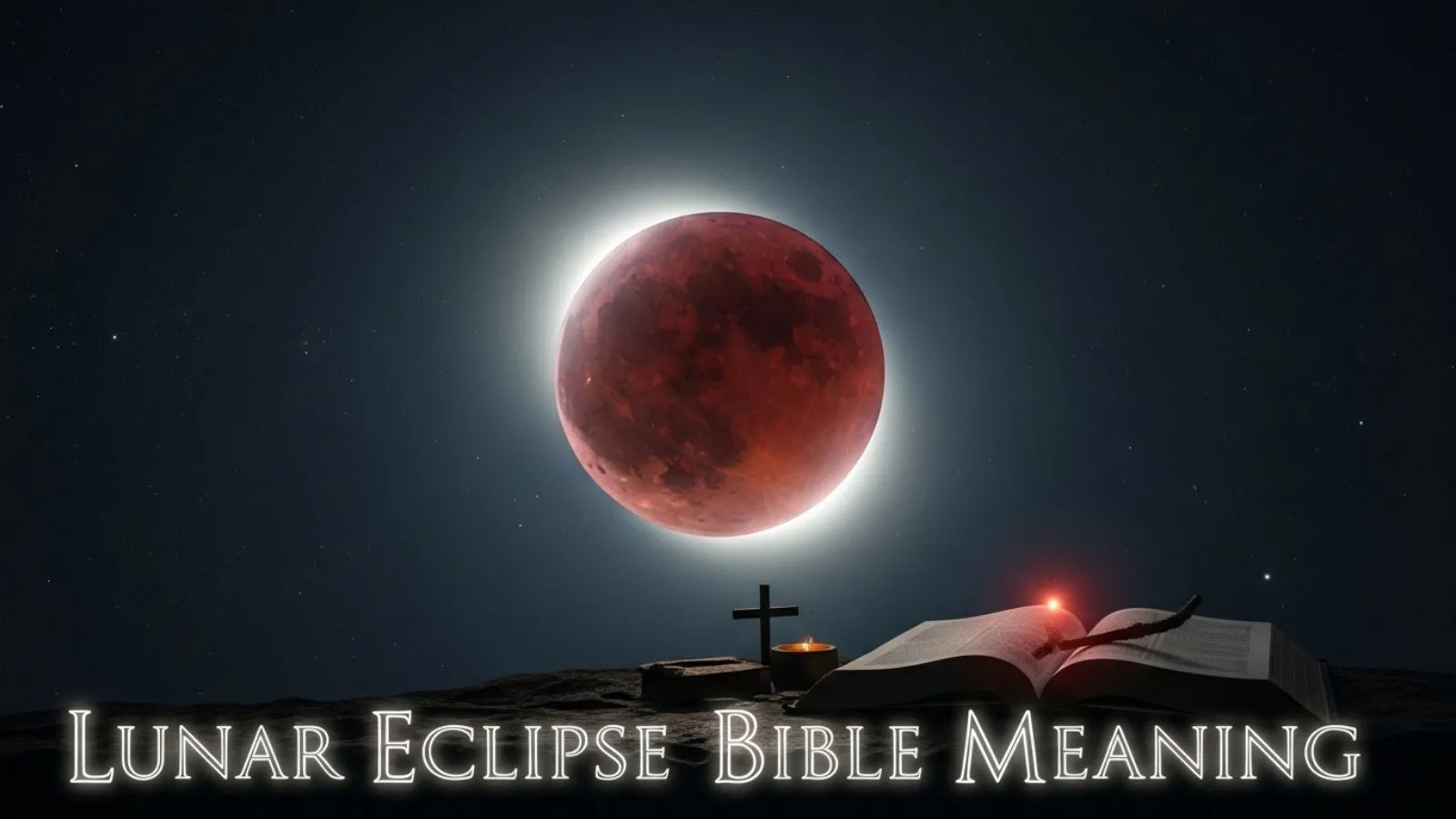
One night, you look up at the sky. The moon is bright, calm, and peaceful. But slowly, something changes.
A shadow moves across it. The light fades. The moon turns dark, even red. It feels strange and quite powerful.
You may wonder, “What does this mean?”Is it just nature? Or could it be something more?
Many people feel a deep emotion when they see a lunar eclipse. It can feel like a sign. A moment that touches the heart.
In the Bible, the sky often carries meaning. The sun, moon, and stars are not just lights, they can be symbols of God’s message.
So, what is the lunar eclipse Bible meaning?Could it be a sign of warning or hope?
Let’s explore what Scripture and faith reveal about this powerful moment in the sky.
Eclipse Meaning
The eclipse meaning can be understood both naturally and spiritually.
From a scientific perspective, an eclipse occurs when one celestial body blocks or enters the shadow of another. The Bible, however, approaches the heavens primarily from the perspective of God’s creation and authority.
Spiritually, darkness in Scripture can have several meanings depending on the passage.
Biblical meanings of darkness can include:
- Judgment: Darkness sometimes accompanies descriptions of God’s judgment.
- Distress: Biblical writers sometimes use darkness to describe difficult times.
- Mystery: God’s ways can be beyond human understanding.
- A call to repentance: Prophetic warnings often encouraged people to turn back to God.
- The end of an age: Prophetic passages sometimes use heavenly darkness when describing major future events.
Yet an eclipse does not necessarily mean that something bad will happen.
Ecclesiastes 3:1 reminds us:
“To every thing there is a season, and a time to every purpose under the heaven.”
The safest biblical approach is to appreciate the eclipse as part of God’s creation and use it as an opportunity to reflect on Him rather than fear it.
What Does a Lunar Eclipse Mean Biblically
The Bible does not say that every lunar eclipse has a specific personal or spiritual message. However, the Bible does use the darkening of the moon as a powerful sign connected with God’s power, judgment, and significant events. In biblical prophecy, the moon becoming dark or turning to blood can point to the “day of the Lord,” a time when God acts in a major way.
One of the clearest examples is found in Joel 2:31:
“The sun shall be turned into darkness, and the moon into blood, before the great and terrible day of the LORD come.”
This language is also repeated in Acts 2:20, where Peter connects the signs in the heavens with God’s prophetic work.
A lunar eclipse itself is a natural event. The Earth moves between the sun and moon, causing the moon to appear dark or reddish. The Bible, however, teaches that the heavens can remind people of God’s greatness and authority.
Biblical ideas associated with a lunar eclipse
- A reminder of God’s sovereignty: The moon and other heavenly bodies are part of God’s creation (Genesis 1:16).
- A prophetic sign: Scripture sometimes describes changes in the sun, moon, and stars in connection with the “day of the Lord.”
- A call to repentance: Joel’s prophecy immediately calls people to return to God with all their hearts (Joel 2:12–13).
- A reminder of God’s coming judgment: Darkened heavenly bodies can represent God’s judgment in prophetic passages.
- A reminder to watch and pray: Jesus taught His followers to remain spiritually alert concerning future events (Matthew 24:42).
- Not necessarily a personal warning: The Bible does not teach that seeing an eclipse automatically means something bad will happen to an individual.
It is important to avoid treating every modern lunar eclipse as a guaranteed fulfillment of biblical prophecy. The Bible gives the spiritual meaning of heavenly signs within specific prophetic contexts, rather than telling believers to interpret every eclipse as a direct message from God.
Lunar Eclipse Biblical Meaning
The lunar eclipse biblical meaning is best understood through the Bible’s symbolism of the moon becoming dark or appearing like blood. Scripture connects such heavenly signs with God’s authority, prophetic events, judgment, and the coming “day of the Lord.”
For example, Matthew 24:29 describes events surrounding Christ’s coming:
“The sun shall be darkened, and the moon shall not give her light.”
Similarly, Revelation 6:12 says:
“The sun became black as sackcloth of hair, and the moon became as blood.”
These verses show that unusual changes in the heavens can have prophetic significance in biblical imagery. However, they should not be used to claim that every lunar eclipse is predicting a particular event.
What a lunar eclipse can remind Christians of
- God created the heavens: The moon exists because God created it as part of His ordered creation (Genesis 1:14–18).
- God controls creation: Biblical passages frequently point people toward God’s authority over the heavens and earth.
- Prophecy deserves attention: Scripture uses cosmic signs when describing important future events.
- God calls people to repentance: Joel 2:12 says, “Turn ye even to me with all your heart.”
- Christians should remain spiritually prepared: Jesus says, “Watch therefore” in Matthew 24:42.
- God’s purposes are greater than human understanding: Ecclesiastes 3:11 reminds us that God works according to His purposes and timing.
Does a lunar eclipse mean something bad?
Not necessarily. A lunar eclipse is a normal astronomical event and does not automatically mean that judgment, death, disaster, or another negative event is coming.
The Bible does contain passages where the moon is darkened as part of prophetic descriptions. But those passages should be interpreted in their biblical context. Christians should not live in fear because of an eclipse. Instead, such an event can be an opportunity to appreciate God’s creation and remember His call to faithfulness.
A balanced biblical perspective
The Bible encourages believers to recognize God’s greatness in creation:
“The heavens declare the glory of God; and the firmament sheweth his handywork.” : Psalm 19:1
So, if you see a lunar eclipse, you can view it as a beautiful reminder that God is the Creator and remains sovereign over His creation. If the eclipse causes you to think about biblical prophecy, the appropriate response is not fear or speculation but faith, repentance, prayer, and readiness to follow God.
In short: The Bible gives lunar darkness prophetic symbolism, especially in passages about the day of the Lord. But Scripture does not teach that every lunar eclipse has a unique personal message or that every eclipse is a direct sign of the end times.
Biblical Meaning of Lunar Eclipse
The Bible does not directly use the term “lunar eclipse,” but it speaks clearly about changes in the moon. These changes often point to important spiritual events.
One key verse is:
“The sun shall be turned into darkness, and the moon into blood, before the great and terrible day of the Lord.” Joel 2:31
This verse shows that when the moon changes, it can be a sign of something big. A moment when God is moving. A time to wake up and pay attention.
Another verse says:
“The moon will turn red like blood…” Acts 2:20
A red moon, often seen during a lunar eclipse, is sometimes called a “blood moon.” In the Bible, this can be a sign of:
- Warning A call to turn back to God
- Change A shift in seasons or life
- God’s power A reminder that He controls all creation
But this is not only about fear. It is also about hope.
In Genesis, we read:
“Let there be lights in the sky to mark signs and seasons.” Genesis 1:14
This tells us that the moon and sky are part of God’s design. They can be guides, not just objects.
So, the biblical symbolism of a lunar eclipse can mean:
1. A Call to Reflect
When the moon darkens, it can remind us to look inside our hearts.
Are we walking with God? Are we drifting away?
It is a gentle nudge to pause and pray.
2. A Sign of Change
Just as the moon changes, life changes too.
A lunar eclipse can mean a new season is coming.
It may feel dark for a moment, but light will return.
3. A Reminder of God’s Control
Even when the sky looks strange, God is still in charge.
The eclipse shows His power over creation.
This brings peace: nothing is out of His hands.
4. A Warning with Love
Some people feel fear during an eclipse. But in the Bible, warnings are not to scare us, they are to guide us back to God.
God uses signs to say:
“Come back. I am here.”
Solar Eclipse Bible Meaning
The solar eclipse Bible meaning is best understood through the Bible’s broader teaching about the sun, darkness, signs in the heavens, and God’s authority over creation. The Bible does mention the sun becoming dark as part of prophetic and symbolic language, but it does not teach that every solar eclipse is a direct message from God.
In Scripture, darkness of the sun can point to a time of judgment, great distress, or a major event in God’s plan.
“The sun shall be turned into darkness, and the moon into blood, before the great and terrible day of the LORD come.” : Joel 2:31
Jesus also used similar language when describing the end times:
“The sun shall be darkened, and the moon shall not give her light.” : Matthew 24:29
So, spiritually, a solar eclipse may remind a Christian of God’s greatness, human dependence on Him, the seriousness of repentance, and the hope of Christ’s return. However, Christians should avoid assuming that a particular eclipse automatically predicts a specific biblical event.
Biblical lessons associated with a solar eclipse:
- God has authority over the heavens and the earth.
- Darkness can symbolize judgment or distress.
- Creation can remind us of God’s power.
- An eclipse can encourage spiritual reflection and prayer.
- Scripture does not tell Christians to fear ordinary eclipses.
- Prophetic passages should be understood in their biblical context rather than through speculation.
What Does the Bible Say About Solar Eclipse
The Bible does not use the modern scientific term solar eclipse. However, it describes occasions when the sun becomes dark. These descriptions occur especially in prophetic passages.
For example, Amos 8:9 says:
“I will cause the sun to go down at noon, and I will darken the earth in the clear day.”
The Bible also says that God created the sun, moon, and stars and established their purposes.
“And God made two great lights; the greater light to rule the day, and the lesser light to rule the night.” : Genesis 1:16
This gives an important biblical perspective. The sun is part of God’s creation; it is not a god or an object that Christians should worship.
The Bible therefore encourages believers to look beyond the event itself and recognize the Creator.
Psalm 19:1 says:
“The heavens declare the glory of God; and the firmament sheweth his handywork.”
A solar eclipse can therefore become an opportunity to appreciate God’s creation, but Scripture does not command believers to interpret every eclipse as a prophecy.
Eclipse in the Bible Revelation
The phrase eclipse in the Bible revelation is closely connected with passages in Revelation that describe unusual signs involving the sun, moon, and stars.
One important passage is:
“The sun became black as sackcloth of hair, and the moon became as blood.” : Revelation 6:12
Another passage describes a great heavenly sign:
“A third part of the sun was smitten, and a third part of the moon, and a third part of the stars.” : Revelation 8:12
These passages use powerful prophetic imagery. They communicate the seriousness of God’s judgment and events surrounding the fulfillment of His purposes.
It is important, however, not to automatically identify every modern eclipse with Revelation. Revelation uses symbolic and prophetic language, and the Bible does not give believers a calendar saying that a particular solar eclipse fulfills a particular verse.
Key biblical points:
- Revelation contains imagery involving the sun and moon.
- Darkness can represent judgment and the seriousness of God’s intervention.
- Revelation points believers toward God’s ultimate victory.
- A modern eclipse should not automatically be declared a fulfillment of Revelation.
- Christians should focus on Scripture rather than eclipse predictions.
What Does the Bible Say About Lunar Eclipse
The Bible does not specifically teach the modern scientific concept of a lunar eclipse, but it does speak about the moon becoming dark or appearing like blood.
The best-known example is Joel 2:31:
“The sun shall be turned into darkness, and the moon into blood.”
Peter repeated this prophecy in Acts 2:20:
“The sun shall be turned into darkness, and the moon into blood, before that great and notable day of the Lord come.”
Jesus also spoke about heavenly signs in Matthew 24:29.
The phrase “moon into blood” has often been associated with a blood moon or lunar eclipse. However, Scripture does not say that every lunar eclipse is the fulfillment of Joel’s prophecy.
The biblical message is bigger than the astronomical event. These passages call attention to God’s sovereignty, judgment, prophetic fulfillment, and the coming Day of the Lord.
Therefore, seeing a lunar eclipse can remind Christians of biblical prophecy, but believers should avoid fear or making unsupported predictions about the end times.
Solar Eclipse Meaning Spiritual
The solar eclipse meaning spiritual can be viewed as a reminder of God’s power, human limitations, and the temporary nature of earthly things.
When daylight suddenly becomes dark, it can naturally remind a believer of the biblical contrast between light and darkness.
Jesus said:
“I am the light of the world: he that followeth me shall not walk in darkness, but shall have the light of life.” : John 8:12
From a Christian perspective, an eclipse can therefore encourage reflection on questions such as:
- Am I walking faithfully with God?
- Am I trusting God during uncertain times?
- Do I recognize God as the Creator?
- Am I allowing God’s Word to guide me?
- Am I living in the light of Christ?
An eclipse should not become a source of superstition. The Bible repeatedly directs believers toward faith in God rather than fear of signs.
1 John 1:5 teaches:
“God is light, and in him is no darkness at all.”
So, spiritually, an eclipse can be a meaningful reminder, but its meaning should come from biblical truth rather than personal superstition.
When Is the Next Solar Eclipse
The question when is the next solar eclipse is an astronomical question rather than a biblical one. Solar eclipses happen according to predictable movements of the Sun, Moon, and Earth.
The Bible does not provide dates for future solar eclipses. It also does not instruct Christians to calculate an eclipse date to determine when biblical prophecy will occur.
Jesus specifically warned against attempting to predict the exact timing of His return:
“But of that day and hour knoweth no man.” : Matthew 24:36
For the exact date and location of the next solar eclipse, an up-to-date astronomical source should be used because eclipse schedules are calculated scientifically and can be updated with precise visibility information.
From a biblical perspective, the important point is that an eclipse date should not be treated as a prediction of the Second Coming or the end of the world.
Blood Moon
A blood moon is a common name for a lunar eclipse in which the Moon can appear reddish or copper-colored. The Bible contains several passages that mention the moon appearing like blood.
Joel 2:31 says:
“The sun shall be turned into darkness, and the moon into blood.”
The same prophetic language appears in Acts 2:20, while Revelation 6:12 describes the moon becoming “as blood.”
Because of these verses, many Christians connect the phrase blood moon with biblical prophecy. However, we should be careful not to claim that every blood moon is a direct fulfillment of these passages.
The biblical focus is on God’s prophetic purposes, not on predicting events from every lunar eclipse.
A blood moon can remind Christians of:
- God’s sovereignty over creation.
- Biblical prophecy.
- The seriousness of God’s judgment.
- The coming Day of the Lord.
- The importance of remaining spiritually prepared.
- The hope that ultimately belongs to those who trust God.
Ultimately, Scripture calls believers to remain watchful and faithful rather than fearful.
“Therefore be ye also ready: for in such an hour as ye think not the Son of man cometh.” : Matthew 24:44
A Biblical Takeaway
Eclipses can be beautiful and powerful reminders of God’s creation, but the Bible does not teach that Christians should fear them or treat every eclipse as an omen. Scripture’s emphasis is on trusting God, living faithfully, repenting from sin, and being spiritually ready.
“The heavens declare the glory of God.” : Psalm 19:1
The best response to an eclipse is therefore not panic or superstition, but wonder, worship, wisdom, and faith in God.
Lunar eclipse in the Bible: Spiritual Significance and Symbolism
Beyond the Bible verses, the spiritual symbolism of a lunar eclipse is deeply personal.
It often reflects a time of inner change.
Think of your life. Have you ever felt:
- Lost or unsure?
- Distant from your faith?
- Ready for something new?
A lunar eclipse can mirror these feelings.
Darkness Before Light
When the moon goes dark, it does not stay that way.
The light always comes back.
This is a beautiful message:
Your dark season will not last forever.
God may be working quietly in your life, even when you cannot see it.
Spiritual Awakening
Sometimes, the eclipse can feel like a wake-up call.
You may feel a strong urge to pray, reflect, or change something.
This can be a spiritual awakening.
God may be inviting you to grow closer to Him.
Letting Go
The shadow on the moon can also mean it is time to release something:
- Old habits
- Past pain
- Fear or doubt
Letting go creates space for healing and faith.
Biblical Interpretations in Dreams or Real Life
Seeing a lunar eclipse in real life or even in a dream can carry meaning.
In Real Life
If you witness a lunar eclipse, ask yourself:
- What am I feeling right now?
- Is there something God is showing me?
If you feel peace, it may be a sign of trust and hope, if you feel uneasy, it could be a gentle call to seek God more deeply.
In Dreams
Dreaming of a lunar eclipse often points to:
- Hidden emotions coming to light
- A season of change
- A need for spiritual clarity
If the dream feels calm, it may mean growth and renewal.
If it feels scary, it may be a warning but one filled with love, guiding you back to God.
Always remember:
God speaks with purpose, not confusion.
Practical Lessons & Faith Insights
A lunar eclipse reminds us to pause, pray, and trust God.
Even in darkness, His light is near. Stay strong in faith, reflect on your path, and welcome change with hope.
Conclusion:
Lunar Eclipse Bible meaning often points to moments of divine warning, reflection, and transformation.
It symbolizes times when God calls people to repent and realign their hearts with His will.
Just as the moon is temporarily darkened, believers may face spiritual testing or uncertainty, yet hope remains because God’s light is never truly lost.
Ultimately, it reminds us to stay faithful, trust God’s timing, and seek renewal through prayer and obedience always during the season of life and faith.

I am Caleb Anderson, a Christian writer passionate about exploring deep biblical meanings and spiritual truths.
On Biblicaltribez.com, I share faith based insights to help readers grow closer to God through Scripture.
My writing focuses on making the Bible easy to understand, meaningful, and relevant to everyday life.