Skip to content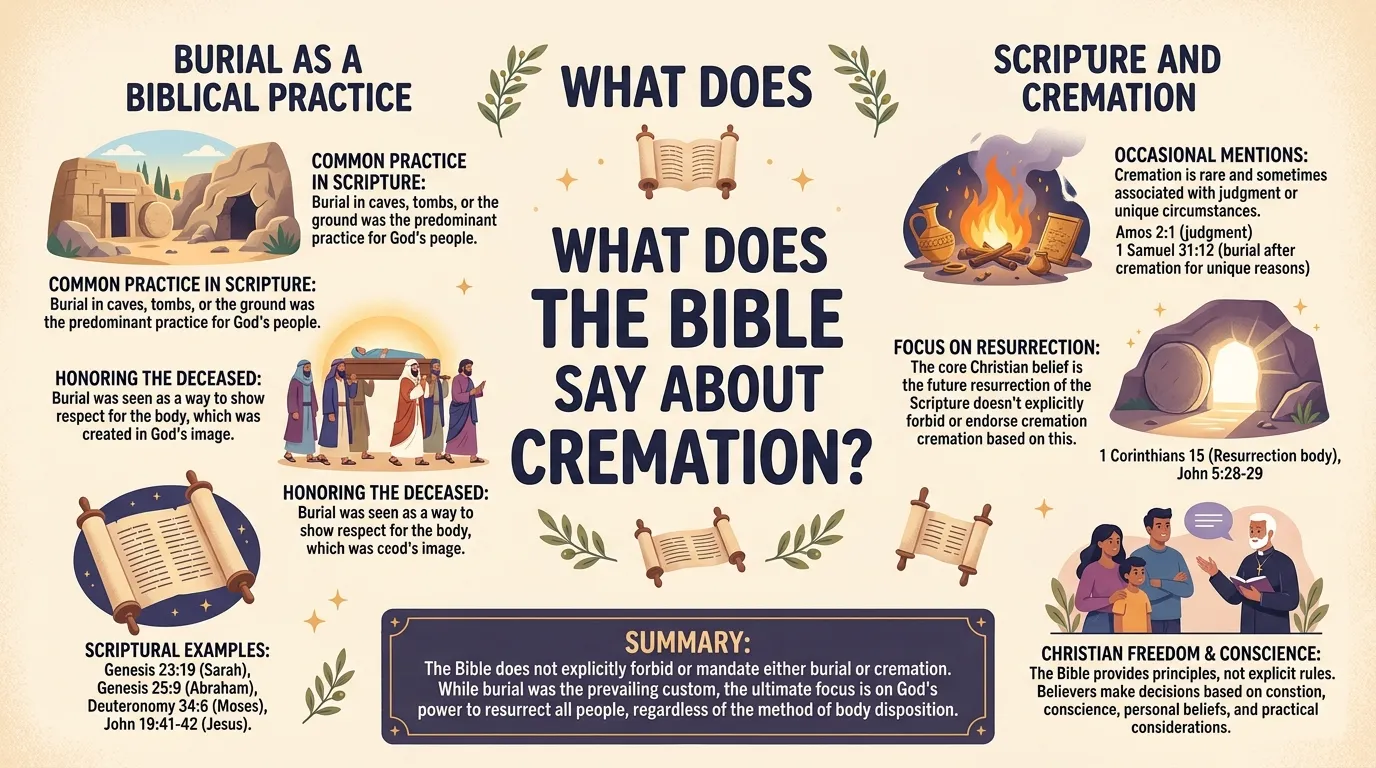
When a loved one dies, families face many hard choices. One of them is If to bury the body or choose cremation. For Christians, this can raise an important question: what does the Bible say about cremation?
The Bible does not give a direct command saying, “Christians must be buried,” and it does not give a direct command saying, “Christians must not be cremated.” Cremation is not clearly forbidden in Scripture. At the same time, burial was the normal way people cared for the dead in many biblical stories.
So, can a Christian be cremated? Yes. A Christian can choose cremation without believing that it will prevent the resurrection. Our hope is not based on what happens to our earthly bodies after death. Our hope is in Jesus Christ and the power of God.
In this article, we will look at what Scripture says about death, burial, cremation, the resurrection, and how Christians can make this choice with faith and peace.
Does the Bible Mention Cremation?
The Bible does not describe modern cremation as we know it today. There is no biblical verse that says, “Do not cremate the dead.”
Some passages do mention the burning of bodies or bones. However, we should be careful when reading these passages because they do not all describe normal funeral cremation.
For example, after King Saul and his sons died in battle, the men of Jabesh-gilead recovered their bodies. They burned the bodies and then buried their bones.
1 Samuel 31:11–13 describes this event.
The men of Jabesh-gilead showed respect for Saul and his sons by recovering their bodies and giving them a burial.
This passage is important because it shows that burning the body was not always connected with disrespect or judgment. The people acted because they wanted to care for the dead.
Still, this passage should not be used to claim that the Bible commands cremation. It simply shows that burning a body did occur in biblical history.
Was Burial the Normal Practice in the Bible?
Yes. Burial was a common practice throughout the Bible.
Abraham buried Sarah in the cave of Machpelah (Genesis 23:19). Abraham himself was later buried by Isaac and Ishmael (Genesis 25:9–10).
Jacob was buried in the family burial place in Canaan (Genesis 50:13). Joseph also gave instructions about his bones before his death (Genesis 50:25).
In the New Testament, Jesus was placed in a tomb after His crucifixion.
Matthew 27:59–60 says that Joseph of Arimathea placed Jesus’ body in his own new tomb.
This shows that burial was an important cultural practice among God’s people.
But there is an important difference between saying “burial was common” and saying “burial is commanded.”
The Bible clearly shows burial, but it does not say that every believer must be buried to be saved or resurrected.
Does God Care What Happens to the Body After Death?
Yes, the Bible teaches that the human body has value.
Our bodies are part of God’s creation. For Christians, the body also has a special purpose because believers are called to honor God with their bodies.
1 Corinthians 6:19–20 teaches that the believer’s body is a temple of the Holy Spirit and should be used to honor God.
Death does not make the body worthless.
This is one reason Christians should treat the dead with dignity. If a family chooses burial or cremation, the body should not be treated as something meaningless or as an object of shame.
Christian care for the dead should show love, respect, and dignity.
Does Cremation Prevent the Resurrection?
No. Cremation cannot stop God from raising a person from the dead.
This is one of the biggest fears people have when thinking about cremation. Some wonder, “If the body becomes ashes, how can God resurrect it?”
The Bible gives us a strong answer.
1 Corinthians 15:42–44 explains that the body is buried in weakness and raised in power. Paul teaches that there is a resurrection body.
God is not limited by the condition of a person’s earthly remains.
Think about this: many people die in ways that destroy the body. Some die at sea. Others die in fires, accidents, wars, or natural disasters. Their bodies may not remain whole.
Does that make resurrection impossible?
No.
God created the human body in the first place. The God who created life from dust has the power to raise the dead.
Romans 8:11 teaches that the Spirit of God, who raised Jesus from the dead, gives life.
Our resurrection depends on God’s power, not on If our bodies remain intact.
What Does 1 Corinthians 15 Teach About the Resurrection?
First Corinthians 15 is one of the most important chapters in the Bible about resurrection.
Paul explains that Christians will receive a transformed resurrection body.
He writes:
“It is sown a natural body; it is raised a spiritual body.”
1 Corinthians 15:44
Paul uses the picture of a seed. A seed is placed into the ground, and something different and greater comes from it.
The point is not that the old body must remain physically unchanged. The point is that God has the power to give new life.
This gives Christians confidence.
Cremation does not make God less powerful. Burial does not make God more powerful.
The resurrection is God’s work.
Does Cremation Show a Lack of Faith?
Not necessarily.
Choosing cremation does not automatically mean a person has weak faith or does not believe in the resurrection.
A Christian family may choose cremation for many reasons. These may include family wishes, cost, cultural practice, location, or personal preference.
The important question is not simply, “Was the body buried?”
A better question is, “Was the person treated with dignity, and was the decision made in a way that honors God?”
Christians should avoid judging another believer’s faith based only on the choice of burial or cremation.
Romans 14:10 warns believers against judging one another over matters where Christians may have different convictions.
What Does the Bible Say About Ashes?
Ashes appear in several places in Scripture, often as a picture of human weakness, grief, repentance, or mortality.
For example, Job said:
Job 42:6 speaks of repentance “in dust and ashes.”
In the ancient world, sitting in ashes could also express deep sorrow or repentance.
However, the Bible does not teach that human ashes have special spiritual power.
Ashes are not a person’s soul.
They are not a source of spiritual protection. They do not need to be feared.
The Bible teaches that the person belongs to God, and Christian hope rests in God’s promise of resurrection.
What Does “Dust to Dust” Mean?
The Bible teaches that human beings were formed from the dust of the ground.
Genesis 2:7 says that God formed man from the dust of the ground and breathed life into him.
After sin entered the world, God told Adam:
Genesis 3:19 says, “for dust you are and to dust you shall return.”
This reminds us that physical death is part of the human condition after the Fall.
Ecclesiastes 3:20 also says that all people go to one place and that all are from the dust and return to the dust.
These verses teach an important truth: our earthly bodies do not last forever.
If a person is buried and returns to dust over time or is cremated and reduced to ashes, the final hope of a Christian is not found in preserving earthly remains.
The hope is found in Christ.
Did Jesus Say Anything About Cremation?
Jesus did not give a teaching about cremation.
The Gospels record that Jesus was buried after His death. His body was placed in a tomb, and He rose again on the third day.
His burial and resurrection are central to the Christian faith.
However, Jesus’ resurrection does not mean Christians must use the exact same burial method.
The most important message is that Jesus defeated death.
Because Christ rose from the dead, Christians have hope beyond the grave.
John 11:25 records Jesus saying:
“I am the resurrection and the life.”
This is the heart of Christian hope.
Is Burial More Biblical Than Cremation?
If by “more biblical” we mean more commonly shown in Scripture, then burial has stronger biblical examples.
Abraham, Sarah, Jacob, Joseph, David, and Jesus were connected with burial practices.
But if the question is If the Bible makes burial a requirement for every Christian, the answer is no.
Scripture does not say that a person must be buried to receive eternal life.
It also does not say that cremation removes a person’s place in God’s kingdom.
Therefore, Christians can recognize the biblical tradition of burial while also understanding that cremation is not directly prohibited.
Can a Christian Choose Cremation?
Yes.
A Christian may choose cremation while still believing fully in:
- Jesus Christ
- His death and resurrection
- The forgiveness of sins
- Eternal life
- The resurrection of the dead
- The final victory over death
The choice should be made with wisdom and respect.
If a person has strong convictions about burial, those convictions should be respected. If another Christian chooses cremation in good conscience, that person should not automatically be treated as less faithful.
Romans 14:23 teaches the importance of acting according to faith and conscience.
This is a helpful principle when Christians face questions that Scripture does not directly command or forbid.
What About Cremation and the Soul?
The Bible makes a clear distinction between physical death and the hope of life with God.
When the body dies, death does not mean that God has lost the person.
Ecclesiastes 12:7 says:
“the spirit shall return unto God who gave it.”
For Christians, death is not the end.
Paul wrote that to be “absent from the body” is to be “present with the Lord” (2 Corinthians 5:8).
The Christian’s hope is therefore much bigger than the question of what happens to the body.
The body matters, but God’s promise is greater than the grave.
Should Christians Pray About Cremation?
Yes.
Any major family decision can be brought to God in prayer.
James 1:5 teaches that if anyone lacks wisdom, they should ask God, who gives generously.
A family can pray together and ask God for wisdom, peace, and unity.
Prayer can also help family members who disagree.
Instead of turning the funeral decision into an argument, Christians can ask:
- What choice respects the wishes of the person who died?
- What choice can the family make with a clear conscience?
- How can we honor God?
- How can we care for grieving family members?
- How can the funeral point people toward the hope of Christ?
These questions keep the focus where it belongs.
How Should Christians Think About Cremation?
A healthy biblical approach is to keep the main thing the main thing.
Cremation is a physical decision. Resurrection is a spiritual promise from God.
Do not allow fear about cremation to replace the hope of the gospel.
Jesus said in John 6:40 that everyone who looks to the Son and believes in Him has eternal life, and Jesus will raise that person up at the last day.
That promise is not based on burial.
It is based on Christ.
Cremation, Grief, and Christian Hope
Death hurts.
Even Christians who believe in eternal life still grieve when someone they love dies.
Jesus Himself wept at the tomb of Lazarus in John 11:35.
This shows us that grief is not a lack of faith.
Christians can cry, remember loved ones, attend funerals, and feel deep sadness while still trusting God.
Paul tells believers in 1 Thessalonians 4:13–14 not to grieve like those who have no hope.
Notice that Paul does not say Christians will never grieve.
He says they do not grieve without hope.
That difference matters.
A cremation service can become an opportunity to remember God’s faithfulness, thank Him for the life of the person who died, and point grieving hearts toward Jesus.
How Can Families Honor a Loved One After Cremation?
If a family chooses cremation, there are many respectful ways to honor the person.
They may hold a Christian funeral or memorial service. They may read Scripture, sing worship songs, pray, share memories, and thank God for the person’s life.
Families can also focus on the person’s faith and the legacy they left behind.
For children and teenagers, a memorial can be a safe place to ask questions about death and faith.
Parents can explain that death is painful, but Christians believe Jesus has defeated death.
The goal is not to make children afraid of death. The goal is to help them understand Christian hope.
What Should Christians Remember About Cremation?
The Bible gives us several truths that can guide this decision.
First, God created the human body, so we should treat the dead with dignity.
Second, burial was common in Scripture, but the Bible does not command every believer to be buried.
Third, Scripture does not directly forbid cremation.
Fourth, God’s resurrection power does not depend on the condition of our earthly remains.
Finally, Jesus is the center of Christian hope.
The most important question is not what happens to our bodies after death.
The most important question is If we have placed our faith in Christ.
A Simple Christian View of Cremation
If you are trying to decide between burial and cremation, you do not need to live in fear.
You can study Scripture. Talk with trusted Christian leaders. Listen to the wishes of the person who died. Pray with your family. Then make the decision with wisdom and a clear conscience.
Christians may have different views on this subject.
Some will prefer burial because of its strong biblical tradition. Others may choose cremation because they do not believe Scripture forbids it.
We should be careful not to turn a matter where Scripture gives freedom into a test of salvation.
Our salvation comes through Jesus Christ.
Our resurrection comes through God’s power.
FAQs:
1. Is cremation a sin according to the Bible?
No Bible verse directly says that cremation is a sin. Scripture does not specifically forbid cremation. Burial was common in biblical times, but Christians are not told that cremation prevents salvation or resurrection.
2. Does God allow cremation?
The Bible does not give a direct command about modern cremation. Because Scripture does not specifically forbid it, Christians may choose cremation while still trusting in God and the resurrection.
3. Will God resurrect someone who was cremated?
Yes. Cremation does not stop the resurrection. First Corinthians 15 teaches that God will raise the dead with a transformed body. God’s power is not limited by the condition of human remains.
4. Is burial more biblical than cremation?
Burial has more examples in the Bible, including the burials of Abraham, Sarah, Jacob, Joseph, and Jesus. However, Scripture does not say that burial is required for every believer. Therefore, burial can be viewed as a strong biblical tradition without treating cremation as a sin.
5. Can Christians keep the ashes of a loved one?
The Bible does not give a specific command about keeping cremated remains. Families may make this decision with wisdom, respect, prayer, and a clear conscience. The ashes themselves do not have spiritual power. Christian hope rests in God and the resurrection.
Conclusion:
So, what does the Bible say about cremation? The Bible does not directly forbid cremation, nor does it command Christians to use it. Burial was common in biblical times, and Scripture shows many examples of people being buried with honor and respect.
At the same time, the Christian hope of resurrection does not depend on the body remaining whole. God has the power to raise the dead, If the person was buried, cremated, or died in circumstances where the body could not be preserved.
For Christians, the most important truth is not the method used after death. It is the promise of Jesus Christ. He said, “I am the resurrection and the life” (John 11:25).
When families face this difficult decision, they can pray, seek wisdom, respect one another, and trust God. Death is painful, but for those who belong to Christ, death does not have the final word.

I am Caleb Anderson, a Christian writer passionate about exploring deep biblical meanings and spiritual truths.
On Biblicaltribez.com, I share faith based insights to help readers grow closer to God through Scripture.
My writing focuses on making the Bible easy to understand, meaningful, and relevant to everyday life.