Skip to content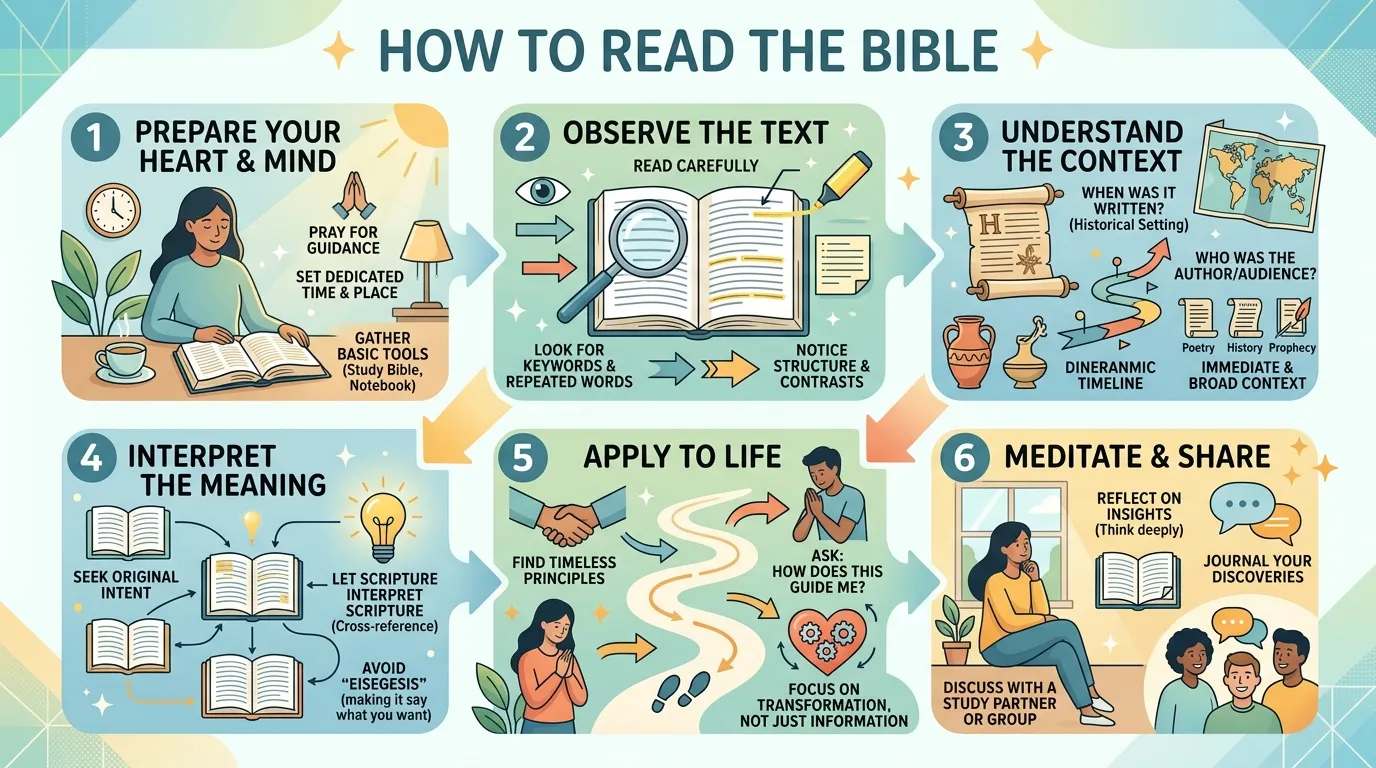
Reading the Bible can feel hard at first. It is a big book with many stories, names, laws, poems, letters, and teachings. You may open it and wonder, “Where should I start?” or “How do I know what this verse means?”
The good news is that you do not need to understand everything at once. Learning how to read the Bible is a process. You can start with a few verses, ask God for wisdom, learn the setting, and think about how the message applies to your life.
The Bible is not just a book to finish. It is Scripture that points us to God, teaches truth, corrects us, gives hope, and helps us grow in faith. Paul says that Scripture is “profitable for teaching, for reproof, for correction, and for training in righteousness” (2 Timothy 3:16).
If you are a child, teenager, new believer, or longtime Christian, this guide will help you build a simple and useful Bible-reading habit.
How to Read the Bible for the First Time
Start small. You do not need to read five chapters every day. Even 10–15 minutes can help you build a steady habit.
Choose a clear Bible translation that you can understand. Then pick a book of the Bible rather than opening to a random page each day.
The Gospel of John is a good starting point because it focuses on the life, words, death, and resurrection of Jesus.
As you read, ask three simple questions:
- What does this passage say?
- What does it mean?
- How should I live because of it?
These questions help you move from simply reading words to understanding God’s message.
Why Should You Read the Bible?
The Bible helps us know God and understand His will. It also teaches us how to live with wisdom, love, faith, and hope.
Psalm 119:105 says, “Your word is a lamp to my feet and a light to my path.”
The picture is simple. A lamp helps you see where you are going. In the same way, God’s Word gives guidance when life feels unclear.
Reading Scripture can help you:
- Grow closer to God
- Learn about Jesus
- Understand God’s character
- Grow in wisdom
- Find comfort during hard times
- Learn how to pray
- Fight temptation
- Build stronger faith
- Make wise choices
- Encourage other people
Bible reading is not about trying to earn God’s love. Christians read Scripture because God has already shown His love through Christ.
Start With Prayer
Before reading, take a moment to pray.
You do not need a long or fancy prayer. Ask God to help you understand His Word and live it out.
Psalm 119:18 says, “Open my eyes, that I may see wondrous things out of your law.”
This prayer comes from someone who wants to understand God’s Word with an open heart.
You might pray:
“God, please help me understand what I read today. Show me what is true, help me learn from Your Word, and give me strength to live it. Amen.”
Prayer does not replace careful study. Instead, prayer and study work together.
Choose the Right Book of the Bible
One of the biggest mistakes beginners make is starting anywhere without a plan.
The Bible contains 66 books in the Protestant Bible, and each book has its own purpose, setting, and style. Some books are easier for beginners than others.
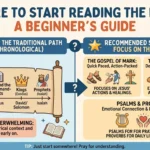
Good Books for Beginners
John : Learn about Jesus and His ministry.
Mark : A short and fast-moving account of Jesus’ life.
Luke : A detailed Gospel that tells the story of Jesus.
Acts : Learn how the early church began and spread.
James : Practical teaching about Christian living.
Philippians : A short letter about joy, faith, humility, and life in Christ.
Psalms : Helpful for prayer, worship, fear, sadness, and hope.
If you are completely new to the Bible, starting with one of the Gospels is often helpful because Jesus is central to the Christian faith.
Read the Bible in Context
A verse can be misunderstood when it is taken out of its setting.
For example, Philippians 4:13 says, “I can do all things through Christ who strengthens me.”
Many people use this verse as a general statement about achieving any goal. But reading Philippians 4:10–13 shows that Paul was talking about learning to live faithfully through both plenty and need.
Context helps you understand what the writer actually meant.
When reading a passage, look at:
- Who wrote it?
- Who received it?
- What was happening?
- What comes before the passage?
- What comes after it?
- What is the main message?
You do not need to know every historical detail before you begin. Just slow down and look at the surrounding verses.
Understand the Different Types of Writing
The Bible contains different forms of writing. Knowing the type can help you read it correctly.
Narrative
Narrative tells a story. Examples include Genesis, Ruth, Samuel, and the Gospels.
When reading a story, ask what happened and what the passage teaches about God and people.
Poetry
Psalms and parts of other books use poetry. Poetry often uses images and strong expressions.
For example, Psalm 23 speaks of God as a shepherd. It teaches about God’s care and guidance.
Wisdom Literature
Books such as Proverbs, Job, and Ecclesiastes explore wisdom, suffering, work, choices, and life.
Proverbs often gives short wisdom statements. Read them as wisdom principles, not as promises that every situation will always work in exactly the same way.
Letters
The New Testament contains letters written to churches and individuals.
Romans, Corinthians, Ephesians, James, and Philippians are examples.
Read letters as complete arguments. Do not build a teaching on one sentence without understanding the larger message.
Prophecy
Books such as Isaiah, Jeremiah, Ezekiel, and Revelation contain prophetic writing.
These books can include symbols, visions, warnings, promises, and messages about God’s judgment and salvation. They often require more study, so they may not be the easiest place for a beginner to start.
Read Slowly Instead of Quickly
You do not get extra spiritual points for reading fast.
Sometimes one verse can teach more than several chapters when you stop and think about it.
Try reading a short passage two or three times.
On the first reading, understand the basic message. On the second, notice important words. And on the third, ask what the passage teaches you about God and faithful living.
A simple habit is:
Read → Think → Pray → Apply
This keeps Bible reading from becoming a race.
Use the S.O.A.P. Bible Study Method
The SOAP method is a simple way to study Scripture.
S : Scripture: Write down a verse or passage that stands out.
O : Observation: What does the passage say? What do you notice?
A : Application: What should you do because of what you learned?
P : Prayer: Talk to God about what you read.
For example, you might read James 1:19, which teaches believers to be quick to hear, slow to speak, and slow to anger.
Your application could be simple:
“Today I will listen before I answer when someone upsets me.”
This turns Bible reading into practical Christian living.
Ask What the Passage Teaches About God
One of the best ways to read the Bible is to look for what it reveals about God.
Ask:
- What does this passage show about God’s character?
- What does it teach about God’s holiness?
- Where do I see God’s mercy?
- What does it show about God’s justice?
- What does it teach about His faithfulness?
- What does it reveal about Jesus?
The Bible is not mainly a self-help book. Its central story is about God and His work of salvation.
Luke 24:27 shows Jesus explaining how the Scriptures pointed to Him. This reminds Christians that the Bible has a larger story that reaches its fulfillment in Christ.
Ask What the Passage Teaches About People
The Bible also tells the truth about human nature.
It shows faith and failure, courage and fear, obedience and sin.
When reading a Bible story, ask:
What did this person do?
Why did they do it?
Was their action faithful to God?
What can I learn from this?
Be careful, though. Not every action described in the Bible is an action the Bible approves.
The Bible records the sins and failures of many people. A story can describe something without telling us to copy it.
Do Not Force Every Verse to Be About You
This is an important Bible-reading principle.
Some passages speak directly to believers. Others describe events, laws, promises, judgments, or situations in a specific historical setting.
For example, when reading an Old Testament passage, ask what it meant to the original audience before asking how it applies to you today.
Application should grow from meaning.
A helpful pattern is:
Original meaning → Biblical principle → Personal application
This protects you from making a verse say something it never meant to say.
Compare Scripture With Scripture
The Bible contains many connected teachings.
If you find a difficult passage, look for other passages that discuss the same subject.
For example, if you are studying forgiveness, you can read passages such as Matthew 6:14–15, Ephesians 4:32, and Colossians 3:13.
Seeing several passages together can give you a fuller picture.
At the same time, avoid using one verse to cancel another. Good Bible study seeks to understand the whole message of Scripture.
What Should You Do When You Do Not Understand a Verse?
Do not panic.
Every Christian finds difficult passages. Even experienced Bible teachers continue learning.
First, read the passage again. Then read the surrounding verses.
You can also check a trusted study Bible, Bible dictionary, or reliable commentary. Compare several sources when a topic is difficult.
If you still do not understand it, mark it and keep reading.
You do not have to solve every question in one sitting.
Make a Simple Bible Reading Plan
A Bible reading plan helps turn good intentions into a habit.
Try this beginner plan:
- Week 1: Read John 1–3.
- Week 2: Read John 4–7.
- Week 3: Read John 8–11.
- Week 4: Read John 12–16.
- Week 5: Read John 17–21.
Do not worry if you miss a day. Simply begin again.
The goal is not perfection. The goal is to spend regular time in God’s Word.
How Kids Can Read the Bible
Children can read Scripture too. The approach should be simple and clear.
Parents can begin with Bible stories about creation, Noah, Abraham, Moses, David, and Jesus.
After reading, ask easy questions:
- What happened?
- Who was in the story?
- What did the person do?
- What does this teach us about God?
- What can we learn today?
Parents can also read with their children at bedtime or during family devotion.
The goal is not to make Bible reading feel like school. Help children see Scripture as God’s Word and a source of truth, hope, and love.
How Teenagers Can Read the Bible
Teen years bring many questions about identity, friendship, relationships, school, pressure, fear, and the future.
The Bible speaks to these areas through its teaching about wisdom, purity, love, courage, humility, work, and faith.
Teenagers can start with John, James, Proverbs, Psalms, or Philippians.
Keep a notebook and write down questions. Do not be afraid of hard questions. A desire to understand Scripture can lead to deeper faith.
Psalm 119:9 asks how a young person can keep their way pure. The answer points to living according to God’s Word.
How Adults Can Apply Bible Reading to Daily Life
Bible reading should shape everyday life.
At work, Scripture can teach honesty and faithful service.
In marriage, it can shape love, patience, forgiveness, and humility.
In parenting, it can encourage patience, instruction, discipline, and grace. And in church, it can help believers serve others and live in unity.
Also in difficult seasons, Scripture can remind us of God’s promises and faithfulness. James 1:22 warns believers not to be hearers only, but doers of the word.
The point is clear: knowing Scripture should affect how we live.
How to Read the Bible Every Day
A daily Bible habit does not need to be complicated.
Pick a regular time. Keep your Bible nearby. Remove distractions and read a short passage.
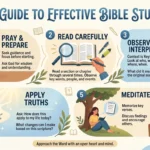
You can use this simple routine:
- Pray for understanding.
- Read a short passage.
- Read it again.
- Look at the context.
- Write down one lesson.
- Choose one way to apply it.
- Pray about what you learned.
Some days you may feel deeply moved. Other days may feel ordinary.
Do not judge your whole faith by your feelings. Keep coming back to God’s Word.
Common Mistakes to Avoid When Reading the Bible
Bible reading becomes more useful when you avoid a few common mistakes.
Reading too much at once: More chapters do not always mean more understanding.
Ignoring context: A verse can mean something very different when separated from the passage.
Only reading favorite verses: Read whole books to understand the larger story.
Treating every passage the same: Poetry, history, prophecy, wisdom, and letters should be read with care.
Expecting instant answers: Some truths take time to understand.
Using Scripture only for motivation: The Bible teaches far more than positive thinking. It reveals God’s holiness, human sin, redemption, judgment, grace, and hope.
What Is the Best Way to Read the Bible?
The best way to read the Bible is with prayer, context, patience, understanding, and a desire to obey what God teaches.
Start with a manageable book. Read small sections. Understand the passage before applying it. Study difficult parts with trusted resources. Most of all, look at the Bible as one unfolding story centered on God’s work and His plan of redemption.
You do not need to become a Bible expert before you begin.
Open the Bible. Read. Ask questions. Pray. Learn. Keep going.
Over time, those small steps can help God’s Word become part of your daily life.
FAQs:
What is the best way to start reading the Bible?
Start with a Gospel such as John. Read a small section each day, pray for understanding, and think about what the passage teaches about God, Jesus, and faithful living.
Should I read the Bible from Genesis to Revelation?
You can, but beginners may find it easier to start with the New Testament. Reading a Gospel first can help you understand Jesus and the central message of Christianity before moving through the whole Bible.
How long should I read the Bible each day?
There is no required number of minutes. Start with 10–15 minutes and focus on understanding rather than speed. A short, consistent reading habit is better than a large plan you cannot maintain.
What should I do when I do not understand the Bible?
Read the passage again and check its context. Look at the verses before and after it. You can also use a trusted study Bible or commentary. Keep difficult questions noted and continue learning.
How can I understand what the Bible means?
Begin with the original context. Ask who wrote the passage, who received it, what was happening, and what the larger section teaches. Then consider how its biblical truth applies to your life today.
Conclusion:
Learning how to read the Bible does not require perfect knowledge or years of study. Begin with a prayer and a small passage. Read slowly, look at the context, ask good questions, and think about what the passage teaches about God.
Let Scripture shape more than your thoughts. Let it shape your choices, relationships, prayers, family life, and faith.
Remember that understanding takes time. You may not understand every passage on your first reading, and that is okay.
The important thing is to keep coming back to God’s Word.
As you read, pray for wisdom. As you learn, seek truth. And as you understand, put God’s Word into practice.
Start small. Read faithfully. Pray often. Live what you learn.

I am Joseph Parker, a devoted Bible content writer dedicated to sharing God’s Word with clarity and purpose.
Through Biblicaltribez.com, I create inspirational and scripture-centered articles that strengthen faith.
My goal is to guide readers into a deeper understanding of biblical teachings and Christian living.