Skip to content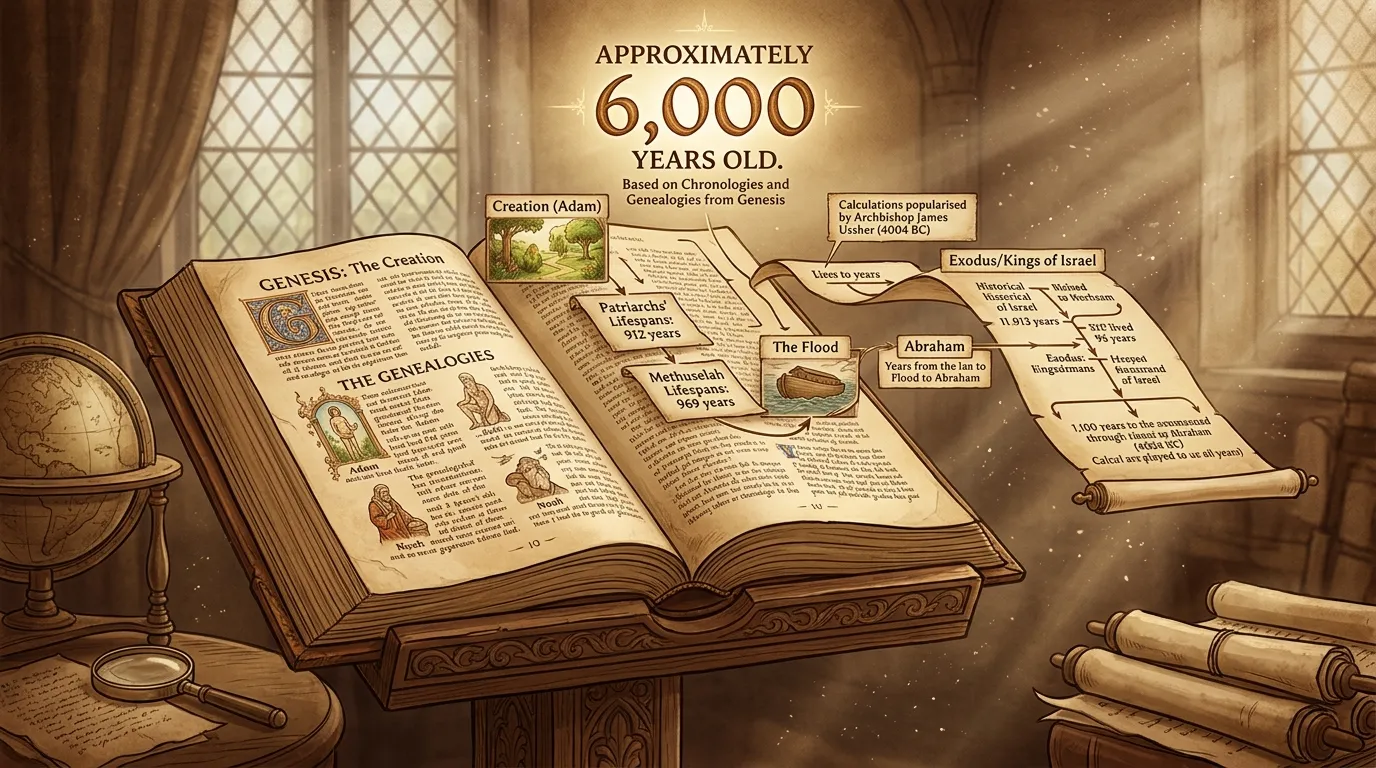
How old is the Earth according to the Bible? If you read Genesis and trace the family lines through Scripture, you can build a biblical timeline from creation to later events. Some Christians use this timeline to estimate that Earth is around 6,000 to 10,000 years old. Others believe the Bible does not give a precise age and accept an older Earth.
The key point is this: the Bible never gives a direct number for Earth’s age. The younger estimates come from adding biblical genealogies, dates, and historical events. The result depends on how those passages are read.
In this guide, you will learn what Genesis says about creation, how biblical genealogies are used to estimate Earth’s age, why Christians disagree, and what the Bible does:and does not:tell us. You will also see why the question is more complex than simply adding up every name in the Bible.
Quick Answer
The Bible does not state, “The Earth is X years old.” Some Christians calculate an age of roughly 6,000 years by adding biblical genealogies and dates from creation onward. Other Christians believe the genealogies were not meant to provide a complete year-by-year timeline and accept an older Earth.
So, the safest biblical answer is: Scripture gives a history of creation and humanity, but it does not give a precise numerical age for the Earth.
Definition & Meaning
The question “how old is the Earth according to the Bible” usually refers to the age of Earth based on the biblical account of creation and the timeline found in Scripture.
Genesis begins with the creation of the heavens and the Earth:
“In the beginning God created the heavens and the earth.” : Genesis 1:1
The Bible then describes creation, Adam and Eve, their descendants, the Flood, Abraham, Israel, and later generations.
Some Bible readers connect these events into one continuous timeline. They add the ages given for people in genealogies, such as those in Genesis 5 and Genesis 11. This approach produces a young-Earth estimate.
But the Bible does not say that every generation between two people must be listed in every genealogy. That makes the calculation less certain than it may first appear.
What Does the Bible Say About the Age of the Earth?
The Bible clearly teaches that God created the world.
Genesis 1 gives the creation account. It describes light, the sky, land, plants, heavenly bodies, animals, and humanity. Genesis 2 gives more detail about Adam, the garden, and human life.
Yet Genesis does not provide a sentence that tells us the exact number of years since creation.
This matters because a biblical creation account and a precise age are not the same thing.
The Bible focuses on who created the world and why creation matters, rather than giving readers a scientific age for the planet.
Psalm 24:1 says:
“The earth is the Lord’s, and all its fullness.”
The main biblical message is God’s ownership and authority over creation.
How Do People Calculate a Young Earth Age?
The most common young-Earth method uses biblical genealogies.
Genesis 5 gives a line from Adam to Noah. It often gives the age of a father when a particular son was born. Genesis 11 continues a genealogy after the Flood and gives more ages.
For example, Genesis 5 records ages such as:
- Adam was 130 when Seth was born.
- Seth was 105 when Enosh was born.
- Enosh was 90 when Kenan was born.
- Kenan was 70 when Mahalalel was born.
- Mahalalel was 65 when Jared was born.
The chapter continues this pattern.
A reader can add these numbers and continue the timeline through later biblical events.
This is one reason some Christians arrive at an Earth age near 6,000 years.
However, this method depends on an important assumption: that the genealogies list every generation in a complete chronological sequence.
That assumption is debated.
Do Biblical Genealogies Include Every Generation?
Not always.
The Bible sometimes uses genealogies for purposes other than giving a complete family record. A genealogy may highlight important ancestors while leaving out some generations.
One clear example appears in Matthew 1.
Matthew presents the genealogy of Jesus and organizes it into groups. The genealogy is not simply a complete list of every person who lived between Abraham and Jesus.
This shows that biblical genealogies can have a theological and literary purpose.
That does not make them unreliable. It means we should be careful about using every genealogy as a precise chronological clock.
What Is the Young Earth View?
The young Earth view generally holds that God created the Earth thousands of years ago rather than billions of years ago.
Many young-Earth Christians connect Genesis with the genealogies and other biblical dates. They often estimate an age in the range of 6,000 to 10,000 years, depending on their interpretation.
A well-known historical example is James Ussher, who calculated a creation date in 4004 BC. His calculation came from a detailed study of biblical chronology.
Modern young-Earth Christians may use different calculations, so there is not one universal number.
The important point is that the young-Earth view treats the biblical timeline as a meaningful chronological framework.
What Is the Old Earth Christian View?
Other Christians believe Earth is much older.
They may accept scientific estimates that place Earth at about 4.54 billion years old while still believing that God created it.
Some Christians interpret the “days” of Genesis 1 as ordinary days. Others understand the days in a different way, such as long periods or a literary structure.
Views also differ on how Genesis relates to scientific models.
This means that belief in God as Creator does not automatically lead every Christian to the same conclusion about Earth’s age.
Does Genesis Say the Creation Days Were 24 Hours?
Genesis repeatedly uses the Hebrew word yom, commonly translated as “day.”
Genesis 1 also uses phrases such as “evening and morning.”
For this reason, many Christians understand the creation days as ordinary days.
Others point out that the Bible can use “day” in different ways depending on context. They argue that Genesis may use the word in a broader sense.
The debate is not simply about the dictionary meaning of one word. It also involves literary context, biblical interpretation, and theology.
So, Christians can read the same chapter and reach different conclusions.
What Does Adam Have to Do With Earth’s Age?
Adam is important because biblical chronology often starts with him.
Genesis 5 gives ages for Adam and his descendants. If each generation is treated as part of a continuous timeline, readers can estimate how much time passed from Adam to Noah.
Then Genesis 11 gives another genealogy after the Flood.
This creates a possible framework:
Creation → Adam → Noah → Flood → Abraham → Israel → David → Jesus
The Bible gives many important dates and ages within this broad story.
But gaps in genealogies and differences in interpretation can affect the final calculation.
Does the Bible Give a Date for Creation?
No.
The Bible does not give a modern calendar date such as:
Creation happened in 4004 BC.
Dates such as 4004 BC come from later chronological calculations.
Ussher’s famous date was the result of combining biblical information with historical chronology. It is not a date directly stated in Genesis.
This distinction is important when discussing what the Bible actually says.
Why Do Christians Reach Different Answers?
There are several reasons.
First, Christians differ in how they understand Genesis 1.
Second, they differ in how they interpret biblical genealogies.
Third, they differ in how they connect biblical history with evidence from the natural world.
Fourth, they may use different chronological assumptions when calculating dates.
The result is that two sincere Christians can agree that God created the Earth while disagreeing about its exact age.
That disagreement does not mean they have different views about every part of Christian faith.
Bible Verses About Creation
Several passages help explain the Bible’s teaching about creation.
Genesis 1:1
God created the heavens and the Earth.
Genesis 1:27
Human beings were created in God’s image.
Psalm 33:6
The heavens are described as being made by God’s word.
John 1:3
John teaches that all things came into being through the Word.
Colossians 1:16
Paul says that all things were created through Christ and for Christ.
These passages focus strongly on God’s role as Creator.
They tell us much about who created, but they do not give a simple numerical age for Earth.
Bible Timeline Used by Young-Earth Readers
A young-Earth calculation may follow a timeline like this:
| Biblical event | How it is used |
| Creation | Starting point |
| Adam | Beginning of human genealogy |
| Noah | Genesis 5 provides ages |
| Flood | Major chronological marker |
| Abraham | Later biblical history |
| Exodus | Additional historical marker |
| David | Kings and historical records |
| Jesus | New Testament historical period |
This timeline can help readers understand how biblical chronology works.
However, it should not be treated as proof that the Bible explicitly says Earth is 6,000 years old. The final number depends on interpretive choices.
Young Earth vs. Old Earth: What Is the Difference?
| View | Main idea | Common approach | Key caution |
| Young Earth | Earth is thousands of years old | Uses biblical chronology | Depends on how genealogies are read |
| Old Earth | Earth is very ancient | Accepts an older timescale | Requires a particular reading of Genesis |
| Theistic evolution | God created through an evolutionary process | Combines Christian belief with evolutionary science | Views differ on Genesis and Adam |
| Literary creation view | Genesis teaches theological truth through structured language | Focuses on literary design | Does not provide a simple Earth-age calculation |
No single row should be treated as the only Christian position.
Common Mistakes When Reading Biblical Earth Age
A common mistake is saying, “The Bible says Earth is 6,000 years old.”
That wording is too strong.
A better statement is:
“Some Christians calculate an Earth age of roughly 6,000 years from biblical genealogies and chronology.”
Another mistake is assuming every genealogy must contain every generation.
A third mistake is treating a later calculation as if it were a direct biblical statement.
The safest approach is to separate what Scripture says from what interpreters calculate from Scripture.
What About the Scientific Age of Earth?
Modern science estimates Earth’s age at about 4.54 billion years.
That number comes from several lines of evidence, including radiometric dating and studies of rocks, meteorites, and Earth’s geological history.
Christians respond to this evidence in different ways.
Some reject the scientific timescale and defend a young-Earth interpretation.
Others accept the scientific age and believe it can fit within a Christian understanding of God as Creator.
Still others hold positions between these views.
The important thing is to avoid claiming that the Bible itself gives the scientific age of Earth. It does not.
A Simple Way to Study This Question
If you want to study the topic for yourself, start with Scripture.
Read these passages:
- Genesis 1–2
- Genesis 5
- Genesis 10–11
- Matthew 1
- Luke 3
- John 1:1–3
- Colossians 1:15–17
Then ask three questions:
What does the passage clearly say?
What am I assuming?
Is my conclusion directly stated, or am I calculating it?
This simple method can prevent many misunderstandings.
Quick Reference Checklist
| Question | Best short answer |
| Does the Bible give Earth’s exact age? | No |
| Does Genesis teach that God created Earth? | Yes |
| Do some Christians calculate a young age? | Yes |
| Is 6,000 years a direct Bible statement? | No |
| Are biblical genealogies important to young-Earth calculations? | Yes |
| Do all Christians agree on Earth’s age? | No |
| Can Christians disagree while affirming God as Creator? | Yes |
FAQs:
1. How old is the Earth according to the Bible?
The Bible does not give an exact numerical age. Some Christians calculate an age of around 6,000 years by adding biblical genealogies and chronology. Others believe the genealogies do not provide a complete timeline.
2. Does the Bible say the Earth is 6,000 years old?
No. Scripture never gives the statement “Earth is 6,000 years old.” The figure comes from chronological calculations based on biblical passages and assumptions about the genealogies.
3. When did God create the Earth according to the Bible?
Genesis 1 says that God created the heavens and the Earth “in the beginning.” However, it does not provide a calendar date for creation.
4. How do Christians calculate the age of the Earth from the Bible?
Young-Earth interpreters mainly use ages and genealogies in passages such as Genesis 5 and Genesis 11. They connect these numbers with later biblical chronology to estimate the time from creation to known historical events.
5. Does the Bible support an old Earth?
The Bible does not directly state an old or young numerical age for Earth. Some Christians believe an old Earth fits their interpretation of Genesis and other biblical passages.
6. What year does the Bible say creation happened?
The Bible does not give a specific year. Dates such as 4004 BC come from later chronological calculations, not from a direct statement in Genesis.
7. Can you believe in the Bible and an old Earth?
Yes. Many Christians believe that God created the universe while also accepting an ancient Earth. Other Christians believe Earth is only thousands of years old. The disagreement centers on biblical interpretation and the relationship between Scripture and scientific evidence.
Conclusion:
So, how old is the Earth according to the Bible? The most accurate answer is that Scripture does not give a precise number.
Some Christians use the genealogies in Genesis and other biblical timelines to calculate an age of roughly 6,000 years or somewhat more. Others believe those genealogies were not designed to give a complete chronology and accept an ancient Earth.
The Bible’s clearest message is not a number. It is that God created the heavens and the Earth. If you want to study the question deeply, read Genesis 1–11 and examine the genealogies closely.
Keep a clear line between what the text says and what later readers calculate from it. That approach leads to a more honest and useful understanding of biblical creation.

I am Joseph Parker, a devoted Bible content writer dedicated to sharing God’s Word with clarity and purpose.
Through Biblicaltribez.com, I create inspirational and scripture-centered articles that strengthen faith.
My goal is to guide readers into a deeper understanding of biblical teachings and Christian living.