Skip to content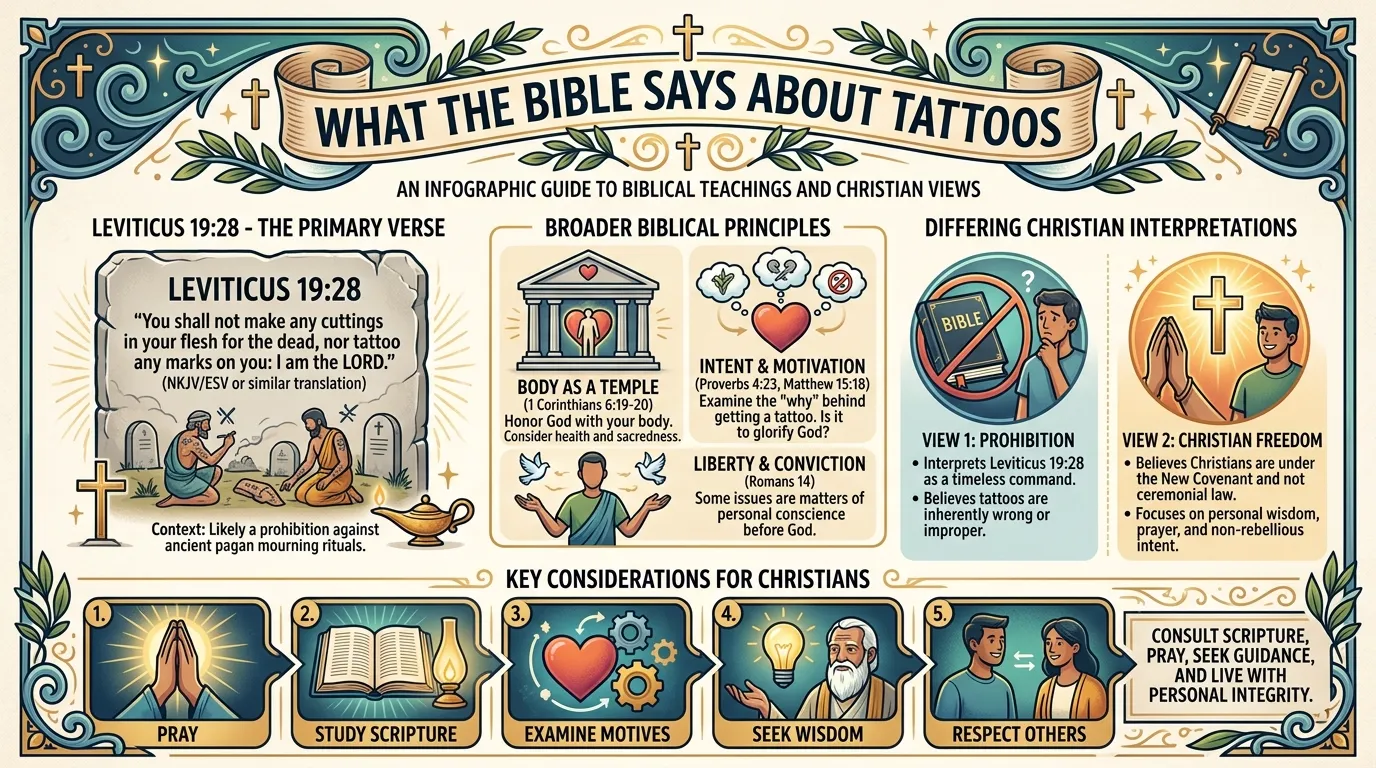
If you are asking what does the Bible say about tattoos, you are not alone. Many Christians wonder if getting a tattoo is a sin, whether an old tattoo should be removed, or if a Christian can get a tattoo with a good message.
The main Bible verse people point to is Leviticus 19:28. It says, “Do not cut your bodies for the dead or put tattoo marks on yourselves. I am the Lord.”
At first glance, the answer may seem simple: “The Bible says no tattoos.” But the issue needs more care.
We must look at the verse, its setting, the purpose of the command, and how Christians apply Old Testament laws today.
This article will explain tattoos in the Bible, the Leviticus 19:28 tattoo meaning, the Old Testament context, and the main Christian views. It will also help you think through the choice if you already have a tattoo or are considering getting one.
Quick Answer
The Bible mentions tattoo marks directly in Leviticus 19:28 and tells Israel not to mark their bodies in connection with the dead.
Christians disagree on how this command applies today. Some believe Christians should avoid tattoos because the verse directly forbids them. Others believe the command focused on ancient mourning and pagan practices, not every modern tattoo.
So, the Bible gives a clear warning about certain body-marking practices, but Christians differ on whether that creates a universal ban on every modern tattoo.
Definition & Meaning
A tattoo is a permanent mark made by placing pigment under the skin. The Bible does not give a broad discussion of modern tattoo culture.
The main passage is Leviticus 19:28. Some Bible translations use the words “tattoo marks,” while others use phrases such as “marks” or “tattoo.”
This matters because we should not take one modern definition and place it into an ancient setting without asking what the original command addressed.
The verse mentions two related actions: cutting the body for the dead and making marks on the body. This connects the command with practices surrounding death and mourning.
What Does Leviticus 19:28 Say About Tattoos?
Leviticus 19:28 is the key passage behind most discussions about Christian views on tattoos.
The NIV says, “Do not cut your bodies for the dead or put tattoo marks on yourselves. I am the Lord.”
The NKJV uses similar language and says, “nor tattoo any marks on you.”
The verse appears in a larger chapter filled with commands about holy living. God was teaching Israel how to live as His people.
The command does not stand alone. It sits among instructions about worship, sexual conduct, justice, food, honesty, and separation from practices connected with surrounding peoples.
That larger setting helps us see why the verse deserves more than a quick “yes” or “no.”
Why Did God Forbid These Marks?
The text connects the body cuts with the dead. This points to ancient mourning customs.
A scholarly study of Leviticus 19:26–28 notes that the passage sits within commands against religious customs and practices associated with surrounding cultures and magical beliefs.
The Bible also mentions people cutting themselves in connection with mourning in other passages. For example, Deuteronomy 14:1 tells Israel not to cut themselves or shave their foreheads for the dead.
So the main concern was not simply fashion or personal appearance.
The command addressed behavior that could express mourning in ways God had forbidden. It also helped Israel remain distinct from the religious practices around them.
This is an important part of understanding the Leviticus 19:28 tattoo meaning.
Does Leviticus 19:28 Ban Every Modern Tattoo?
This is where Christian interpretation becomes more complex.
One reading says the command is straightforward. God told His people not to put tattoo marks on themselves. From this view, Christians should avoid tattoos because Scripture gives a direct warning.
Another reading focuses more strongly on the context. It argues that the command addressed ancient practices tied to mourning for the dead and pagan religious customs. From this view, a modern tattoo with no connection to those practices may not be the same thing.
Bible scholarship also notes that the exact nature of ancient tattooing and body marking is not completely certain. Bible Gateway’s Bible encyclopedia says Leviticus 19:28 is the only biblical passage commonly translated with the word “tattoo,” while other possible tattoo references remain uncertain.
Because of this, Christians should be careful about claiming that every tattoo is automatically the same practice described in ancient Israel.
Old Testament Law and Christians Today
A major question is this: Do Old Testament commands apply to Christians in the same way today?
Christians believe the Old Testament is God’s Word, but the New Testament teaches that believers relate to the Law through Christ.
For example, Jesus said He did not come to abolish the Law and the Prophets but to fulfill them (Matthew 5:17).
The New Testament also teaches believers to focus on holiness, love, obedience, and life in Christ.
That does not mean Old Testament commands have no value. They still teach us about God’s character, sin, holiness, worship, and the history of God’s people.
But Christians must understand each command in light of the whole Bible.
That is why two sincere Christians can read Leviticus 19:28 and reach different conclusions about a modern tattoo.
What Does the New Testament Say About Tattoos?
The New Testament does not give a direct command that says, “Christians must not get tattoos.”
Instead, it gives broader principles about how believers should use their bodies and make personal choices.
First Corinthians 6:19–20 says that the believer’s body is a temple of the Holy Spirit and that Christians should glorify God in their bodies.
This principle can lead a Christian to ask important questions.
Does the tattoo honor God?
Why do I want it?
What message does it communicate?
Am I doing this from faith or from pressure? Would I still make the same choice after prayer and careful thought?
These questions can be more useful than simply asking whether a tattoo looks good.
Is Getting a Tattoo a Sin?
There is no single Christian answer accepted by every church.
Some Christians believe getting a tattoo is sinful because they understand Leviticus 19:28 as a continuing prohibition.
Others believe the specific command dealt with ancient mourning and religious practices. They do not see every modern tattoo as sinful.
Romans 14 gives an important principle for areas where sincere believers disagree. Paul teaches believers to act according to faith and not treat personal convictions lightly.
This means a Christian should not mock another believer for refusing tattoos.
At the same time, someone who believes a tattoo is permitted should not pressure another Christian to get one.
A wise Christian should seek to honor God rather than win an argument.
Can a Christian Get a Bible Verse Tattoo?
A Bible verse tattoo raises an interesting question.
Some Christians see a Scripture tattoo as a way to remember God’s Word. Others still avoid tattoos because of their understanding of Leviticus 19:28.
The Bible does not specifically approve Bible verse tattoos.
So the better question is not simply, “Is the verse good?”
Ask why you want it.
A Christian may want a verse tattoo to remember God’s faithfulness. Another person may want one because friends have them. Someone else may want it to build an image or gain attention.
The same outward action can come from very different motives.
First Samuel 16:7 reminds us that God looks at the heart. That does not make actions unimportant, but it reminds us that motives matter.
What About Christian Tattoos With Good Symbols?
Some people choose crosses, fish symbols, Bible verses, doves, crowns, or other Christian images.
A Christian symbol does not automatically make every tattoo decision wise.
The design may be good, but the heart and purpose still matter.
For example, ask whether the tattoo will help you remember Christ or simply help you appear religious.
Also think about how permanent the decision is.
A design that feels meaningful at age 18 may feel very different ten or twenty years later.
Good intentions are important, but wisdom matters too.
Should Christians Avoid Tattoos With Pagan or Occult Symbols?
This is a much clearer area of concern.
Christians are called to reject idolatry and occult practices.
If a tattoo represents a false god, occult practice, magic, or a belief that conflicts with biblical faith, a Christian should take that seriously.
First Corinthians 10:14 says, “Therefore, my dear friends, flee from idolatry.”
The issue is not simply ink in the skin. The spiritual meaning behind the symbol matters.
A Christian should never choose a symbol that celebrates something Scripture tells believers to reject.
What If You Already Have a Tattoo?
Do not panic.
If you became a Christian after getting a tattoo, your tattoo does not make you beyond God’s grace.
Your relationship with God does not depend on having perfect skin.
The gospel centers on repentance, faith, and God’s grace through Jesus Christ.
If an old tattoo represents something sinful or deeply conflicts with your faith, you can bring that matter to God in prayer.
You may decide to cover it, remove it, or simply live differently from that point forward.
Tattoo removal can be difficult and costly, so do not make a rushed decision out of fear.
Instead, seek wise Christian counsel and consider your situation carefully.
Tattoos and the Principle of Honoring God
One of the strongest biblical principles is simple: honor God with your life.
Colossians 3:17 says that whatever believers do in word or deed should be done in the name of the Lord Jesus.
That principle reaches beyond tattoos.
It applies to clothes, speech, entertainment, money, relationships, work, and countless other choices.
Before getting a tattoo, ask whether your choice fits the life you want to live as a follower of Christ.
If your conscience strongly warns you against it, do not ignore that warning simply because someone else says it is acceptable.
Romans 14:23 teaches that acting against conscience can become sin.
A clear conscience before God is worth more than following a trend.
Tattoo Decisions: Mistakes vs. Wise Choices
| Common mistake | A wiser approach |
| Getting a tattoo because friends pressure you | Take time and make your own decision |
| Ignoring Leviticus 19:28 | Read the verse and study its context |
| Assuming every tattoo is automatically sinful | Consider the historical and biblical setting |
| Choosing an occult or idolatrous symbol | Reject symbols that conflict with biblical faith |
| Acting on a sudden emotion | Wait and pray before making a permanent choice |
| Thinking a Christian tattoo is always approved | Examine both the design and your motive |
| Shaming Christians who disagree | Respect sincere differences in conviction |
| Making a permanent choice without thought | Consider your future, work, family, and faith |
Questions to Ask Before Getting a Tattoo
If you are still unsure, slow down.
You do not need to make the decision today.
Start with prayer. Ask God for wisdom and an honest heart.
Then study the relevant passages. Leviticus 19:28 should be part of that study, but it should not be the only verse you read.
Think about your motive.
Are you trying to express faith, remember someone, follow a trend, fit in, show rebellion, or attract attention?
Then consider the design.
Would you feel comfortable explaining its meaning to a mature Christian you respect?
Also think about permanence. A tattoo can last for decades. Your beliefs, job, relationships, and tastes may change.
Wisdom means thinking beyond today.
Quick Reference: A Biblical Tattoo Checklist
| Question | What to consider |
| What does Leviticus 19:28 say? | It forbids body cuts and marks in a context connected with the dead. |
| Why does context matter? | The command appears among laws about holiness and separation from surrounding practices. |
| Does the New Testament directly ban tattoos? | No direct New Testament command addresses modern tattoos. |
| What is your motive? | Check whether your reason honors God or comes from pressure, pride, or impulse. |
| What does the design mean? | Avoid symbols tied to idolatry or practices opposed to biblical faith. |
| What does your conscience say? | Do not knowingly act against a conscience shaped by faith. |
| Have you prayed about it? | Give yourself time to seek wisdom before making a permanent choice. |
| Have you sought wise counsel? | Talk with a mature Christian if you remain unsure. |
| Is it permanent? | Remember that removing a tattoo can be difficult, so think long term. |
What Is the Safest Christian Approach?
If you want the most cautious approach, you can choose not to get a tattoo.
This avoids the concern raised by the direct wording of Leviticus 19:28.
But Christians who believe modern tattoos are not forbidden should still take biblical principles seriously.
They should avoid idolatrous meanings, act from faith, examine their motives, and consider how their choice reflects their commitment to Christ.
The safest approach is not to find the weakest argument that supports what you already want.
Instead, seek truth.
Read Scripture.
Pray.
Check your motives.
Listen to wise counsel. Then make your choice with a clear conscience before God.
What Does the Bible Say About Tattoo Removal?
The Bible does not give instructions about removing tattoos.
If you regret a tattoo, you do not need to believe that removal will automatically make you right with God.
Physical removal is a personal decision.
Some people may remove a tattoo because its message conflicts with their faith. Others may keep an old tattoo but no longer identify with its original meaning.
Remember that Christian faith is not about creating a perfect outward appearance.
Second Corinthians 5:17 points believers toward becoming a new creation in Christ.
The focus should be on a changed life and a faithful heart.
Does a Tattoo Change Your Relationship With God?
A tattoo does not have the power to make God’s grace disappear.
Christians should not treat tattoos as though they are stronger than the work of Christ.
At the same time, grace does not mean that choices never matter.
God cares about how believers live.
If a person knowingly chooses something that violates God’s commands or their conscience, that matters.
So the question should not be, “Can God forgive me if I get this tattoo?”
The better question is, “How can I make this decision in a way that honors God?”
That question moves the focus from fear to faithful living.
A Balanced Christian View on Tattoos
A balanced view avoids two extremes.
The first extreme says, “Every tattoo is clearly a sin, and anyone who has one is disobedient.”
That statement may go beyond what the full biblical evidence allows, especially when we consider the ancient context of Leviticus 19:28 and the lack of a direct New Testament tattoo command.
The second extreme says, “God does not care about tattoos at all.”
That also goes too far.
God cares about holiness, motives, worship, the use of our bodies, and our love for Him.
The wise path is to take Scripture seriously without adding rules that Scripture does not clearly give.
FAQs:
1. Is having a tattoo a sin according to the Bible?
Christians disagree on this question. Leviticus 19:28 clearly mentions tattoo marks and forbids them in its ancient Israelite context. Some Christians apply that command to all tattoos today, while others understand it as a prohibition of ancient mourning and religious practices.
2. What is the main Bible verse about tattoos?
Leviticus 19:28 is the main passage. It tells Israel not to cut their bodies for the dead or put tattoo marks on themselves.
3. Does the New Testament say Christians cannot get tattoos?
The New Testament does not contain a direct command that says Christians cannot get tattoos. Instead, it gives broader teachings about holiness, the body, conscience, worship, and honoring God.
4. Can Christians get tattoos of Bible verses?
The Bible does not specifically approve or forbid Bible verse tattoos. Christians should consider the teaching of Leviticus 19:28, their motives, their conscience, and whether the decision honors God.
5. What if I became a Christian after getting a tattoo?
Having a tattoo does not prevent someone from following Christ. You can bring your past to God and live faithfully from this point forward. You do not need to panic or assume that your tattoo puts you outside God’s grace.
6. Should Christians avoid tattoos with spiritual symbols?
Christians should avoid symbols that promote idolatry, occult practices, or beliefs that oppose biblical faith. A religious-looking design should not be treated as automatically pleasing to God.
7. What should I do if I am unsure about getting a tattoo?
Do not rush. Pray, study Scripture, examine your motives, consider the design and its meaning, and seek wise counsel. If your conscience does not give you peace, waiting is a wise choice.
Conclusion:
So, what does the Bible say about tattoos? The clearest biblical reference is Leviticus 19:28, where God forbids Israel from making body marks in a passage connected with the dead and ancient mourning practices.
Christians differ on how that command applies to modern tattoos. Some avoid tattoos because they see the command as still binding. Others believe the ancient context makes a difference and do not consider every modern tattoo sinful.
Whatever view you hold, do not make the decision from pressure or impulse. Study Scripture, pray, examine your motives, and protect your conscience.
Your goal should not be to justify what you already want. Your goal should be to live in a way that honors God.
If you already have a tattoo, remember that your hope is not found in perfect skin. It is found in Christ and in faithfully following Him.

I am Caleb Anderson, a Christian writer passionate about exploring deep biblical meanings and spiritual truths.
On Biblicaltribez.com, I share faith based insights to help readers grow closer to God through Scripture.
My writing focuses on making the Bible easy to understand, meaningful, and relevant to everyday life.