Skip to content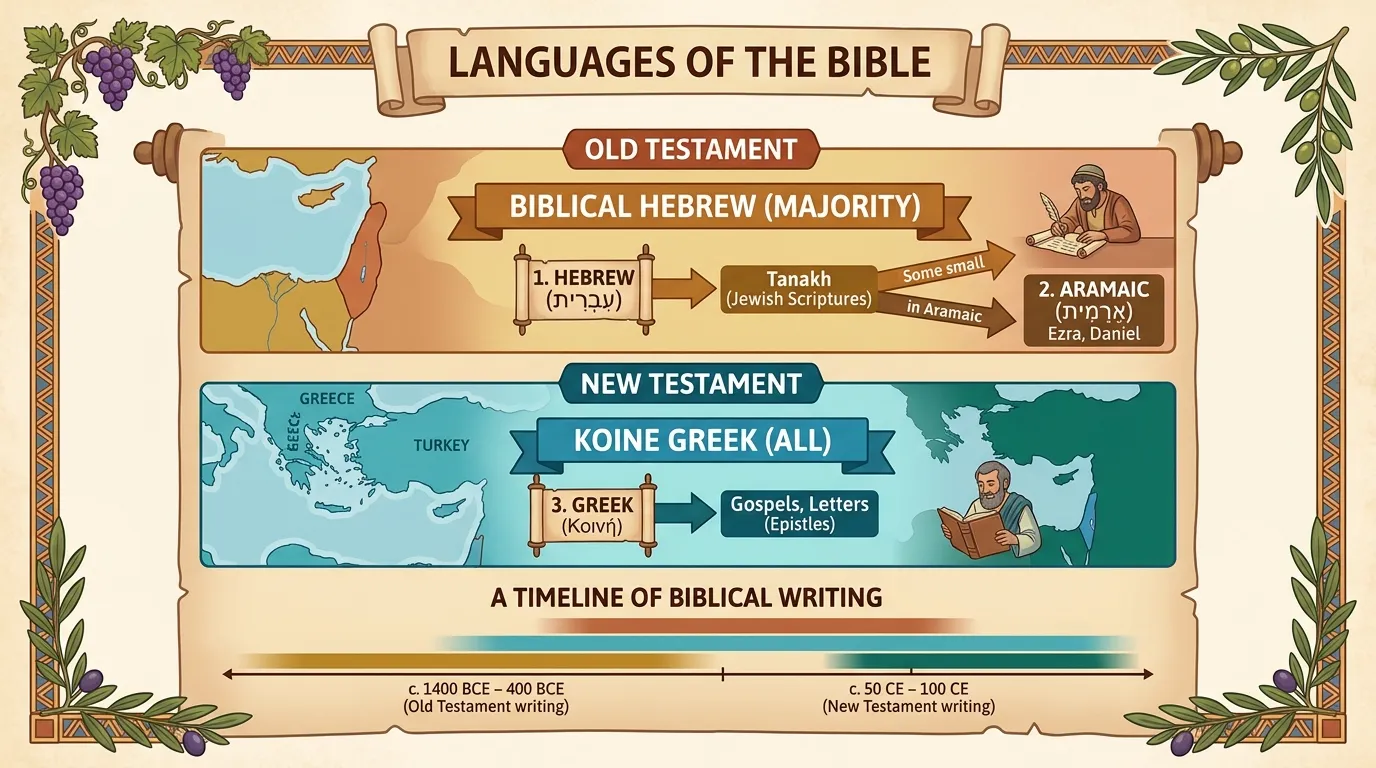
Have you ever opened a Bible and wondered how people first wrote its words? Today, the Bible is available in thousands of languages. We can read it in English, Spanish, Urdu, Arabic, French, and many other languages. But the first writers of the Bible did not use modern languages.
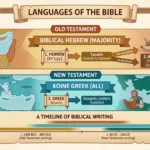
The Bible was written in three main ancient languages: Hebrew, Aramaic, and Greek. Most of the Old Testament was written in Hebrew. A small part of the Old Testament was written in Aramaic. The New Testament was written in Greek.
Knowing this can make Bible reading more meaningful. It helps us see how God’s Word moved through different people, cultures, and generations before reaching us today.
The Bible itself says that God’s Word is living and powerful. Hebrews 4:12 says, “For the word of God is living and active.” The message of Scripture does not lose its power because its original languages are ancient.
So, what language was the Bible written in, and why does it matter to Christians today? Let us explore the answer and see what these ancient languages teach us about faith, God’s message, and His plan.
What Language Was the Bible Written In?
The Bible was originally written mainly in Hebrew and Greek, with some sections written in Aramaic.
Each language played an important role in the history of God’s people.
Hebrew: The Main Language of the Old Testament
Hebrew is the main language of the Old Testament, also called the Hebrew Scriptures.
Much of the history, law, poetry, wisdom, and prophecy of Israel was written in Hebrew. Books such as Genesis, Exodus, Psalms, Proverbs, Isaiah, and many others were mainly written in this language.
Hebrew was closely connected with the people of Israel. It was the language used in many important parts of their national and spiritual life.
For example, Genesis begins with the famous words, “In the beginning God created the heaven and the earth” (Genesis 1:1).
The Hebrew text gives us the earliest written form of this powerful creation account.
Hebrew also has many rich words that can carry deep meaning. Ideas such as covenant, blessing, peace, wisdom, and faithfulness appear throughout the Hebrew Scriptures.
This reminds Christians that the Old Testament was written within a real historical and cultural setting.
Aramaic: A Smaller Part of the Bible
Aramaic was another important language in the biblical world.
Some parts of the Old Testament were written in Aramaic. Examples include sections of Daniel and Ezra.
Aramaic was widely used in the ancient Near East. It became an important language for communication among different peoples and kingdoms.
The presence of Aramaic in Scripture shows that the Bible developed across different historical periods and cultures.
Aramaic is also important when studying the world of Jesus. Jesus lived in a region where Aramaic was commonly spoken.
Some familiar words in the New Testament come from Aramaic. For example, Jesus said “Talitha cumi” in Mark 5:41 when He raised Jairus’s daughter.
These words remind us that the Bible records real events involving real people who lived in a real historical world.
Greek: The Language of the New Testament
The New Testament was written in Greek, specifically a common form of Greek often called Koine Greek.
Greek was widely used throughout the Roman world. It allowed the message about Jesus Christ to spread across many different regions.
The four Gospels Matthew, Mark, Luke, and John—were written in Greek. The same is true of Acts, the letters of Paul, the other New Testament letters, and Revelation.
John 1:1 gives one of the clearest examples:
“In the beginning was the Word, and the Word was with God, and the Word was God.”
The Greek word translated as “Word” is Logos. It carries a rich meaning connected with God’s Word, expression, and revelation.
Greek also helped early Christians communicate the gospel to people from many different backgrounds.
Why Were Different Languages Used in the Bible?
The use of Hebrew, Aramaic, and Greek reflects the history of God’s people.
The Bible was not written at one time by one person. It was written over many centuries by different human authors in different places and situations.
Yet Christians believe that God guided the writing of Scripture.
2 Timothy 3:16 says:
“All scripture is given by inspiration of God.”
This does not mean that every biblical writer used the same language. Instead, God worked through human history, culture, language, and people to communicate His message.
This is an important part of the Christian belief in Scripture.
The different languages also show how God’s message reached beyond one generation or nation. The Bible began in particular historical settings, but its message was eventually shared with people around the world.
What Does the Bible’s Original Language Teach Us Spiritually?
The original languages of the Bible can offer several spiritual lessons.
God’s Message Can Cross Language Barriers
Today, Christians around the world read the Bible in different languages.
The original Hebrew, Aramaic, and Greek texts have been translated into many languages so people can understand God’s Word.
This reflects the universal reach of the gospel.
Jesus told His followers:
“Go ye into all the world, and preach the gospel to every creature.”
Mark 16:15
The message of Christ was never meant to remain limited to one language or nation.
God’s Truth Is Bigger Than One Language
A translation may use different words from the original text, but the central message of Scripture remains clear.
The Bible teaches about God’s love, sin, forgiveness, faith, salvation, wisdom, and hope.
For example, John 3:16 teaches that God loved the world and gave His Son so that those who believe in Him may have eternal life.
This truth can be understood by people from many cultures.
The language may change, but God’s invitation to know Him remains.
Studying Language Can Deepen Bible Understanding
Learning about biblical Hebrew, Aramaic, or Greek can help readers understand certain words and ideas more deeply.
For example, studying the original word behind “peace,” “love,” “grace,” or “faith” can sometimes provide helpful context.
However, Christians do not need to learn ancient languages before they can understand God’s Word.
A simple Bible reading can still bring comfort, wisdom, and spiritual growth.
The most important thing is not knowing every ancient word. It is listening to God’s message and living it out.
Biblical Interpretations in Dreams or Real Life
Some people may dream about an old Bible, ancient writing, Hebrew letters, Greek words, or an unknown language. They may wonder if this has a special spiritual meaning.
The Bible does not give a fixed meaning for every dream about a language or ancient text. Therefore, Christians should avoid claiming that every such dream is a direct message from God.
Instead, use prayer, Scripture, and wisdom when thinking about spiritual experiences.
If a dream about biblical language creates peace, it may encourage you to spend more time reading God’s Word.
If it creates fear or confusion, remember that God calls His people to seek Him rather than become controlled by fear.
James 1:5 says that if anyone lacks wisdom, they should ask God.
A dream can lead someone toward reflection, but Scripture should remain the foundation of Christian faith.
Practical Lessons & Faith Insights
The story of the Bible’s languages gives us a simple lesson: God’s Word can reach people across cultures and generations.
Read Scripture with an open heart. Pray for wisdom. If a difficult word or passage confuses you, study its context and seek trustworthy Christian resources.
You do not need to know Hebrew, Aramaic, or Greek to draw close to God.
FAQs:
1. What language was the Bible written in?
The Bible was mainly written in Hebrew and Greek, with some portions of the Old Testament written in Aramaic. Hebrew was the main language of the Old Testament, while Greek was the language of the New Testament.
2. Was the whole Old Testament written in Hebrew?
No. Most of the Old Testament was written in Hebrew, but some sections were written in Aramaic. Parts of Daniel and Ezra are notable examples.
3. What language did Jesus speak?
Jesus likely spoke Aramaic as a common spoken language. He also lived in a multilingual setting where Hebrew and Greek were known and used in different situations.
4. Why was the New Testament written in Greek?
Koine Greek was widely used across the Roman world. Writing the New Testament in Greek helped the early Christian message reach many different communities and regions.
5. Do I need to know Hebrew or Greek to understand the Bible?
No. You can understand the central message of the Bible through a good translation. Studying Hebrew or Greek can add useful detail, but it is not required for a meaningful relationship with God.
Conclusion:
So, what language was the Bible written in? The Bible was mainly written in Hebrew and Greek, with some parts in Aramaic. These languages reflect the rich history through which God’s Word was given and preserved.
For Christians, the greatest lesson is that God’s message is not limited by language, culture, or time. His Word continues to speak to people today.
As you read Scripture, pray for wisdom and allow its message to strengthen your faith, hope, and trust in God.
God’s Word has crossed centuries and languages and it can still speak to your heart today.

I am Caleb Anderson, a Christian writer passionate about exploring deep biblical meanings and spiritual truths.
On Biblicaltribez.com, I share faith based insights to help readers grow closer to God through Scripture.
My writing focuses on making the Bible easy to understand, meaningful, and relevant to everyday life.