Skip to content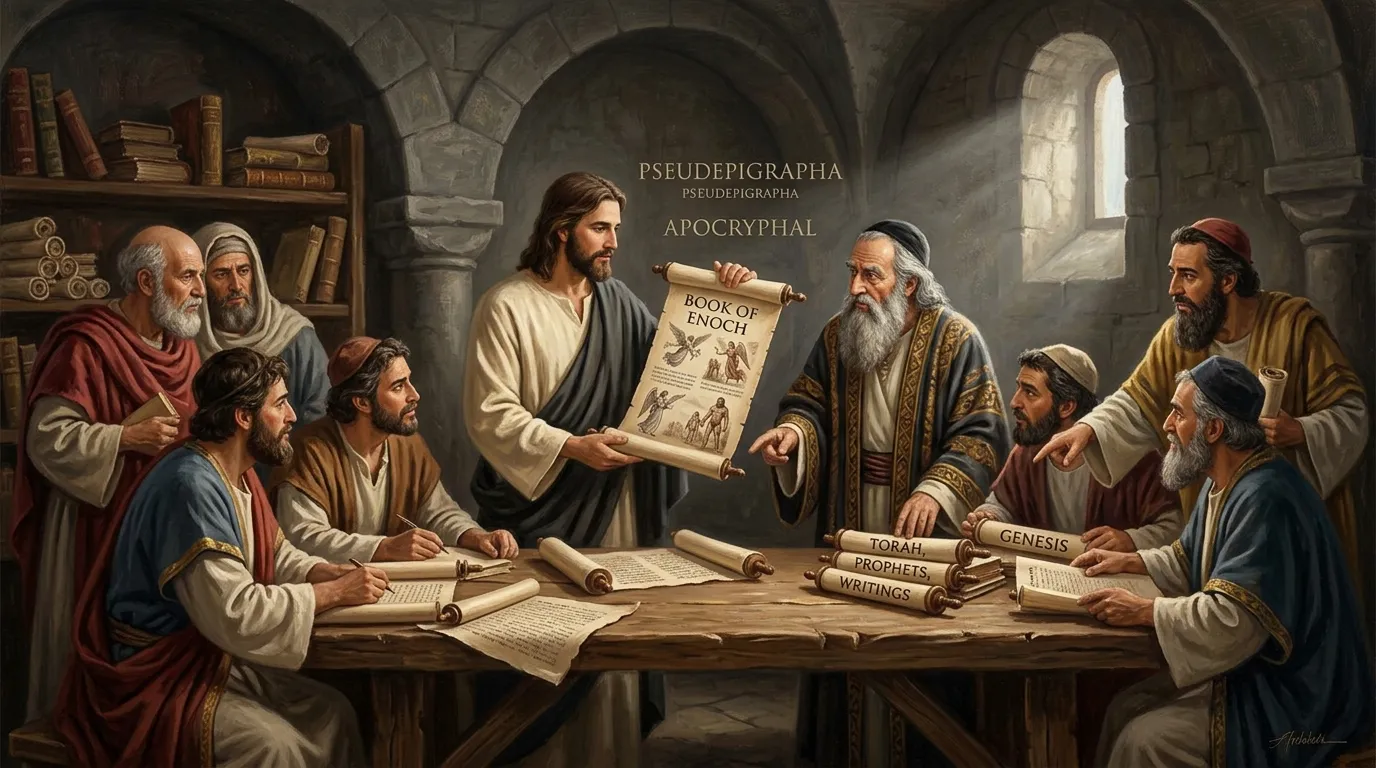
Have you ever heard someone say, “The Book of Enoch was removed from the Bible”? This question can make many Christians curious. If Enoch is named in the Bible, why is there also a book connected to his name that most Bibles do not include?
The question becomes even more interesting when we read the New Testament. Jude speaks about a prophecy connected with Enoch. This can make readers wonder if the Bible is telling us to read the Book of Enoch as Scripture.
The short answer is that the Book of Enoch was not simply removed from the Bible. The book known as 1 Enoch was not accepted as part of the biblical canon by most Jewish and Christian traditions.
It was also written long after the historical Enoch mentioned in Genesis, although it presents itself as revelations connected with him.
At the same time, the book is important for understanding some ideas found in the Jewish world before and around the time of Jesus. It can also help explain the background of certain biblical themes.
So, what is the real story? Why is the Book of Enoch not in the Bible? And what should Christians believe about it?
Let us look at the question through Scripture, history, and Christian faith.
Biblical Meaning of Why Is the Book of Enoch Not in the Bible
The first thing to understand is that Enoch himself is in the Bible.
Genesis 5:24 says:
“And Enoch walked with God: and he was not; for God took him.”
Enoch was a man who lived in close fellowship with God. Hebrews 11:5 also presents Enoch as an example of faith. His life points us toward trust, obedience, and a relationship with God.
But the Bible does not say that Enoch wrote a book that must be included in Scripture.
What Is the Book of Enoch?
The name “Book of Enoch” usually refers to 1 Enoch, an ancient Jewish religious work. It is not one single book written at one time. Scholars understand it as a collection of writings from different periods.
It contains visions, heavenly journeys, stories about angels, judgment, and the coming day of God.
Some parts of the book are very old. However, the work as a whole was written many centuries after the Enoch described in Genesis.
This is one important reason Christians should be careful. A book can be ancient and interesting without being inspired Scripture.
Jude Mentions Enoch
One of the biggest reasons people ask about Enoch is found in the New Testament.
Jude 14–15 says:
“And Enoch also, the seventh from Adam, prophesied of these, saying, Behold, the Lord cometh with ten thousands of his saints.”
This passage is closely related to a passage found in 1 Enoch.
Does this mean Jude considered the entire Book of Enoch to be Scripture?
Not necessarily.
The Bible sometimes mentions words, people, or ideas from sources outside the biblical canon. A biblical writer can use a true statement from another source without declaring that the entire source is inspired by Scripture.
For example, Paul quoted pagan Greek writers in Acts 17:28 and Titus 1:12. Their writings were not therefore made part of the Bible.
The important point is this:
Jude’s use of material connected with Enoch does not automatically make the entire Book of Enoch part of Scripture.
Why Was It Not Accepted Into the Biblical Canon?
The Bible’s canon developed over time as Jewish and Christian communities recognized which writings carried biblical authority.
For the Old Testament, the Jewish Scriptures did not include 1 Enoch as part of the Hebrew Bible. Early Christians also differed in how they viewed various writings outside the commonly accepted Scriptures.
Several questions mattered when writings were considered for biblical authority:
- Was the writing connected to a recognized prophet or apostle?
- Was it received by God’s people as authoritative?
- Did it agree with the faith already taught in Scripture?
- Was it widely used as Scripture by the early community?
- Was its origin consistent with the period and person it claimed to represent?
The Book of Enoch did not gain broad acceptance as Scripture among the Jewish and Christian communities that shaped the biblical canon used by most Christians today.
Was the Book of Enoch Removed?
This is a common claim, but it needs clarification.
There is no simple historical event where Christians took the Book of Enoch out of the Bible.
It is more accurate to say that 1 Enoch was generally not included in the biblical canon of most Jewish and Christian traditions.
That distinction matters.
Something cannot be “removed” from a canon in which it was never broadly accepted as canonical Scripture.
However, there is an important exception.
The Ethiopian Orthodox Church Includes Enoch
The Book of Enoch has a special place in the Ethiopian Orthodox Tewahedo Church.
The Ethiopian biblical tradition includes 1 Enoch among its sacred books. This makes the Ethiopian canon different from the canon used by most Protestant, Roman Catholic, and Eastern Orthodox Christians.
So, saying “no Bible contains Enoch” would be incorrect.
A better statement is:
Most Christian Bibles do not include 1 Enoch, while the Ethiopian Orthodox biblical tradition does.
This is an important part of the history and should not be ignored.
Spiritual Significance and Symbolism
The Book of Enoch can still be interesting to Christians, even if their tradition does not treat it as Scripture.
One of its strongest themes is God’s judgment.
It describes a world filled with evil and points toward a future time when God will judge wickedness. This theme fits with a message that appears throughout the Bible.
For example, Ecclesiastes 12:14 teaches:
“For God shall bring every work into judgment.”
Jesus also taught about final judgment, and Revelation describes God’s ultimate victory over evil.
The Book of Enoch can therefore provide historical background for ideas that were being discussed in the Jewish world around the time of the New Testament.
But Christians should keep an important boundary.
The Bible should remain the final authority for Christian belief.
A person can read ancient religious literature to understand history without treating every statement in that literature as God’s inspired Word.
Enoch’s Life Gives Us a Clearer Spiritual Lesson
The most important biblical lesson about Enoch does not come from the Book of Enoch.
It comes from Genesis and Hebrews.
Enoch walked with God.
Hebrews 11:5 says:
“Enoch was translated that he should not see death… for before his translation he had this testimony, that he pleased God.”
This gives Christians a simple spiritual message:
Walk with God faithfully, even when the world around you is confusing.
You do not need secret knowledge to grow closer to God.
You need faith, prayer, obedience, and trust in God’s Word.
Biblical Interpretations in Dreams or Real Life
Some people discover the Book of Enoch through dreams, spiritual experiences, or conversations about angels and heaven.
If you have a dream about Enoch, angels, judgment, or heavenly places, it is wise not to assume that the dream is automatically a divine message.
The Bible encourages believers to test spiritual claims.
1 John 4:1 says:
“Beloved, believe not every spirit, but try the spirits whether they are of God.”
A peaceful dream may encourage you to seek God. A frightening dream may remind you to pray and look for God’s peace. But Christians should measure spiritual experiences against Scripture, not use a dream to create new doctrine.
The same principle applies when reading the Book of Enoch.
You can study it. You can learn about its historical background. But important Christian beliefs should be built on the Bible.
If something you read causes fear or confusion, return to God’s Word and pray for wisdom.
Practical Lessons & Faith Insights
The story of Enoch teaches us that walking with God matters more than searching for hidden mysteries.
Read Scripture carefully. Pray for wisdom. Test spiritual claims. Learn history, but keep the Bible at the center of your faith.
James 1:5 reminds believers that God gives wisdom to those who ask Him.
Conclusion:
So, why is the Book of Enoch not in the Bible? Most Jewish and Christian traditions did not recognize 1 Enoch as part of the biblical canon. It was not simply removed by one person or one church council.
Jude’s reference to Enoch does not mean the entire book is inspired Scripture. Still, Enoch’s biblical life gives Christians a beautiful lesson: walk with God and trust Him.
When questions about ancient books become confusing, return to God’s Word. His truth does not depend on hidden knowledge. Seek Him with faith, prayer, and a humble heart.
Why is the Book of Enoch not in the Bible? Learn its history, Jude’s reference to Enoch, biblical views, and what Christians should believe.

I am Caleb Anderson, a Christian writer passionate about exploring deep biblical meanings and spiritual truths.
On Biblicaltribez.com, I share faith based insights to help readers grow closer to God through Scripture.
My writing focuses on making the Bible easy to understand, meaningful, and relevant to everyday life.