Skip to content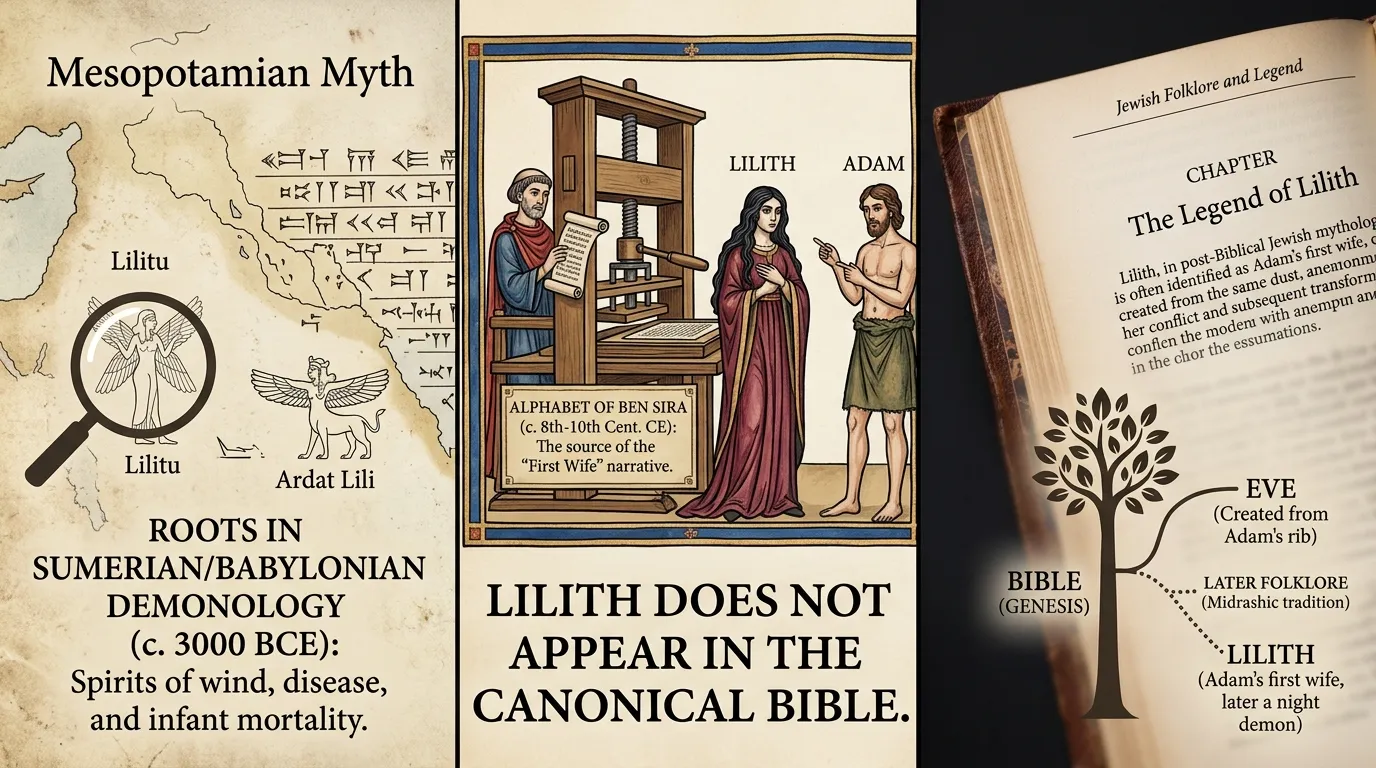
Many people search for “who is Lilith in the Bible” because they have heard that Lilith was Adam’s first wife. Some stories say she lived in the Garden of Eden before Eve. Others describe her as a demon or a dark spiritual figure.
But what does the Bible itself say?
The answer is important: the Bible does not tell a story about Lilith as Adam’s first wife. The name or a related Hebrew term appears in Isaiah 34:14 in some Bible translations, but translations differ on how they render the word.
The popular story of Lilith as Adam’s first wife comes from later Jewish folklore, not from Genesis.
This difference matters when we study Scripture. Christians should separate what the Bible teaches from later traditions and legends. Genesis clearly presents Eve as the woman God gave to Adam, and Scripture never names another woman as Adam’s wife before Eve.
Let’s look at Lilith from a biblical, historical, and Christian point of view.
Who Is Lilith in the Bible?
Lilith is not presented in the Bible as Adam’s first wife. Scripture does not give Lilith a personal story, genealogy, marriage to Adam, or role in the Garden of Eden.
The confusion mainly comes from two things.
First, Isaiah 34:14 contains a Hebrew word often transliterated as lilith. Different Bible versions translate it in different ways. Some use terms such as “night creature,” “night monster,” or “screech owl,” while some modern translations retain “Lilith” or explain it as a night demon.
Second, later Jewish writings developed a story about Lilith as Adam’s supposed first wife. That story became famous over time, but it is not part of the Genesis account.
So, when someone asks, “Who is Lilith in the Bible?”, the safest biblical answer is:
Lilith is not a character in Genesis or a biblical wife of Adam. The word appears in Isaiah 34:14 in some translations, while the famous story of Lilith as Adam’s first wife comes from later Jewish folklore.
That simple distinction helps us avoid confusing Scripture with tradition.
Is Lilith Adam’s First Wife?
No, the Bible does not say that Lilith was Adam’s first wife.
This is one of the most common claims about Lilith, but there is no verse in Genesis that gives Adam a wife named Lilith.
Genesis 2 tells us that God saw that the man was alone. God said, “It is not good for the man to be alone,” and then made a suitable helper for him. God formed the woman from the man’s side and brought her to him.
Adam then recognized the woman as his own flesh:
“This is now bone of my bones and flesh of my flesh.”
Genesis 2:23 identifies the woman as the one Adam received from God. Later, Genesis 3:20 gives her the name Eve.
The biblical account does not say, “Lilith was Adam’s first wife.”
It does not describe a woman leaving Eden before Eve.
It does not say that God sent angels to bring Lilith back.
Those details belong to later tradition.
What Does Genesis Say About Adam and Eve?
To understand the Lilith question, it helps to read Genesis carefully.
Genesis 1:27 says that God created humanity in His image and created them male and female.
Genesis 2 then gives a closer look at the creation of the man and woman. Adam is formed from the dust of the ground. God then says that Adam should not remain alone.
God brings animals before Adam, but none is found to be a suitable helper for him.
Then God creates the woman from Adam’s side.
Genesis 2:24 gives the foundation for marriage:
“They will become one flesh.”
The passage then says that Adam and his wife were both naked and were not ashamed.
There is no Lilith in this account.
Why Do Some People Think Genesis Has Two Women?
Some people connect Lilith with Genesis 1:27 because Genesis 1 says that God created male and female, while Genesis 2 later describes the creation of the woman.
This has led some readers to suggest that Genesis describes two different women.
But that is not what the biblical text requires.
Genesis 1 gives a broad account of God’s creation of humanity. Genesis 2 gives a closer account of the man and woman. These chapters can be read together without adding another wife to the story.
The idea that the first woman was Lilith comes from later interpretation, not from a clear statement in Genesis.
What Does Lilith Mean in Isaiah 34:14?
This is where the subject becomes more interesting.
The Hebrew Bible contains the term lilith in Isaiah 34:14. However, Bible translations do not all translate the Hebrew word in the same way.
For example, some translations use “Lilith,” while others use phrases such as “night creature,” “night monster,” or “screech owl.”
Isaiah 34 describes God’s judgment on Edom. The chapter uses vivid images of a ruined land filled with wild animals and creatures of the night.
So the verse is not telling the story of Adam’s wife.
It is describing a place of desolation and judgment.
A Cambridge Bible commentary notes that lilith is connected with the Hebrew idea of night and discusses it as a figure associated with ancient demonology. It also notes that this is the Bible’s only occurrence of the term.
This is why we should be careful.
Isaiah 34:14 is biblical. The full story of Lilith as Adam’s first wife is not.
Is Lilith a Demon in the Bible?
The answer depends on what we mean by “Lilith.”
The Bible does not develop Lilith into a named demon with a full biography.
Isaiah 34:14 uses a Hebrew term that some translations understand as a night creature or night demon. This reflects an ancient setting in which strange beings were associated with deserted places and the night.
But Scripture does not give Christians a complete teaching about a demon named Lilith.
That means we should not build a detailed doctrine about Lilith from one difficult Hebrew word.
The Bible gives much clearer teaching about spiritual evil. Scripture speaks about Satan, demons, temptation, sin, and God’s power over evil.
For example, James 4:7 says:
“Submit yourselves, then, to God. Resist the devil, and he will flee from you.”
The main message for Christians is not fear of Lilith.
It is trust in God.
Where Did the Story of Lilith as Adam’s First Wife Come From?
The famous story developed in later Jewish tradition.
One important source is a medieval work called the Alphabet of Ben Sira. It is an anonymous work generally dated to the early medieval period, often placed around the eighth to tenth centuries. It presents Lilith as Adam’s first wife.
In this story, Lilith and Adam are both created from the earth. She refuses to accept a subordinate position and leaves Adam and Eden.
The story later includes angels and other supernatural details.
However, this work is not part of the Old Testament or New Testament.
It is also not the biblical book of Sirach.
That point is easy to miss.
The Alphabet of Ben Sira and the biblical Book of Sirach are different works.
Therefore, Christians should not quote the Lilith story as if it were Scripture.
Why Do People Say Lilith Was Created Like Adam?
The idea comes from the later story, not Genesis.
According to the Alphabet of Ben Sira, Lilith was created from the same earth as Adam. Because she believed they were created as equals, she refused to submit to him and eventually left.
This story is sometimes used today to explain the difference between Lilith and Eve.
But there is an important biblical point:
Genesis never says that another woman was created before Eve.
Genesis 2 specifically presents the woman God made for Adam as his wife. Adam calls her “woman,” and Genesis 3:20 identifies her as Eve.
So the idea of Lilith as Adam’s first wife should be described as Jewish folklore or later tradition, not biblical history.
Lilith and Eve: What Is the Biblical Difference?
The Bible clearly identifies Eve as Adam’s wife.
Genesis 3:20 says Adam named his wife Eve because she would become the mother of all the living.
This is a direct biblical statement.
Lilith, on the other hand, is never named as Adam’s wife anywhere in Genesis.
This gives us a simple way to understand the difference:
- Eve is a biblical character.
- Eve is named as Adam’s wife.
- Eve appears in Genesis.
- Lilith is not named in Genesis.
- Lilith’s famous first-wife story comes from later tradition.
- Isaiah 34:14 contains a Hebrew term sometimes translated as Lilith.
Keeping these points separate helps us read the Bible with care.
Does the Bible Say Lilith Was in the Garden of Eden?
No.
There is no biblical verse that says Lilith lived in the Garden of Eden.
Genesis describes Adam and Eve in the garden. The serpent later tempts the woman, and Adam and Eve disobey God’s command. Genesis 3 then describes their fall and removal from Eden.
The name Lilith does not appear in that story.
The idea that Lilith lived in Eden before Eve comes from later folklore.
This is an important lesson for Bible study: not every story connected with the Bible comes from the Bible.
Many cultures have created legends around biblical people and events. Some are interesting from a historical or literary point of view, but they should not be treated as Scripture.
Is Lilith Mentioned in the New Testament?
No.
The New Testament does not name Lilith.
The New Testament does teach about Satan, demons, temptation, angels, and spiritual warfare. But it does not introduce Lilith as Adam’s former wife or as a particular demon Christians must fear.
Paul tells believers to put on the “full armor of God” in Ephesians 6:10–18.
The focus is on standing firm in God.
That is much more important than trying to identify every figure found in later folklore.
What Should Christians Believe About Lilith?
Christians should begin with Scripture.
When a tradition conflicts with or adds to the biblical story, we should label it correctly.
That does not mean we cannot study Jewish folklore. We can. It can help us understand how people interpreted biblical stories in later periods.
But folklore should not be placed on the same level as God’s Word.
A healthy Bible study asks:
- What does the Bible actually say?
- What does the verse mean in its context?
- What do later traditions say?
- Are those traditions supported by Scripture?
- What should I believe based on the biblical text?
This approach protects us from fear and confusion.
What Can Christians Learn From the Lilith Question?
The question of Lilith teaches us more than facts about an old tradition.
It teaches us how to read Scripture.
Test What You Hear
You may hear someone say, “Lilith was Adam’s first wife.”
Instead of accepting the claim at once, open the Bible.
Search Genesis.
Look at the passages about Adam and Eve.
You will find Eve, but you will not find a biblical story about Lilith as Adam’s wife.
Keep Scripture and Tradition Separate
Traditions can be useful for historical study.
But Christians should not treat every ancient story as biblical truth.
The Bible remains the foundation for Christian faith.
Do Not Let Strange Stories Create Fear
Some versions of Lilith’s story are frightening. They describe demons, children, spirits, and supernatural danger.
For children and teenagers especially, these stories can sound much more biblical than they really are.
The Christian response should not be panic.
Scripture calls believers to trust God, pray, resist evil, and walk in truth.
Focus on God’s Message
The Bible does not give us every detail about every spiritual being.
It gives us what we need to know for faith and godly living.
Deuteronomy 29:29 reminds us that some things belong to God, while the things He has revealed are given for us to follow.
That is a wise principle when studying difficult Bible questions.
Is Lilith a Symbol of Feminism?
In modern culture, Lilith is sometimes used as a symbol of female independence, strength, or resistance to male control.
That idea comes from later interpretations of her story.
It is not a biblical teaching about Lilith.
Some modern writers have reshaped Lilith into a positive or empowering figure. Others continue to use her as a symbol of danger or rebellion.
Christians should recognize these modern meanings without confusing them with Scripture.
The Bible’s teaching about people of all genders should be studied from actual biblical passages, especially Genesis 1–3, Ephesians 5, 1 Peter 3, and other relevant texts.
Is Lilith Mentioned in the King James Bible?
The King James Version does not use the name “Lilith” in Isaiah 34:14. It uses the term “screech owl.”
Other English translations handle the Hebrew word differently.
This shows why Bible translations sometimes produce different wording for difficult Hebrew terms.
It does not mean that one translation secretly removed a story about Adam’s wife.
The context of Isaiah 34 remains a judgment passage about a devastated land.
Is Lilith Mentioned in the Bible as a Woman?
Not in the way the popular legend describes her.
Isaiah 34:14 contains a Hebrew term that some translations render as “Lilith,” but the verse does not introduce a woman named Lilith with a personal history.
There is no biblical genealogy for her.
There is no biblical account of her leaving Eden.
Those ideas belong to later tradition.
How Should Parents Explain Lilith to Children?
Parents can keep the explanation simple.
You might say:
“Lilith is a figure from later Jewish folklore. The Bible does not say she was Adam’s first wife. Genesis says that Eve was Adam’s wife. Isaiah has a difficult Hebrew word that some translations connect with Lilith, but it does not tell the popular story about Adam and Lilith.”
This gives children the truth without making the subject scarier than it needs to be.
Teenagers can also learn an important Bible-study skill from this topic: always check the original source of a claim.
A social media video may call something “biblical,” but that does not make it biblical.
What Does the Bible Say About Fear and Spiritual Evil?
The Bible repeatedly points believers toward God instead of fear.
Psalm 23:4 says:
“I will fear no evil, for you are with me.”
Romans 8:38–39 teaches that nothing in creation can separate believers from the love of God in Christ.
Ephesians 6:10–11 calls Christians to be strong in the Lord and put on the armor of God.
These truths matter more than legends about Lilith.
If a story about Lilith causes fear, return to Scripture.
Pray.
Read God’s Word.
Remember who God is.
The Bible’s central message is not that Christians should live in fear of dark spiritual figures. It is that God is sovereign, faithful, and powerful.
FAQs:
1. Who is Lilith in the Bible?
Lilith is not presented in the Bible as Adam’s first wife. The Hebrew term lilith appears in Isaiah 34:14 and is translated in different ways. The famous story of Lilith as Adam’s first wife comes from later Jewish folklore.
2. Was Lilith Adam’s first wife?
No. The Bible does not say that Lilith was Adam’s first wife. Genesis presents Eve as Adam’s wife and does not mention another woman before her.
3. Is Lilith mentioned in Genesis?
No. The name Lilith does not appear in the Genesis account of creation, Adam, Eve, and the Garden of Eden.
4. What Bible verse talks about Lilith?
Isaiah 34:14 is the main biblical passage connected with the name Lilith. Some translations use “Lilith,” while others use terms such as “night creature,” “night monster,” or “screech owl.”
5. Is Lilith a demon?
Some ancient and later traditions portray Lilith as a female demon or night spirit. However, the Bible does not give a full account of a demon named Lilith or teach the popular story about her as Adam’s first wife.
Conclusion:
So, who is Lilith in the Bible? The most accurate answer is that Lilith is not Adam’s first wife in Scripture.
The Bible does not tell a story of Lilith living in Eden, marrying Adam, or leaving him. Instead, Genesis clearly presents Eve as Adam’s wife.
The word lilith appears in Isaiah 34:14, where translations differ in how they understand and render it.
The famous story of Lilith as Adam’s first wife comes from later Jewish folklore, especially the medieval Alphabet of Ben Sira.
For Christians, the best approach is simple: study Scripture first, know the difference between the Bible and later traditions, and do not let legends replace God’s Word.

I am Joseph Parker, a devoted Bible content writer dedicated to sharing God’s Word with clarity and purpose.
Through Biblicaltribez.com, I create inspirational and scripture-centered articles that strengthen faith.
My goal is to guide readers into a deeper understanding of biblical teachings and Christian living.